Tens of Thousands Rally in Erbil in Powerful Display of Unity to Defend Kurdistan Region’s Federal Status
Mass demonstration at Erbil Citadel draws citizens from all walks of life as protesters reject Baghdad’s decisions, demand constitutional rights, and call for Kurdish political unity
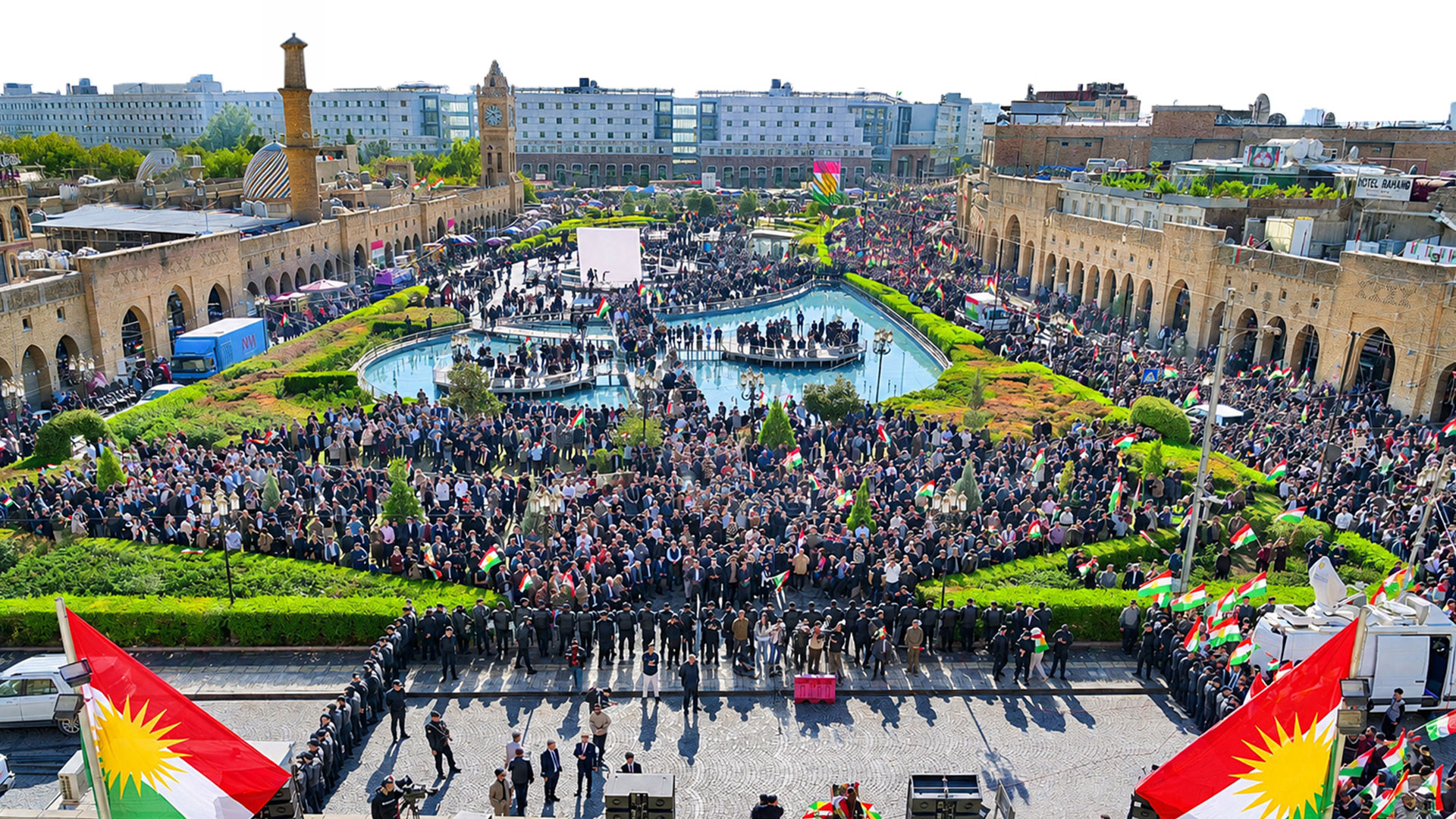
ERBIL (Kurdistan24) — Tens of thousands of people from across the Kurdistan Region gathered in front of the historic Erbil Citadel on Thursday in a massive public demonstration in support of the Region’s constitutional status, rejecting recent decisions by Iraq’s federal government and calling for the protection of Kurdistan Region rights, constitutional achievements, and national identity.
The demonstration began at 10:30 a.m. on Nov. 26, bringing together people from different generations and walks of life, including university students, teachers, public and private sector employees, business owners, retirees, and ordinary citizens. Participants raised Kurdistan’s flag, with no political party flags displayed, emphasizing the gathering’s national character and its message of unity beyond party affiliations.
The demonstration followed a call issued by the Erbil Governorate a day earlier, inviting citizens to express their opposition to recent federal government decisions concerning the Kurdistan Region.
Tens of Thousands of participants made their way toward the city center from several directions, with large groups beginning marches along the main Road as early as 9 a.m.
Kurdistan24 correspondents reported substantial participation along the main routes leading to the city center, with university students and academic staff among the prominent groups joining the demonstration. Salahaddin University alone comprises 16 colleges and 89 departments, in addition to students and staff from Erbil Polytechnic University, private universities, and other educational institutions.
Protesters voiced opposition to what they described as decisions undermining the Kurdistan Region’s constitutional status and rights, including recent federal measures and longstanding disputes over salaries, economic matters, and political and administrative authorities.
A central message emerging from the gathering is that federalism in Iraq must be implemented in practice rather than remaining a political commitment on paper.
Participants and commentators argued that the constitutional principles established after 2003 must be respected through the actual distribution of powers and responsibilities between Baghdad and Erbil.
Calls for Kurdish unity and protection of constitutional rights
Prominent Kurdish singer Shivan Perwer issued a message calling on citizens across the Kurdistan Region to participate in the demonstration regardless of their political affiliations, emphasizing solidarity with the Region and Kurdish national causes.
One demonstrator told Kurdistan24 that Kurdistan represented more than territory, describing it as the people's honor, dignity, and identity.
"This is not Jurf al-Sakhar; this is Kurdistan. The Peshmerga are not Hezbollah; the Peshmerga are our identity and honor," the participant said, drawing a distinction between the Kurdistan Region’s security forces and the Iraqi armed factions.
Another participant, a teacher and school principal who had traveled from an area near the Turkish border, said defending the Kurdistan Region went far beyond public-sector salaries.
"This is not about salaries. This is about our land, honor, dignity, and protecting the dignity of the Kurdish people. We did not sacrifice our martyrs for salaries," he said.
He also pointed to historical solidarity among Kurds across different parts of Kurdistan, saying people from other Kurdish regions had expressed their readiness to support the Kurdistan Region.
Erbil authorities ensure peaceful demonstration
Nabaz Abdulhamid, Erbil's district governor, told Kurdistan24 that the demonstration was organized in response to federal government decisions issued two days earlier and was intended to provide citizens with an opportunity to express their positions peacefully.
He said police, traffic authorities, and security forces had prepared a comprehensive plan to protect demonstrators and maintain public order, urging participants to follow security instructions to ensure the gathering remained peaceful and orderly.
Abdulhamid stressed that Thursday was a regular working day, with government offices remaining open and participation in the demonstration entirely voluntary. Department directors had been instructed to organize their work to ensure that public services were not disrupted.
He also confirmed that, despite participation by political parties and different organizations, only the Kurdistan flag would be raised during the demonstration, underscoring its nonpartisan and national character.
Traffic continued normally across most of Erbil, with only several roads surrounding the city park temporarily closed to accommodate pedestrians and prevent congestion.
The district governor described the recent federal decisions as unconstitutional and welcomed the joint statement issued by the Kurdistan Democratic Party (KDP) and the Patriotic Union of Kurdistan (PUK), expressing hope that Kurdish political unity would also help resolve outstanding internal issues within the Region.
He expressed optimism that the disputes could be resolved through dialogue and constitutional mechanisms, adding that Erbil remained stable, with more than 30 consulates, hundreds of foreign companies, and ongoing development projects.
Abdulhamid said the Peshmerga remained prepared to defend Kurdistan’s territory but expressed hope that the situation would never reach the point of military confrontation. He also anticipated similar demonstrations in Sulaimani, Halabja, Duhok, and other parts of the Region.
Women leaders reject concessions over Kurdistan’s achievements
Khanzad Ahmed, head of the Kurdistan Regional Council for Women's Affairs, said the demonstration carried a clear message rejecting any compromise over the Region’s achievements and called on Kurdish political leaders to maintain a firm position in negotiations with Baghdad.
Speaking to Kurdistan24, Ahmed highlighted the historical role of Kurdish women in political and national movements, saying their contribution extended beyond participation to leadership.
"The message of today's demonstrations across Kurdistan is that we must not compromise on any of Kurdistan's achievements. We have made many concessions in the past merely to preserve Iraq's political process, but we lost Kirkuk and parts of Diyala and Nineveh. We will no longer accept even an inch being taken away from the Kurdistan Region's status," she said.
Ahmed criticized what she described as increasingly centralized federal policies, arguing that Iraq's 2005 Constitution was established on the basis of federalism, partnership, and a multinational political system, rather than centralized rule.
She specifically urged Kurdish leaders not to compromise over the management of the North Oil Company during negotiations with Baghdad.
Ahmed described the demonstrations as highly civilized and said dialogue remained the preferred way forward, provided that the Constitution, particularly Article 140 concerning disputed territories, served as the basis for negotiations.
Kurdish religious figure calls for unity across Kurdistan
In a video message, Sheikh Morshid Khaznawi, a prominent Kurdish religious and national figure, described the current pressure on the Kurdistan Region as more than an administrative or technical disagreement, warning that the developments threatened the foundations of Kurdish political and constitutional achievements.
He said the Region's rights and achievements had not been granted as gifts but had been secured through the sacrifices of generations of Kurds, including the victims of the Anfal campaign and the chemical attack on Halabja.
Khaznawi argued that unilateral decisions, economic pressure, and attempts to assume control over border crossings and oilfields should be viewed within the broader context of the constitutional relationship between Baghdad and Erbil.
He described the Kurdistan Region as a strategic pillar of the Kurdish cause and said pressure against the Region affected Kurds across different parts of Kurdistan, including Qamishli, Mahabad, Amed, Erbil, and Sulaimani.
Addressing Kurdish political parties and leaders, he warned that internal divisions weakened the collective position of the Kurdish people.
"Your division weakens us, and your fragmentation diminishes the strength of our people," he said.
Khaznawi concluded by calling for a unified Kurdish position across all parts of Kurdistan, saying support for the Kurdistan Region was a responsibility rather than a matter of political choice.
Citizens demand implementation of the Constitution
Several demonstrators interviewed by Kurdistan24 emphasized that their demands centered on the implementation of Iraq's Constitution and respect for the Kurdistan Region's federal status.
Rashid Malla Aziz said the Kurdistan Region had constitutional recognition as a federal entity within Iraq, arguing that recent federal decisions should be assessed against the Constitution rather than simply justified through judicial rulings.
He described federalism as guaranteeing the Kurdish people's rights to govern themselves, preserve their language, and live on their own land.
Another demonstrator, Mohammed Yasan, called on the Iraqi government to implement the Constitution, saying the Kurdish people were demanding nothing beyond their constitutionally guaranteed rights.
"We want nothing beyond the Constitution. We are simply asking for our rights to be given to us, and we have neither demanded nor sought anything more than that," he said.
Ali Alwani, another participant, stressed the importance of placing Kurdistan and its interests above political parties and affiliations, saying national unity should take precedence over partisan differences.
Aziz Shekhani also emphasized that the Kurdish people were seeking their rights rather than confrontation with other nations or countries.
"We have no hostility toward any nation, state, or country. We only want our own rights, nothing more. We wish good for everyone," he told Kurdistan24.