Coalition will continue to deter attacks against Kurdistan Region: Coalition Spokesperson
Outlaw militia groups and ISIS "will not prevail."
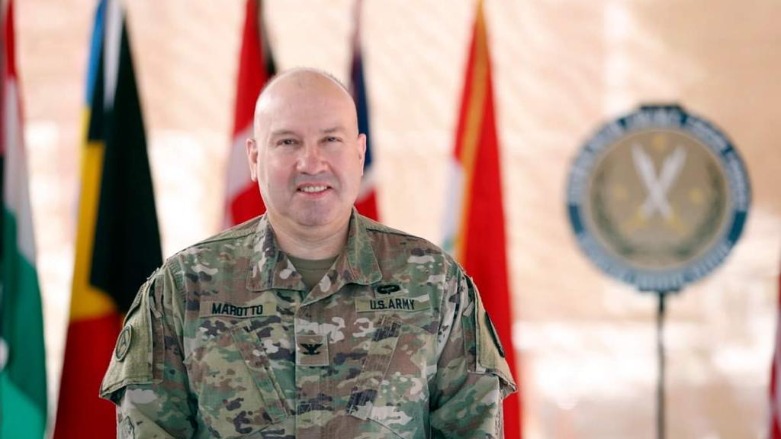
ERBIL (Kurdistan 24) - Col. Wayne Marotto, Spokesman for the US-led Coalition, affirmed in a tweet on Wednesday that the Coalition will continue to deter attacks against the Kurdistan Region.
"@CJTFOIR (Combined Joint Task Force-Operation Inherent Resolve) continues to support our partners in the Kurdistan Region of Iraq & the Peshmerga Forces," he said.
— OIR Spokesman Col. Wayne Marotto (@OIRSpox) July 7, 2021
"We will continue to work together to deter the attacks against the KRI (Kurdistan Region) and its people. OMGs (Outlaw Militia Groups) & Daesh (ISIS) will not prevail."
The statement came after Kurdistan Region Prime Minister Masrour Barzani hosted Brigadier Richard Bell, Deputy Commanding General of the Combined Joint Task Force - Operation Inherent Resolve, in his office in Erbil last Tuesday.
On July 6, one explosive-laden drone landed near Erbil International Airport (EIA) in the Kurdistan Region capital, the region's Directorate General of Counter Terrorism (CTD) and the Coalition confirmed on Tuesday.
The attack did not lead to any casualties or material damage, according to informed security and diplomatic sources.
Following the US assassination of top Iranian military commander Qassim Soleimani and his Iraqi comrade Abu Mahdi al-Mohandis in January 2020, tensions between Washington and militias have surged.
Following months of rocket attacks, in late September, the then US administration issued strong warnings to the Iraqi government and threats to the pro-Iranian militias carrying out the assaults, deterring further strikes. The armed groups declared a ceasefire that effectively ended as a new administration entered the White House.
US-led Coalition forces, including at the Erbil International Airport (EIA), have recently come under attack from rockets, roadside bombs, and, increasingly, explosive-packed drones which can fly at low altitude to avoid radars that trigger the US C-RAM air defense system.
This year at least three attacks have targeted Erbil (including two drone attacks, and one rocket attack).
On February 15, rocket attacks targeted Erbil International Airport - with some striking a residential area, injuring several, killing two, including a Filipino military contractor and a civilian. On June 26, three unmanned aerial vehicles targeted Erbil, leading to no casualties.
The Kurdistan Region’s PM Masrour Barzani on June 26 called for a response to the drone attack since the ‘terror attacks’ by "outlaws question the federal govt’s power and credibility and threaten Iraq’s security."
In a response to the drone attack on Erbil, the US carried out a limited strike on June 27 against three sites around the Iraqi-Syrian border manned by two PMF militias, known as Kata'ib Hizbollah and Kata'ib Sayyid al-Shuhada (KSS). Four militiamen were killed in the strike.