Kurdish and Minority Parties Hold Historic Summit, Condemn Iraqi Government’s Unconstitutional Salary Halt
Parties unanimously denounce Baghdad’s salary freeze as unconstitutional, call for protection of citizens' rights and end to political pressure on the Kurdistan Region.
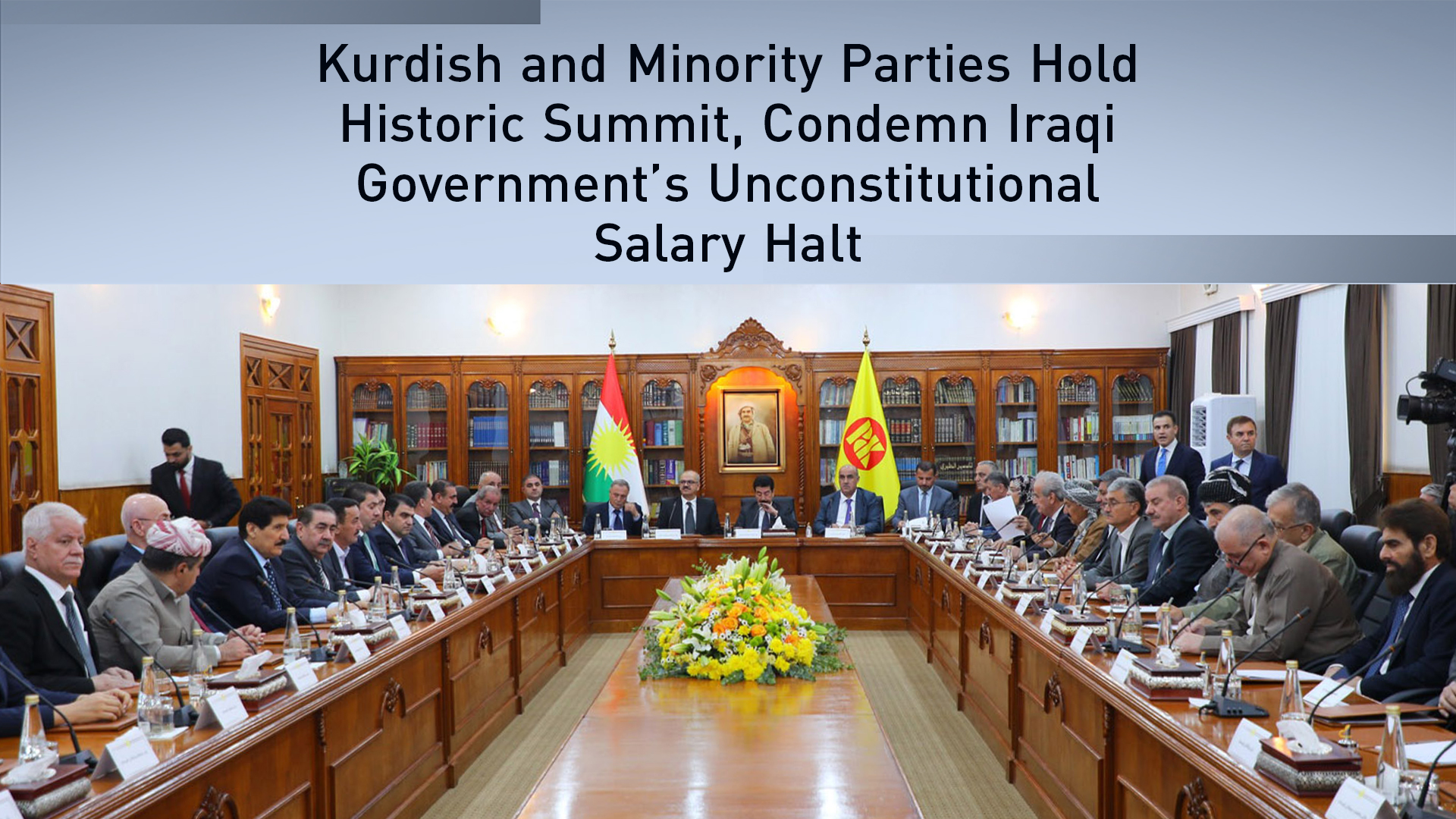
ERBIL (Kurdistan24) — In a rare show of unity, over 40 Kurdish and minority political parties convened on Saturday at the Kurdistan Democratic Party (KDP) Political Bureau in Pirmam to jointly denounce the Iraqi federal government’s decision to withhold public sector salaries from the Kurdistan Region. The gathering reflected escalating political tensions between Erbil and Baghdad over budget entitlements and constitutional responsibilities.
The statement, issued following the high-level meeting, described the Iraqi Ministry of Finance’s recent move to halt salary transfers to the Kurdistan Region as an “illegal and unconstitutional political decision targeting the will of the Kurdish people.” The parties emphasized that this decision violates multiple legal frameworks, including the permanent Iraqi Constitution, previous rulings by the Federal Supreme Court, and formal budget agreements between the federal and regional governments.
Representatives from a wide spectrum of Kurdistan Region political factions — including the Patriotic Union of Kurdistan (PUK), the Change Movement (Gorran), Kurdistan Islamic Union, and various Turkmen, Assyrian, Chaldean, and Armenian parties — affirmed their shared position that public servants’ rights must not be politicized. They called on Baghdad to fulfill its financial obligations and cease what they described as policies of “punitive pressure” on the Kurdistan Region.
“The rights of Kurdish civil servants, Peshmerga forces, teachers, and all public employees must not be used as tools in a political power struggle,” the statement read. “Baghdad’s refusal to send salaries only deepens the crisis and undermines recent momentum for regional stability and progress.”
The dispute stems from ongoing disagreements over revenue-sharing, oil exports, and implementation of the federal budget. While the Iraqi government has accused the Kurdistan Regional Government (KRG) of not fulfilling its commitments under the budget law, Kurdish officials maintain they have complied and demand the resumption of financial transfers.
The political parties urged Baghdad to abandon “policies of financial coercion” and instead pursue negotiation and cooperation to resolve the crisis.
The parties reaffirmed their commitment to peaceful dialogue as the best path forward. “All our decisions and steps will prioritize the public interest of the Kurdistan Region and its citizens,” they noted. “Dialogue and negotiation remain the only effective tools for resolving the current impasse.”
They also praised the patience and resilience of Kurdistan Region employees and public servants, expressing deep gratitude for their sacrifices amid prolonged financial insecurity.
Tensions between Erbil and Baghdad have long simmered over the issue of financial entitlements and oil management. In recent years, disputes over the Kurdistan Region’s independent oil sales and the Federal Supreme Court’s rulings have further complicated relations. The current standoff, sparked by the Ministry of Finance's refusal to disburse budgeted salaries, is seen as the latest episode in a broader struggle over regional autonomy and federal authority.
The declaration was endorsed by a wide coalition of 43 parties, including the KDP, PUK, Gorran, Kurdistan Islamic Union, Socialist Party, Kurdistan Communist Party, and nearly all Kurdish, Turkmen, Assyrian, and Chaldean political movements. This includes minority parties such as the Turkmen Democratic Movement, Chaldean National Council, Assyrian Democratic Movement, and the Armenian Enlightenment Group — showcasing the scale and diversity of support for the unified stance.
As economic uncertainty looms and political negotiations stall, the joint statement marks a significant development in the evolving dynamics of Kurdish-Iraqi federal relations — a unified Kurdish voice demanding justice, autonomy, and constitutional adherence.
Baghdad’s Longstanding Violations of Kurdistan’s Constitutional Rights
Since the adoption of Iraq’s 2005 constitution, which formally recognized the Kurdistan Region as a federal entity with clear rights to autonomy, governance, and economic development, the Iraqi federal government in Baghdad has repeatedly and deliberately violated both the letter and spirit of the constitution. Rather than honoring its legal obligations, successive federal administrations have systematically weaponized economic levers—most notably the salaries of public sector employees—as political tools to pressure and subjugate the Kurdistan Regional Government (KRG).
Article 117 of the Iraqi constitution explicitly recognizes the Kurdistan Region and its institutions, while Article 121 guarantees its authority in matters of administration, education, health, and economic planning. Furthermore, Article 111 stipulates that Iraq’s oil and gas belong to all its people in all regions and governorates. However, Baghdad has consistently circumvented these provisions, often withholding Kurdistan’s fair share of the federal budget under flimsy pretexts and in clear contradiction of court rulings and prior agreements.
Most egregiously, Baghdad has used the issue of salary disbursement as a coercive instrument. Instead of viewing salary payments as a constitutional responsibility toward citizens, the federal government treats them as leverage—delaying or denying them entirely to punish the KRG for exercising its right to manage its own natural resources and to conduct independent foreign and economic policy. These unjustifiable measures have caused tremendous hardship for civil servants, Peshmerga forces, educators, and healthcare workers in the Kurdistan Region, and have stoked social unrest and economic instability.
By weaponizing public finances, the federal government aims to undermine the KRG’s legitimacy and restrict its ability to function effectively. Such actions not only violate multiple constitutional articles but also erode the very fabric of federalism in Iraq. Baghdad’s pattern of economic coercion—especially its most recent refusal to send salaries despite court orders and political agreements—reveals a broader strategy of suppressing the Kurdistan Region’s democratic will and hard-won autonomy.
In the face of these repeated aggressions, the political forces of Kurdistan have remained resolute, insisting on their constitutional rights and the dignity of their people. The recent joint declaration by Kurdish and minority parties is a direct response to Baghdad’s unconstitutional conduct, and a reaffirmation of the Kurdistan Region’s unwavering demand for justice, respect, and the rule of law.