Iran Signals Naval Escalation With Unveiling of Gulf-Spanning Missile
Iran’s IRGC Navy Chief Tangsiri announced the test of a new missile covering the entire Gulf, warning enemies of a "crushing blow" if they attack.
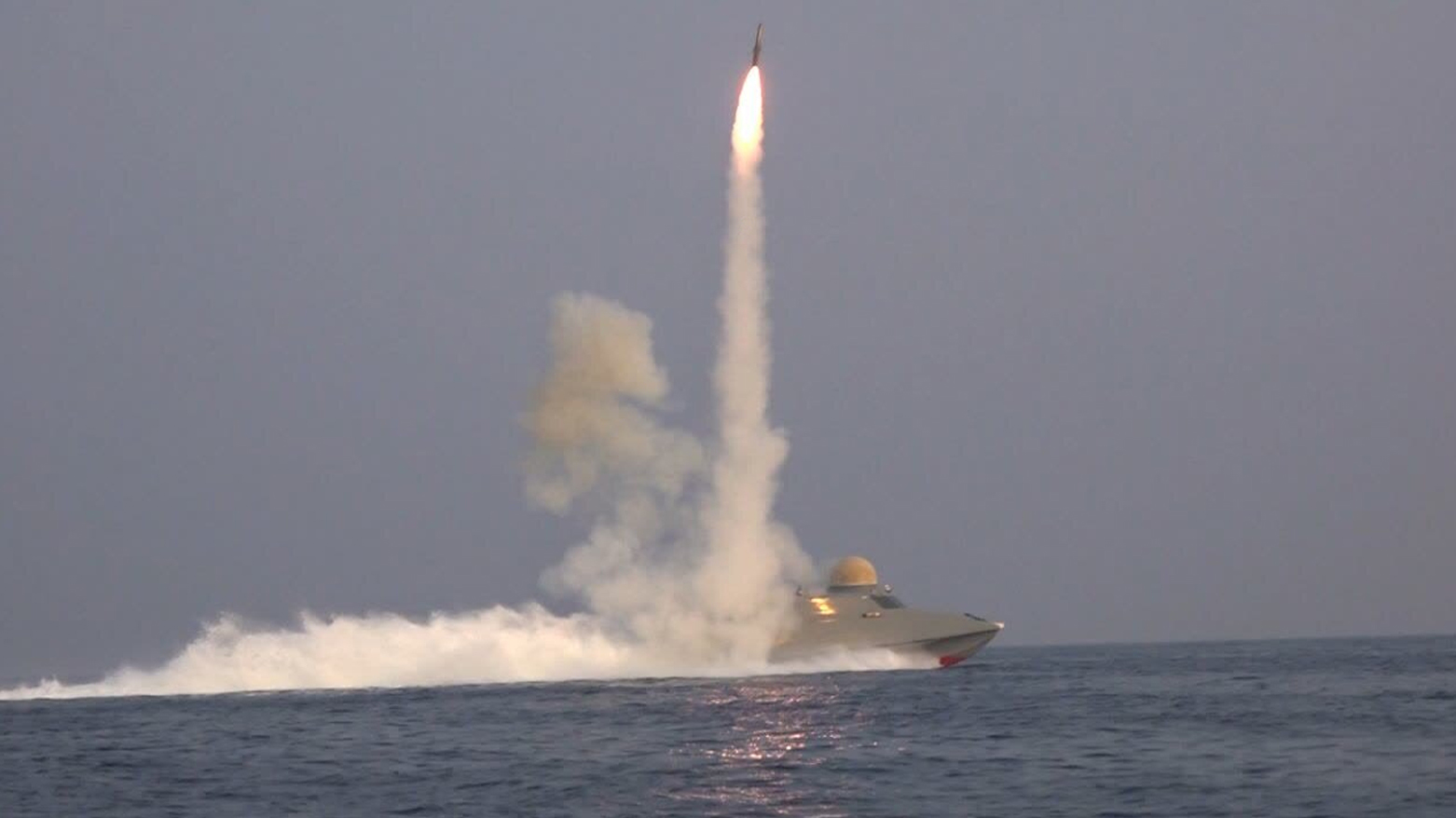
ERBIL (Kurdistan24) – The commander of Iran’s Islamic Revolutionary Guard Corps Navy (IRGC Navy) announced on Saturday the successful test of a new missile capable of traversing the entire length of the Gulf.
The revelation, made during a televised interview and reported by the Iranian Students' News Agency (ISNA), marks a significant escalation in Tehran’s rhetorical and technical posturing, as Rear Admiral Alireza Tangsiri detailed a weapon system designed to hold targets at risk across the entirety of the strategic corridor, asserting that Iranian forces remain fully prepared for the prospect of naval warfare.
Rear Admiral Tangsiri’s comments followed the conclusion of the IRGC Navy’s recent "Authority" (Eghtedar) military exercises, a series of drills conducted across a vast maritime theater encompassing the Gulf, the critical Naaz Islands in the Strait of Hormuz, and the Sea of Oman.
According to the commander, the maneuvers were not merely routine patrols but a demonstration of specific, newly developed capabilities intended to achieve well-defined objectives. Chief among these was the deployment of a missile with a range exceeding the 1,375-kilometer length of the Gulf body of water itself.
Tangsiri emphasized that this weapon, produced domestically within the IRGC Navy’s own industrial complex, possesses unique technical attributes, most notably the ability to be controlled and guided after launch, a feature that significantly enhances its tactical utility against moving targets in a contested maritime environment.
The commander’s disclosure highlights a concerted effort by the IRGC to achieve self-sufficiency in defense production, a theme he returned to repeatedly throughout his interview with ISNA.
Beyond the long-range cruise missile, Tangsiri revealed the operational use of a new ballistic missile characterized by "very precise targeting." While he declined to publicly name the weapon system, he noted that "the enemies saw its precision," a statement implying that foreign intelligence agencies and naval forces operating in the region were the intended audience of the live-fire demonstrations.
This focus on precision suggests a doctrinal shift toward targeted strikes rather than area denial alone, aimed at countering the technological superiority of Western naval assets.
Addressing the specific threat posed by foreign warships—vessels often equipped with advanced defense shields and carrier-based fighter jets—Tangsiri projected tactical confidence.
According to ISNA, when questioned about the IRGC Navy’s ability to confront such high-value assets, Tangsiri rejected the notion that modern defensive systems render these ships invulnerable. Instead, he outlined a multi-domain approach to naval engagement, stating that the “exercise utilized weapons deployed from the surface, below the surface, and above the surface, all specifically calibrated to target and neutralize formidable naval adversaries.”
Furthermore, the Rear Admiral sought to dismantle the perception that Iranian forces are kept at bay by the sophisticated perimeters of foreign fleets. He asserted that “there have been instances where IRGC units approached foreign warships so closely that they were able to mark them physically or electronically without the opposing forces detecting the intrusion.”
The interview also touched upon the persistent surveillance operations conducted by the IRGC Navy.
Tangsiri referenced the release of aerial footage captured by Iranian drones, which reportedly showed detailed monitoring of an American warship. He cited this as evidence that “full surveillance and intelligence oversight are maintained throughout the Gulf,” claiming that Iranian capabilities allow for the complete and constant monitoring of American movements.
Tangsiri also stated that, “foreign warships do not enter Iranian waters or even the waters under Iranian supervision.”
To underscore the consequences of such a violation, he invoked historical precedents, specifically the capture of American and British sailors in previous years.
He warned that if foreign forces were to cross these maritime red lines, the issue of the capture of the "10 Americans, or the other 4 Americans, or the two other instances where we detained the British" would be repeated.
When pressed on the probability of a broader conflict extending into the maritime domain, the commander emphasized that his forces are not only anticipating such a scenario but are actively preparing for it.
"I am neither a politician nor do I deal with politics; rather, I am a military man," Tangsiri told ISNA. He described his role as one of analyzing the enemy's hostility and presence in the region and preparing his forces accordingly.
He further noted that the Supreme Commander-in-Chief constantly directs the armed forces to maintain full readiness, framing the naval buildup not as a choice but as a mandate from the highest levels of the Iranian state.
The rhetoric and the revelations of new missile capabilities collectively paint a picture of a naval force in Iran that is aggressively modernizing and signaling its intent to contest control of the region's vital shipping lanes.