Japan, Australia Urge Calm After Chinese Jet Locks Radar on Japanese Fighters Near Okinawa
Tokyo lodges stern protest as Beijing accuses Japan of “harassment.”
ERBIL (Kurdistan24) — Japan and Australia called for restraint on Sunday after a Chinese military aircraft repeatedly locked its radar onto Japanese fighter jets near Okinawa, escalating tensions already strained by Tokyo’s recent comments on Taiwan.
Japan’s Defense Minister Shinjiro Koizumi said Tokyo issued a formal protest to Beijing after the dangerous encounter, describing the incident as “extremely regrettable” and far beyond what is acceptable during routine air operations.
“We have lodged a strong protest with the Chinese side and demanded strict preventive measures,” Koizumi said.
According to Japan’s Defense Ministry, a Chinese J-15 fighter jet launched from the aircraft carrier Liaoning and “intermittently” locked its fire-control radar onto Japanese F-15s on two occasions Saturday—once for about three minutes in the late afternoon and again for roughly 30 minutes in the evening.
The Japanese jets had been scrambled to monitor Chinese aircraft conducting takeoff and landing drills in the Pacific. Defense officials told Kyodo News that Japan’s F-15s kept a safe distance and avoided any moves that could be interpreted as provocative. There was no violation of Japanese airspace, and no damage or injuries were reported.
Senior Colonel Wang Xuemeng, spokesperson for the Chinese navy, dismissed Japan’s protest, defending China’s training operations near Miyako Island. He accused Japanese aircraft of “harassment” despite Beijing announcing the exercises beforehand.
“We solemnly asked the Japanese side to immediately stop slandering and smearing, and strictly restrain its frontline actions,” Wang said in a statement. He warned that the Chinese Navy would “take necessary measures to resolutely safeguard its security and legitimate rights and interests.”
The incident follows heightened friction between Tokyo and Beijing after Japanese Prime Minister Sanae Takaichi said in early November that Japan’s military could intervene if China acted against Taiwan.
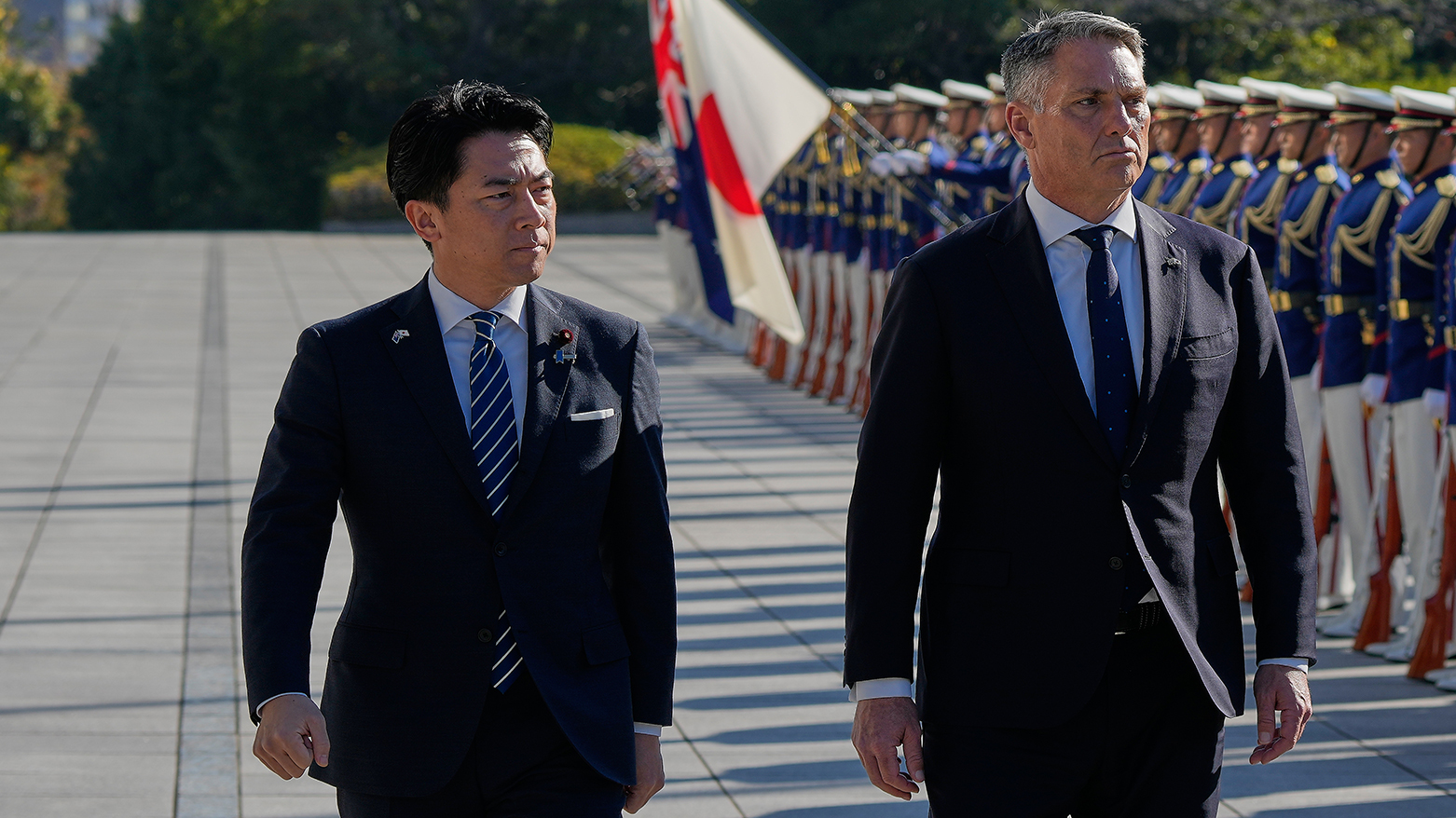
The radar-lock incident dominated previously scheduled talks in Tokyo between Japan’s defense minister and Australian Defense Minister Richard Marles.
“We are deeply concerned by the actions of China in the last 24 hours,” Marles said. “We expect those interactions to be safe and professional.”
Japan and Australia agreed to strengthen their defense partnership through a new “framework for strategic defense coordination,” expanding military cooperation beyond Japan’s traditional reliance on the United States. Australia is now viewed in Tokyo as a semi-ally.
Marles also toured a Mitsubishi Heavy Industries shipyard in Nagasaki on Saturday, observing production of the upgraded Mogami-class frigate, which Australia selected in September to modernize its naval fleet.
Fighter jets use fire-control radars as part of targeting systems ahead of missile launches—making such lock-ons particularly sensitive.
Saturday’s encounter is believed to be the first confirmed radar-lock incident involving fighter jets from China and Japan. A similar incident was reported in 2013, when a Chinese naval vessel locked its fire-control radar onto a Japanese destroyer in the East China Sea, according to Kyodo News.
As Tokyo and Beijing navigate rising distrust, both Japan and Australia warned that incidents like Saturday’s radar lock carry significant risks of miscalculation—raising the stakes across an increasingly contested Indo-Pacific.