Iraq Tops Türkiye’s Food Export Markets as Trade Grows Amid Domestic Failures
Rising imports underscore deepening Ankara–Baghdad economic ties, while mismanagement and corruption weaken Iraq’s food security.
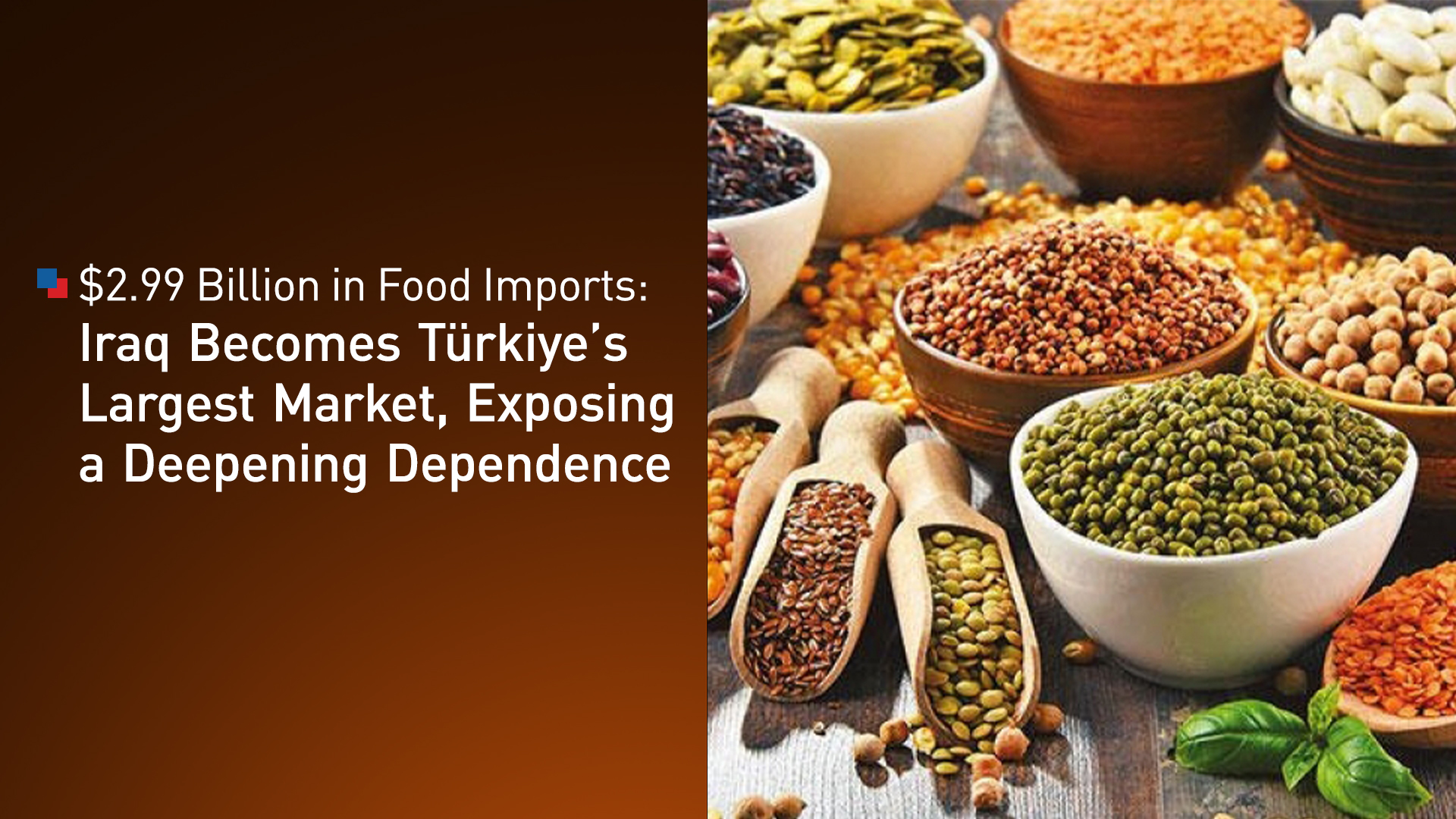
ERBIL (Kurdistan24) — Iraq ranked first among countries importing agricultural and food products from Türkiye in 2025, according to new data released by the Federation of Food and Drink Industry Associations of Türkiye (TGDF), highlighting both the rapid expansion of bilateral trade and Iraq’s growing dependence on foreign food supplies.
According to the most recent figures published by TGDF, Türkiye’s exports of agricultural and food products to Iraq reached $2.99 billion during the first 11 months of 2025, placing Iraq ahead of all other destination markets.
Exports to Germany stood at $1.84 billion, while shipments to the United States reached $1.63 billion over the same period.
Despite maintaining its top position, Turkish exports to Iraq declined by 3.01 percent compared with the same period in 2024. TGDF said the decrease reflects broader regional market challenges, even as Iraq continues to serve as a key outlet for Türkiye’s agricultural and food industries.
The association noted that the Iraqi market remains central to strengthening economic ties between the two neighbors in 2026.
The data underscores the steady growth in trade between Türkiye and Iraq in recent years, driven by geographic proximity, integrated supply chains, and strong demand in the Iraqi market. Food and agricultural products form a core pillar of this relationship, alongside construction materials, consumer goods, and energy cooperation.
Ankara has repeatedly emphasized Iraq’s importance as one of its largest regional trading partners.
However, economic experts say Iraq’s position as Türkiye’s largest food importer also exposes structural weaknesses in the Iraqi economy, particularly within the federal government’s management of food security and agriculture.
Despite vast arable land, water resources, and decades of public spending, Iraq has struggled to rebuild domestic agricultural capacity after years of conflict, policy inconsistency, and institutional decay.
Mismanagement of resources, weak planning, and entrenched corruption within federal ministries—especially in agriculture and food supply chains—have undermined local production, according to Iraqi economists.
Large portions of state funding allocated to agricultural support, irrigation projects, and farmer subsidies have failed to translate into sustainable output, leaving domestic producers unable to compete with cheaper imports.
As a result, Iraq has become one of the region’s most import-dependent countries for basic food commodities, relying heavily on Türkiye to meet domestic demand.
While imports have helped stabilize markets and prevent shortages, critics warn that excessive dependence exposes Iraq to external shocks, price volatility, and political pressure, while further marginalizing local farmers.
With trade between Türkiye and Iraq expected to continue expanding in 2026, experts argue that Baghdad faces a strategic choice: either use this economic relationship as a bridge toward rebuilding domestic agriculture through reform and accountability, or risk deepening long-term dependency driven by governance failures rather than genuine market needs.
In contrast to the federal government’s continued struggles, the Kurdistan Region has pursued a more structured approach to food security and agricultural development over the past decade.
Faced with repeated budget disputes with Baghdad and the volatility of oil revenues, the Kurdistan Regional Government (KRG) has increasingly framed agriculture and food production as strategic sectors essential to economic resilience and self-sufficiency.
The KRG has implemented policies aimed at reviving local farming through land allocation, irrigation support, and incentives for private investment in agriculture, livestock, and dairy production.
Large-scale poultry, meat, and dairy projects have expanded across the region, supplying a growing share of local demand and reducing reliance on imports. Officials argue that these sectors are being developed not only to strengthen food security but also to diversify income sources away from oil, create rural employment, and stabilize prices during periods of political or economic disruption.
While challenges remain, the Kurdistan Region’s experience is increasingly cited by analysts as a contrasting model within Iraq for linking food security policy to broader economic reform and diversification.