French President Outlines Strategy for European Autonomy, Multilateralism at Davos
At Davos, President Macron urged Europe to boost sovereignty through protection, simplification, and investment while revitalizing global cooperation to counter autocracy and economic instability.
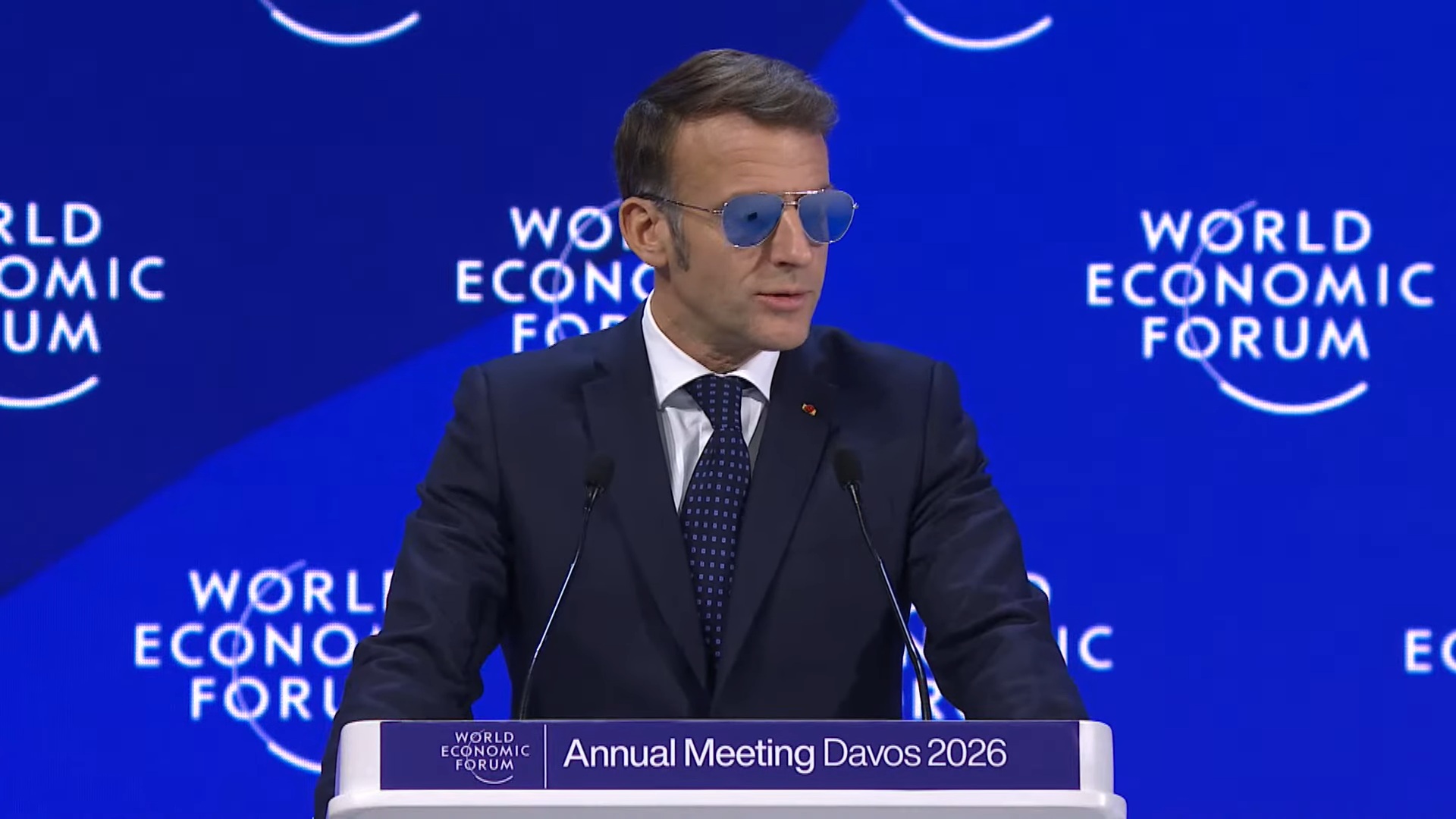
ERBIL (Kurdistan24) - French President Emmanuel Macron delivered a wide-ranging address at the World Economic Forum on Tuesday, characterizing the current geopolitical moment as a profound global shift toward instability and conflict.
Speaking to an audience of world leaders and business executives, Macron outlined a dual strategy focused on strengthening European sovereignty while reinvigorating international cooperation to counter the rise of autocracy and economic fragmentation.
President Macron described a world where the rule of law is increasingly trampled by the "law of the strongest," citing the ongoing Russian aggression against Ukraine, now entering its fourth year, and persistent conflicts in the Middle East and Africa.
He noted that 2024 set a record with more than 60 wars, reflecting a normalization of hybrid conflict across domains such as space, cyber, and trade. In this context, he argued, the structures of collective governance are being eroded by powers that either obstruct or abandon them.
A central theme of the address was the economic challenge posed by major global powers.
Macron criticized what he termed "relentless competition" from the United States, pointing to trade agreements that he said undermine European export interests and demand maximum concessions.
He condemned the accumulation of tariffs as unacceptable, particularly when used to leverage territorial sovereignty. Similarly, he warned of the threat posed by Chinese excess capacities and distortive practices that risk overwhelming industrial sectors.
European Sovereignty: Protection, Simplification, Investment
To address these vulnerabilities, President Macron proposed a comprehensive European strategy built on three pillars: protection, simplification, and investment.
He asserted that Europe must shed its naivety regarding open markets. "The Europeans are the only one not to protect their own companies and their own market when the other countries doesn't respect level playing field," he said.
Macron advocated for the deployment of strong defensive tools, including the anti-coercion mechanism and mirror measures to enforce regulatory standards on imports. He also called for advancing the principle of "European preference" across various sectors, aiming to present a proposal with the European Commission by early 2026.
This approach includes incentivizing higher-quality foreign direct investment, particularly from China, that contributes to growth and technology transfer rather than merely flooding the market with subsidized goods.
The second pillar, simplification, focuses on reducing regulatory burdens that desynchronize the European Union from the rest of the world. Macron urged accelerating the deepening of the Single Market to ensure that the 450 million consumers within the EU truly function as a domestic market for European companies.
He emphasized technological neutrality and non-discrimination as essential components of this streamlining effort.
The third pillar addresses the investment gap. President Macron highlighted that the significant disparity in GDP per capita between the U.S. and Europe is largely driven by differences in innovation.
He called for a massive increase in public and private investment in critical sectors such as artificial intelligence, quantum computing, greentech, and defense.
To mobilize private capital, he prioritized the acceleration of the securitization program and the completion of the Capital Markets Union to ensure European savings are invested within the continent rather than abroad.
Revitalizing Global Cooperation
While pushing for greater European autonomy, Macron rejected isolationism. He warned against two extreme approaches: passively accepting the "vassalization" inherent in bloc politics or adopting a purely moral posture that leads to marginalization. Instead, he argued for an "effective multilateralism" that delivers results through cooperation.
France, holding the G7 presidency this year, aims to restore the forum as a venue for frank dialogue to address global economic imbalances.
Macron identified key structural issues, including American overconsumption, Chinese overinvestment and underconsumption, and European underinvestment. He stressed that correcting these imbalances requires shared responsibility rather than mutual blame.
Furthermore, he expressed a commitment to building bridges with emerging economies, including the BRICS nations and the G20, arguing that global fragmentation is counterproductive.
He also referenced France’s participation in military exercises in Greenland as a demonstration of support for an ally, framing it within the principles of international cooperation rather than aggression.
France as an Economic Hub
Concluding his remarks, President Macron touted France’s own economic credentials. He highlighted the country’s status as the most attractive in Europe for investment over the past six years, underpinned by deep structural reforms.
He specifically pointed to France’s competitive, low-carbon electricity supply, noting the export of 90 terawatt-hours of nuclear-generated power last year.
The President described Europe as a predictable and loyal market where the rule of law remains the "rule of the game," suggesting that this stability is currently underpriced by global markets.
"We do prefer respect to bullies. We do prefer science to plotism. And we do prefer rule of law to brutality," Macron declared, inviting investors to view Europe not just as a legacy market but as a future-oriented hub of stability and innovation.