BCF Aid Convoy to Enter Besieged Kobani Amid Regional Displacement Crisis
The Barzani Charity Foundation said its first aid convoy will reach besieged Kobani on Sunday, easing shortages amid mass displacement. The delivery followed efforts led by President Masoud Barzani, with 114 trucks carrying food, medicine, and energy supplies now reaching Rojava.
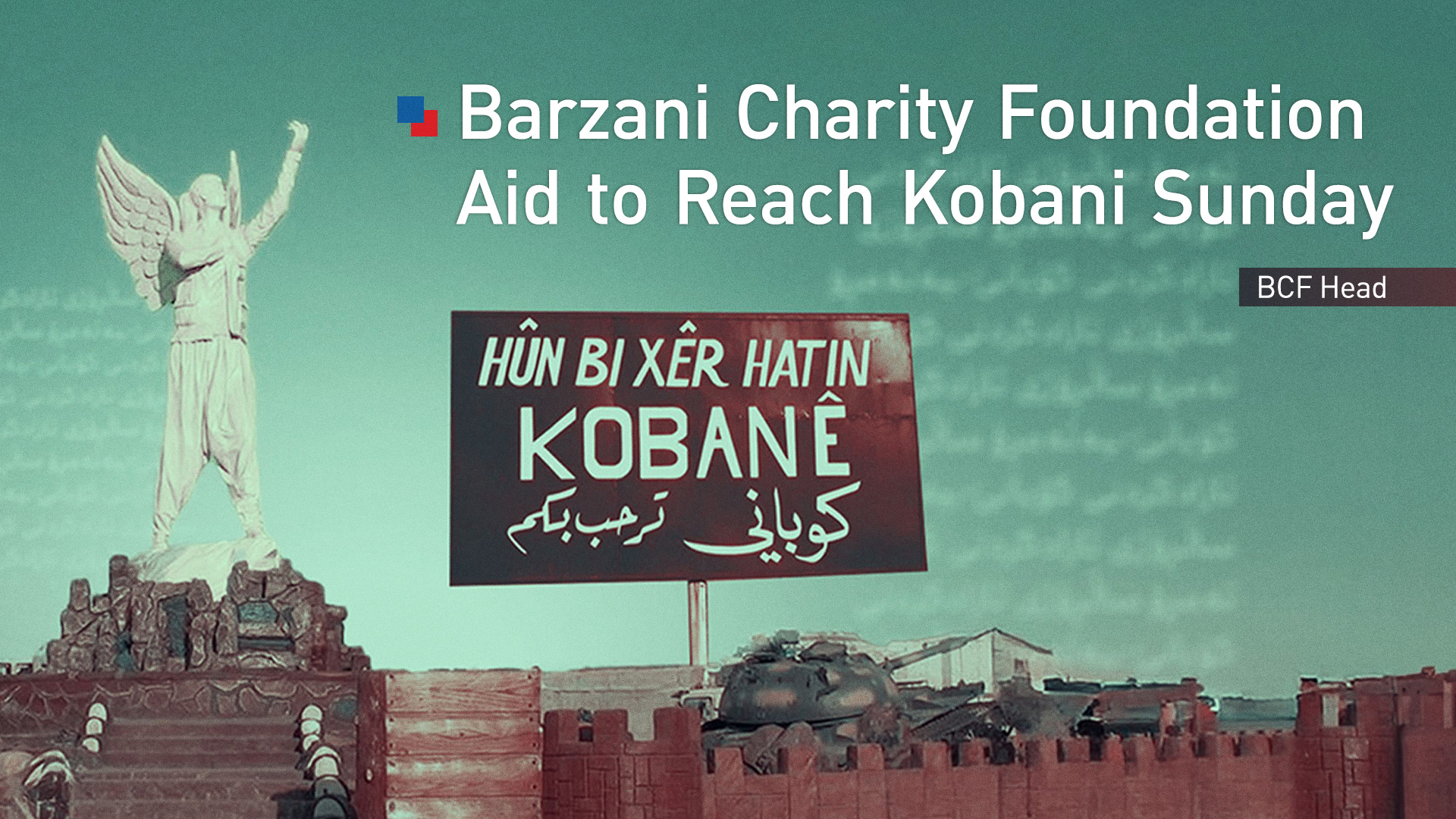
ERBIL (Kurdistan24) - The Barzani Charity Foundation (BCF) announced Sunday that its first humanitarian convoy will successfully reach the besieged city of Kobani on Sunday, marking a significant development in relief efforts as northeastern Syria contends with a mass displacement crisis that local authorities estimate has affected more than 130,000 people.
Speaking at a press conference in the city of Qamishlo on Sunday, Jan. 25, 2026, Musa Ahmad, the President of the Barzani Charity Foundation, confirmed that the breakthrough in reaching Kobani followed sustained diplomatic and logistical efforts directed by President Masoud Barzani.
The delivery occurs during a period of acute humanitarian distress in the city, which has been isolated by a military blockade for more than a week, resulting in critical shortages of food, medicine, and energy supplies.
“Fortunately, today our first convoy of aid reaches Kobani,” Ahmad told reporters. He characterized the successful entry into the city as the “fruit of President Barzani's continuous efforts through the Barzani Headquarters and various contacts to extend a helping hand to that city.”
The foundation revealed that the scale of the ongoing relief operation in Western Kurdistan (Rojava) has now reached a total of 114 trucks.
According to BCF statistics, each vehicle is loaded with approximately 12 tons of essential supplies. The foundation's presence on the ground is supported by a workforce of more than 160 employees, supplemented by a specialized medical team that has been providing emergency services in the region.
Breakdown of Humanitarian Assistance
The humanitarian mission has prioritized the restoration of basic services and the support of vulnerable infrastructure. Ahmad detailed a specific directive from the Prime Minister of the Kurdistan Regional Government (KRG), Masrour Barzani, aimed at stabilizing the educational sector.
Under this order, the foundation has provided diesel fuel to 81 schools to facilitate heating during a winter season marked by the heaviest snowfall in more than 50 years.
Furthermore, 30 additional schools have received comprehensive health and food packages. Foundation officials noted that each of these packages contains 22 distinct types of supplies, designed to meet the immediate nutritional and hygiene needs of students and staff.
The statistical scope of the relief efforts underscores the magnitude of the crisis. Ahmad reported that on Saturday alone, 5,827 families—representing 34,227 individual citizens—benefited from the foundation's aid distribution.
In the healthcare sector, specialized medical teams provided treatment to 1,367 patients, while the foundation’s mobile kitchens are currently distributing 3,500 hot meals on a daily basis. Beyond direct relief, the mission has secured 200 job opportunities for local youth, assisting in the administrative and logistical requirements of the aid campaign.
The foundation is utilizing the Fishkhabour–Semalka border crossing as its primary logistical artery. This crossing remains the sole gateway through which the Kurdistan Region can deliver sustained humanitarian assistance to the residents of Rojava.
The BCF’s current role builds upon its previous experience in the region, specifically following the devastating earthquake of February 2023, when it delivered large convoys of food and medicine to victims in Afrin, Jindires, and Qamishlo.
A Deepening Crisis in Northeast Syria
The arrival of the BCF convoy in Kobani comes as the city and the wider region of Western Kurdistan face what observers characterize as a "slow death" driven by military encirclement and environmental extremes. Akram Saleh, a correspondent for Kurdistan24 reporting from Qamishlo, confirmed on Sunday that a massive wave of displacement has engulfed the region.
Thousands of citizens from surrounding villages have fled toward the center of Qamishlo, where they are currently being sheltered in mosques and schools under harsh conditions.
Official statistics indicate that more than 130,000 displaced persons from areas including Sheikh Maqsud, Ashrafiyeh, Raqqa, and Tabqa have moved across various northern regions. Projections from local authorities suggest this number is likely to reach 150,000 in the coming days as tensions persist.
Despite the presence of multiple international organizations and United Nations agencies in the past, reports from the ground indicate that none are currently providing significant assistance to the newly displaced, leaving the Barzani Charity Foundation as the sole major relief provider remaining on the ground.
The humanitarian situation in Kobani has been particularly lethal. The city has remained under an encompassing military blockade by the Syrian Arab Army (SAA) and affiliated armed groups for eight days. This siege resulted in the total cutoff of water, electricity, internet, and heating fuel.
The Democratic Autonomous Administration of North and East Syria (DAANES) announced on Saturday that a child died in a Kobani hospital due to a critical lack of medical oxygen, as facilities struggle to function on failing emergency generators.
Compounding the medical crisis is the severe weather. The Kurdish Red Crescent reported that five children, including an infant, died in Kobani on Saturday specifically due to exposure to the extreme cold. The fatalities occurred as the region grapples with a historic winter storm.
Kurdish political organizations have condemned the blockade as "collective punishment" and a violation of the Geneva Conventions.
Diplomatic Efforts and the Ceasefire Extension
The escalation of the humanitarian crisis has triggered high-level political reactions and a fragile pause in active hostilities. Late Saturday, the Syrian Democratic Forces (SDF) and the Syrian Ministry of Defense announced a 15-day extension of a standing ceasefire through international mediation.
Damascus indicated that the truce is partially intended to facilitate the transfer of approximately 7,000 Islamic State (ISIS) detainees to Iraqi territory, a process being coordinated with the United States.
However, political leaders have warned that the military pressure exerted by Damascus threatens long-term stability. Gulistan Kiliç, the head of the DEM Party parliamentary group, stated during a Kurdistan24 broadcast that the offensive against Kurdish areas represents an "ethnic war" intended to complete the objectives once pursued by ISIS.
Kiliç argued that NATO members, including the United States and Turkey, have the leverage to lift the blockades on Kobani but have thus far failed to provide a positive response.
In his concluding remarks on Sunday, Musa Ahmad addressed the role of the international community. He noted that during a meeting with the United Nations, representatives expressed "admiration" for the quality and variety of the BCF aid and promised to coordinate more closely to deliver assistance to all affected areas.
Ahmad reiterated the foundation’s readiness to coordinate with any party to serve the inhabitants of Rojava, framing the mission as both a national and humanitarian duty of the Kurdistan Region.
As the 15-day ceasefire begins, the focus of aid organizations remains on whether the entry of the first BCF convoy into Kobani will signal a permanent opening of humanitarian corridors or if the city's 150,000 residents will remain subject to the fluctuating conditions of the siege.
This article was updated on Sunday, Jan. 25, 2026, at 11:35am.