President Masoud Barzani Opens 11th Mesopotamia Health Conference in Erbil
President Barzani said decisive action helped prevent the situation from spiraling further. “We did what was required for western Kurdistan, and we are proud of that.”
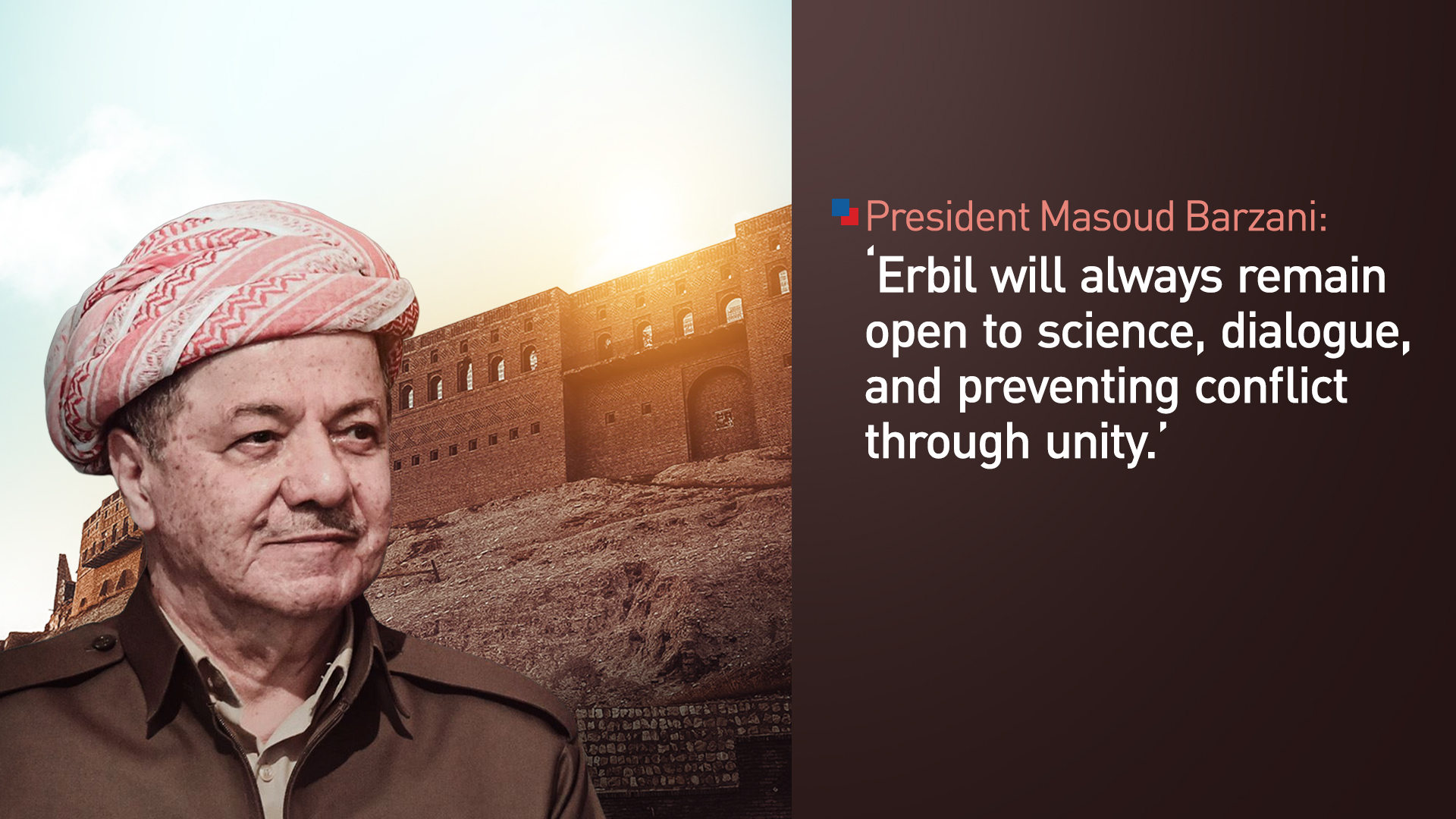
ERBIL (Kurdistan24) — The 11th Mesopotamia Health Conference opened on Thursday in Erbil, with the participation of President Masoud Barzani and more than 800 local and international doctors and medical specialists, bringing together experts from across the Kurdistan Region and abroad.
Addressing participants at the conference, President Barzani welcomed the gathering and underscored Erbil’s openness to medical professionals and scientific exchange, describing such events as vital for advancing healthcare and public service.
“I want to say that the heart and doors of Erbil are always open to doctors and to activities like this,” Barzani said. “A large number of physicians from all four parts of Kurdistan are here today. This is a source of hope and pride. Exchanging knowledge and experience through such initiatives provides a great service to our people.”
Barzani emphasized that Kurdish individuals excel when given opportunity, noting that many prominent professors and scholars have emerged from Kurdistan.
“If the opportunity is provided, the Kurdish individual is no less capable than anyone else,” he said. “We take pride in our distinguished academics and professionals.”
Turning to regional developments, the Kurdish leader reflected on recent tensions in northern Syria, warning that the situation had risked escalating into a broader ethnic conflict. “A major catastrophe was close to happening in western Kurdistan,” Barzani said. “My greatest fear was that it would turn into Kurdish-Arab fighting.”
He stressed that throughout history, Kurds have not initiated wars against people, but have instead resisted oppression. “The Kurds have never started wars against nations,” he said. “Our struggle has always been against tyranny, not against people.”
Barzani said decisive action helped prevent the situation from spiraling further. “We did what was required for western Kurdistan, and we are proud of that,” he said, adding that the circumstances differed significantly from those of 2014.
“This time, it was necessary to extinguish the fire. Thanks to God, it did not become a Kurdish-Arab war. Unfortunate events did occur, but something far worse could have happened.”
He added that efforts to halt the violence succeeded and expressed hope that the agreement reached would hold. “We supported this agreement so the fighting doesn’t grow,” he said.
The president also expressed gratitude to the people of the Kurdistan Region, the Barzani Charity Foundation, humanitarian organizations, public figures, and media outlets for mobilizing support during the crisis. “I thank all the people of Kurdistan and the Barzani Charity Foundation for the good work they carried out during the tensions in Syria,” he said, voicing hope that the unity shown would serve as a foundation for responding to future events.
Barzani also addressed the peace process in Turkey, reaffirming longstanding Kurdish support. “From the very first day, we have supported the peace process in Turkey,” he said, voicing hope that it would reach an outcome beneficial to all parties involved.
On domestic politics, the Kurdish leader said efforts were ongoing to resolve challenges facing the formation of a new Kurdistan Regional Government, while also signaling readiness to assist Baghdad.
“We are making efforts to overcome the obstacles hindering the formation of the Kurdistan Regional Government,” Barzani said. “We are also prepared to offer any assistance required to our brothers in Baghdad to help form a new Iraqi government, so that we can move out of this crisis as soon as possible—both in the Kurdistan Region and in Iraq—though the challenges remain significant.”
Barzani further warned that the broader regional situation remains highly complex, calling on countries to prioritize dialogue over confrontation.
“I hope states resolve their disputes through dialogue and that no war breaks out between any parties,” he said, stressing that conflict serves no one’s interests and causes harm to all.
The Mesopotamia Health Conference is expected to continue with panel discussions and scientific sessions focusing on medical research, public health challenges, and cross-border cooperation in healthcare.
This is a translation of the speech delivered by President Masoud Barzani at a medical conference.
The full Text of President Barzani's speech:
In the name of God, the Most Gracious, the Most Merciful
First, I would like to extend a warm welcome to all of you. I commend the Medical Syndicate and the Mesopotamia Board for organizing this conference, which is the eleventh of its kind. I want to say that the heart and the doors of Erbil are always open to you and to activities of this nature.
A large number of doctors from all four parts of Kurdistan are here today, which is a source of pride and hope for us. These types of activities are extremely valuable; the exchange of such science and experience provides a great service to our nation. You have performed a sacred task; I congratulate you and thank you.
The work of a doctor is a very sacred profession—it is the saving of human lives. There is no work more sacred than this. Therefore, you too are sacred, because your duty is a holy one. I wish you success, and we are with you and support you with all our strength and ability.
A number of distinguished doctors from the diaspora are participating in this, as well as from all four parts of Kurdistan. This demonstrates a reality: if given the opportunity, the Kurdish individual is in no way inferior to others. Thank God, very prominent professors and great scientists have emerged whom we take pride in.
We hope that Kurds in the diaspora take advantage of these opportunities—just as many of these distinguished guests have—and encourage their children to pursue education and science in every field. We hope they distance themselves from things that are alien to our culture and from things that end up harming themselves and their nation. At the same time, teach them not to forget their language, their land, and their people.
Distinguished guests,
I do not wish to take up too much of your time, but we all saw recently that a major catastrophe was about to occur in Western Kurdistan [Northern Syria], unfortunately. I do not want to go into the details of why and how the situation reached that point, but as the Arabic proverb goes: "God averted what could have been worse" (دفع الله ما كان أعظم). My greatest fear was that it would turn into a Kurdish-Arab war.
You yourselves know, if we look back at history, the Kurds have never initiated a war. Furthermore, the instructions from all the leaders of the Kurdish revolutions have always been that our war is against oppressors, not against nations. I feared it would become a war between Kurds and Arabs, which would have been a massive disaster.
Again, why did it come to this? I will not go into those details. In such cases, one must make decisions and take steps away from emotion. What we could do, we did. We are proud that—just as in the past when it was necessary, and conditions were right—we sent Peshmerga who went to Kobane and fought alongside their brothers against ISIS and liberated Kobane.
The circumstances this time were different; this time required the fire to be extinguished. Thank God, and thanks to all parties who cooperated, the war did not expand and did not become a Kurdish-Arab war. Unpleasant things occurred, but far worse things could have happened. Now, an agreement has been reached between our brothers in Western Kurdistan and the Syrian government. We hope this agreement continues. We did what we could to prevent the war from spreading.
Here, I find it necessary to extend endless thanks to every Kurdish individual in all four parts of Kurdistan and abroad for that unity and national sentiment, the value of which cannot be measured, and which gave strength to us all. This was the greatest victory. On the other hand, I thank the people of the Kurdistan Region for the aid and the enthusiasm we witnessed.
Thousands of young people volunteered to go and help their brothers. I thank all the institutions that went to assist their brothers and provided services. Specifically, I want to extend my deepest thanks to the Barzani Charity Foundation and the Ministry of Health of the Kurdistan Region for providing extensive services to our brothers in Western Kurdistan.
I hope that the unity we witnessed at the national level becomes a foundation for the future and for every event that may occur from now on. We must not think about war, but at the same time, we will not accept the oppression of the oppressors. We pray and hope the situation improves so that our brothers and sisters in Western Kurdistan can lead a comfortable life, and we will not hesitate to help them in any way we can.
Regarding the North of Kurdistan [Bakur], it has been a year or a little more since the peace process began. We have supported it since day one and continue to support it. We hope it reaches a conclusion that is beneficial for all sides. I will say no more than that.
Regarding the internal situation of the Kurdistan Region and relations with Baghdad, unfortunately, after last year’s elections, neither has a government been formed in the Region, nor has a government been formed in Baghdad. There are many problems. We must be honest with you and our people: we are making efforts to eliminate these problems and find a suitable solution for the Kurdistan Region. For Baghdad as well, we will do whatever we can to help our friends in Baghdad so that we can emerge from this crisis quickly, both in the Region and in Baghdad. However, many obstacles remain.
The situation in the region [Middle East] in general is complex, as you can see. We hope that war does not break out between any parties, because war is the worst thing possible. We hope the existing problems and disagreements between these states are resolved through dialogue and peace, because war is to the detriment of all the people of the region and to the detriment of all sides.
In conclusion, I congratulate you on this conference and assure you that we support you with all our capabilities. I wish you success. We must also know that if we have the will and belief in our nation’s cause, we will always have friends. If we lack will, are not prepared, and do not believe in ourselves, no one will be our friend. Know this very well.
Finally, I send my respects to the pure souls of all the martyrs, and greetings to all Kurdish and Kurdistani brothers and sisters wherever they may be. I wish you success and, God willing, may Kurdistan always live in joy.
Thank you very much.
This article has been updated on Feb. 5, 2026, at 03:11 pm.