High-Speed Rail Collision in Southern Spain Leaves 39 Dead and Dozens Injured
A high-speed train crash in Spain killed 39 and injured 123. Officials call the derailment on a renovated track "extremely strange" as an investigation begins.
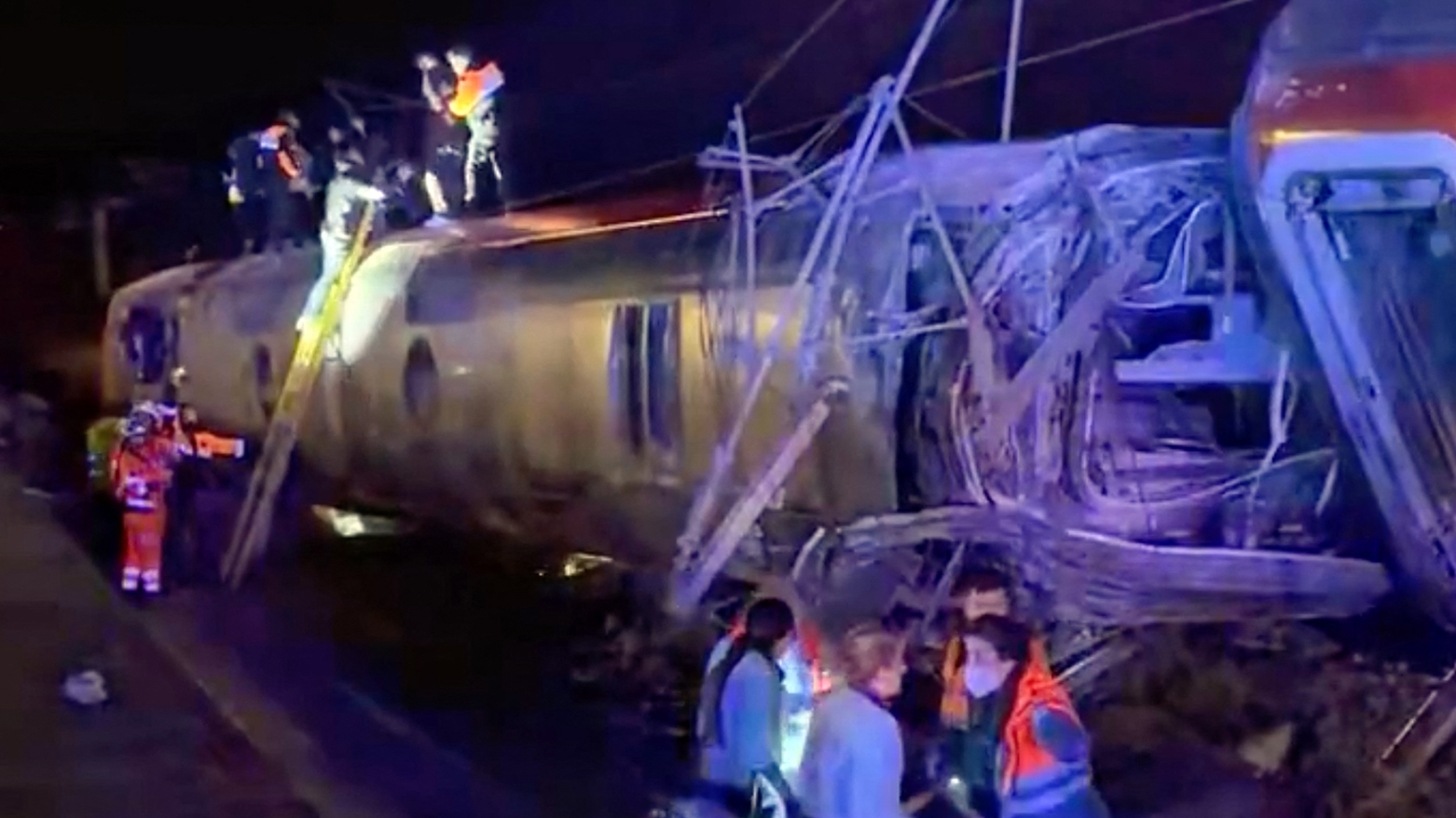
ERBIL (Kurdistan24) - A high-speed train traveling through southern Spain derailed and collided with an oncoming rail service on Sunday evening, killing at least 39 people and injuring more than 120 others in the country’s deadliest rail disaster in over a decade.
Government officials and transportation experts have launched an immediate investigation into the incident, which occurred on a modernized section of track, describing the circumstances of the crash as "extremely strange," according to reports by Agence France-Presse (AFP).
The catastrophe took place near the town of Adamuz when a train operated by the rail company Iryo, which was en route from Malaga to Madrid, derailed while in transit.
According to authorities cited by AFP, the derailed locomotive crossed onto the adjacent track, where it crashed into an oncoming train. The force of the impact caused the second vessel to derail as well.
The interior ministry provided an updated casualty count on Monday, confirming that 39 people had died, a significant increase from the initial toll of 21 provided by police late Sunday.
Emergency services worked through the night to extract survivors from the wreckage, a task complicated by the severe structural damage sustained by the carriages. Some of the train cars tumbled down a four-meter (13-foot) embankment, leaving hundreds of passengers trapped inside the twisted metal.
Francisco Carmona, the head of firefighters in Cordoba, described the rescue operation to public broadcaster RTVE as "hard, tricky work." He noted the harrowing nature of the extraction process, stating that emergency responders were forced to remove deceased passengers in order to reach those who were still alive within the mangled carriages.
The Spanish Interior Ministry reported that, in addition to the fatalities, 123 people were injured in the collision. Of those survivors, five were listed in very seriously condition, while another 24 sustained serious injuries.
The rail operator Iryo confirmed that approximately 300 people were on board its Malaga-Madrid service at the time of the accident. Renfe, the operator of the second train involved in the collision, has not yet released figures regarding the number of passengers it was carrying.
Transport Minister Oscar Puente, addressing reporters regarding the preliminary findings, emphasized the anomalous nature of the accident. He noted that the disaster occurred on a straight section of the railway that had been completely renovated. Furthermore, the first train to derail was described as "practically new."
These factors have confounded initial assessments, with Minister Puente stating that rail experts are "very surprised by this accident because it is very strange and very difficult to explain at this stage."
Survivors of the crash described chaotic scenes as the collision occurred. A passenger on the second train, identified as Montse, told Spanish public television that the train came to a sudden, jolting stop before plunging into darkness.
She recounted being thrown around the carriage and witnessing luggage falling onto other passengers. Another survivor, Lucas Meriako, who was traveling on the Iryo train that initially derailed, compared the experience to a "horror movie," describing a massive impact from the rear and the sensation that the train was about to collapse as glass shattered around the passengers.
The incident marks the most severe rail accident in Spain since 2013, when 80 people were killed after a train derailed on a curved section of track outside Santiago de Compostela.
Spain currently boasts Europe's largest high-speed rail network, spanning more than 3,000 kilometers (1,800 miles) and connecting major urban centers including Madrid, Barcelona, Seville, Valencia, and Malaga.
In response to the tragedy, Adif, the state infrastructure administrator, announced that high-speed services between Madrid and the Andalusian cities of Cordoba, Seville, Malaga, and Huelva would be suspended on Monday.
Prime Minister Pedro Sanchez issued a statement expressing his condolences, characterizing the event as a "night of deep pain" for the nation. "No words can alleviate such great suffering, but I want them to know that the whole country is by their side in this tough moment," Prime Minister Sanchez wrote on the social media platform X.
The Royal Palace also released a statement indicating that King Felipe VI and Queen Letizia were following the developments with great concern and offered their heartfelt condolences to the bereaved families.
International leaders, including French President Emmanuel Macron and European Commission chief Ursula von der Leyen, also extended their sympathies to the Spanish government and people.