Lithuanian FM: Stability in Syria Must Adhere to International Law and Non-Recognition of Occupation in Russia
Lithuania's FM emphasizes that any Syrian stability process must strictly adhere to international law, and also mentioned the non-recognition of illegally occupied territories that was done by Russia.
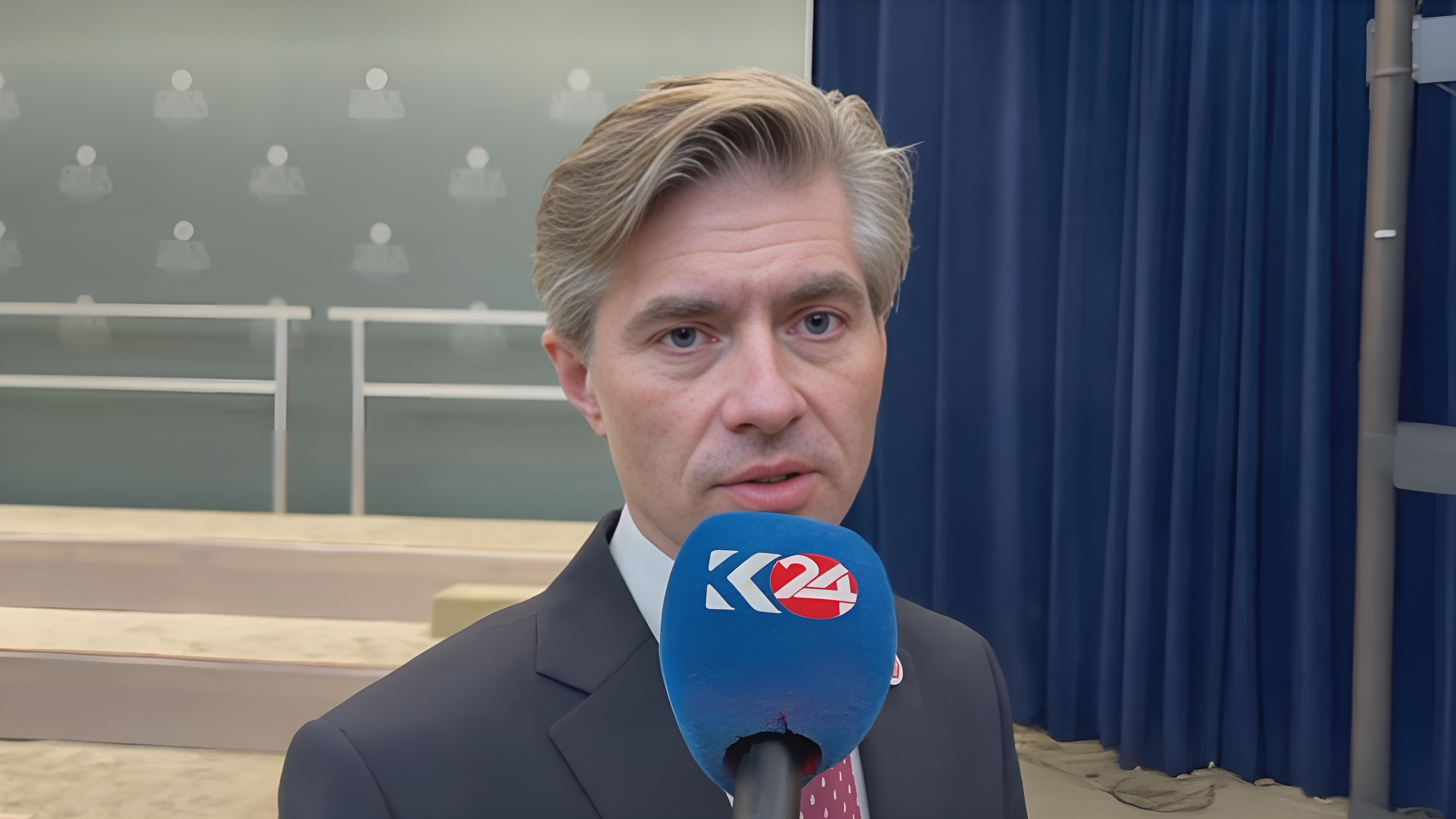
ERBIL (Kurdistan24) - As international attention turns to the evolving political arrangements in northeastern Syria, Lithuania’s foreign minister has stressed that any path toward stability must be anchored in international law, warning that security efforts cannot come at the expense of long-standing legal principles.
In an interview with Kurdistan24, Kęstutis Budrys, the minister of foreign affairs of Lithuania, said his country strongly supports all processes that contribute to stability and security in Syria, but emphasized that such efforts must remain within the framework of international law and binding commitments.
“We strongly support all the—all the processes that will bring more stability and security to Syria. Uh, but one fundamental thing is also important: to follow the principles of international law and international commitments,” Budrys said.
He explained that this legal framework was a central condition during discussions within the European Union concerning support for Syria and the review of sanctions policies. According to Budrys, European partners are obligated to uphold existing commitments, including the non-recognition of territories that have been illegally occupied.
“We have to follow the commitments and international commitments, and one of those is non-recognition of illegally occupied territories, uh, that was done by Russia,” he added.
His remarks come as new details have emerged about a recently signed agreement between the Syrian government and the Syrian Democratic Forces (SDF). The fourteen-point accord, signed on Jan. 29, outlines a phased framework aimed at reshaping security, governance, and administration in northeastern Syria.
The agreement is divided into four implementation phases, all to be carried out within one month, followed by a fifth phase of permanent commitments. It spans military, security, administrative, and economic files, beginning with a permanent and comprehensive ceasefire and the suspension of arrest campaigns and raids.
Under the military provisions, SDF forces are to withdraw from the cities of Hasakah and Qamishli to mutually agreed bases, while Syrian army units redeploy to Shaddadi. The Syrian Ministry of Defense is tasked with forming a special military division for Hasakah, integrating SDF forces into three brigades. In Kobani, local forces are to be incorporated as a single brigade under a military division affiliated with Aleppo province.
Security measures include the deployment of fifteen Interior Ministry vehicles to both Hasakah and Qamishli, alongside the integration of SDF internal security forces into the Syrian Interior Ministry. Senior administrative and security posts are to be shared, with the governor of Hasakah nominated by the SDF and the provincial security chief nominated by Damascus.
The deal also addresses sensitive infrastructure and border management. The Rmelan and Sweidi oil fields are to be handed over to the Ministry of Energy, Qamishli Airport is to come under civil aviation authority, and border teams are to be deployed to Semalka and Nusaybin crossings to formalize civilian administration and reopen the routes.
Civil governance is a central component of the accord. The Syrian government is to supervise all civilian institutions in Hasakah province, integrating autonomous administration bodies into state structures while formally recognizing their employees. The agreement bans the entry of military forces into cities and towns, particularly in Kurdish areas, and guarantees the recognition of certificates issued under the Autonomous Administration of North and East Syria.
It also provides legal operating permits for civil society, cultural, and media institutions, calls for dialogue on Kurdish curricula, and guarantees the return of displaced persons to their cities and villages, including Afrin, Sheikh Maqsud, and Serikaniye, with local representation in civil administrations.
Budrys’ insistence on legal principles underscores the international scrutiny surrounding Syria’s evolving political landscape, as the SDF–Damascus agreement marks a significant step in redefining governance and security in Kurdish regions while placing the process under the lens of international law.