U.S. Prepares Potential Ground Operations in Iran Amid Intense Airstrikes and Ongoing Negotiations
The Pentagon continues preparations for potential ground operations in Iran, which could involve raids by Special Operations forces and conventional troops, should the U.S. President authorize escalation.
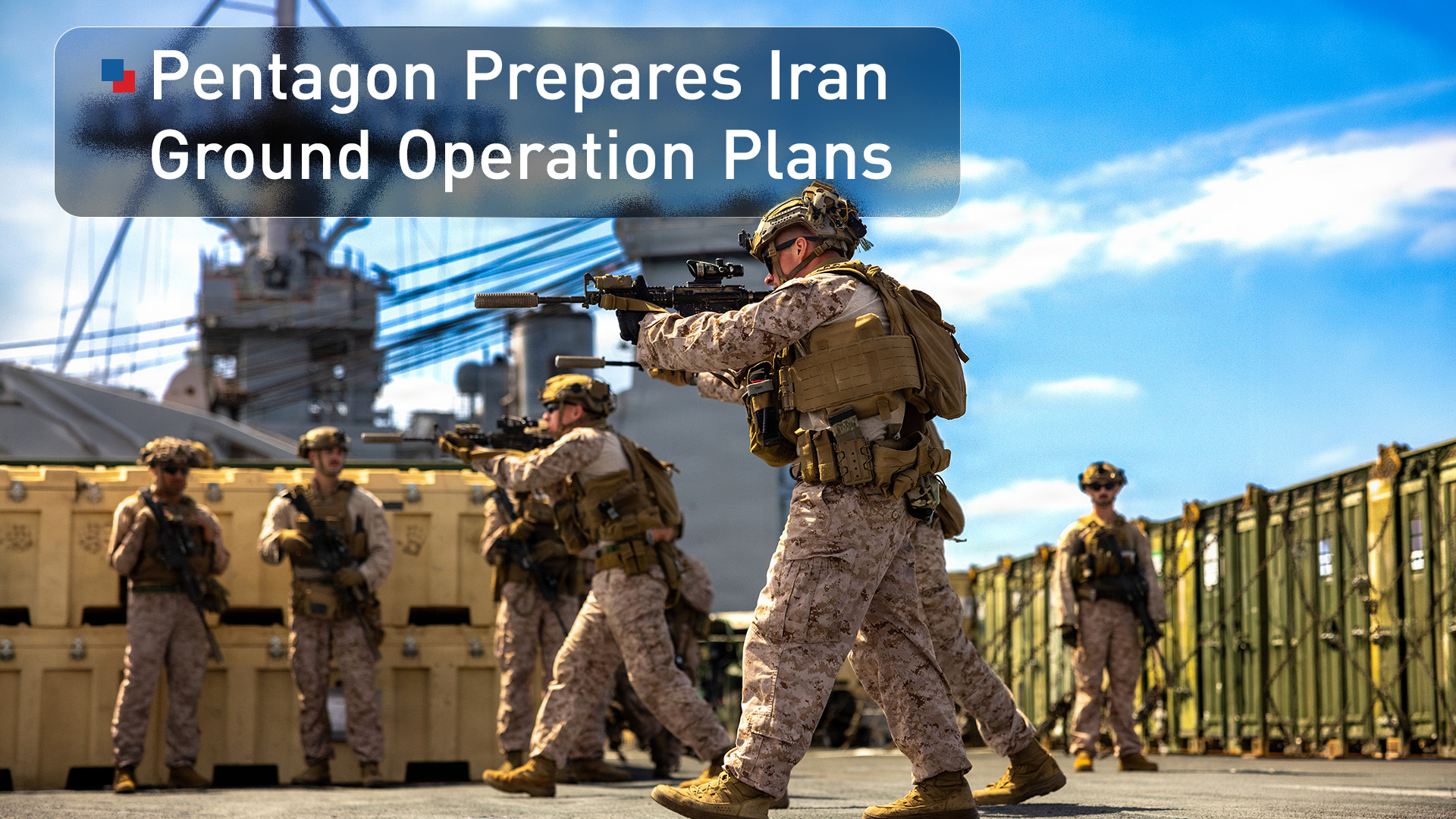
ERBIL (Kurdistan24) - The Pentagon is preparing for weeks of ground operations in Iran, U.S. officials told The Washington Post, as thousands of American soldiers and Marines arrive in the Middle East for what could become a dangerous new phase of the war should President Donald Trump choose to escalate.
According to the report, any potential ground operation would fall short of a full-scale invasion and could instead involve raids conducted by a mixture of Special Operations forces and conventional infantry troops. The officials, speaking on the condition of anonymity to discuss highly sensitive military plans that have been in development for weeks, stated that such a mission could expose U.S. personnel to an array of threats, including Iranian drones, missiles, ground fire, and improvised explosives.
It remains unclear whether the U.S. President will approve all, some, or none of the Pentagon’s plans. The administration has recently fluctuated between declaring the war is winding down and threatening further escalation. White House Press Secretary Karoline Leavitt previously warned that if Tehran does not abandon its nuclear ambitions and cease threats, the President is “prepared to unleash hell.”
In a statement responding to questions for the report, Leavitt clarified the military's role in the planning process: “It’s the job of the Pentagon to make preparations in order to give the Commander in Chief maximum optionality. It does not mean the President has made a decision.”
Discussions within the administration over the past month have reportedly included the possible seizure of Kharg Island, a critical Iranian oil export hub located in the Persian Gulf. Planners have also considered executing raids into other coastal areas near the Strait of Hormuz, specifically aiming to locate and destroy weapons systems capable of targeting commercial and military shipping. One official indicated that the objectives under consideration would likely take “weeks, not months” to complete, while another estimated a potential timeline of “a couple of months.”
The Defense Department did not respond to requests for comment regarding the ground operation plans detailed by the publication.
Public statements from senior U.S. officials present varying perspectives on the likelihood of ground deployments. Speaking in the Oval Office, the U.S. President told reporters, “I’m not putting troops anywhere. If I were, I certainly wouldn’t tell you, but I’m not putting troops.”
Secretary of State Marco Rubio, speaking to reporters in France following meetings with U.S. allies concerned about the economic impact of the conflict, stated that the situation is “not going to be a prolonged conflict.” The Secretary of State reiterated the administration's assessment that the operation is ahead of schedule and asserted that the United States “can achieve all of our objectives without ground troops.”
According to The Washington Post, in the past month, 13 U.S. troops have been killed in action. This figure includes six personnel who died in a plane crash in Iraq, six killed during a drone attack on Port Shuaiba in Kuwait, and one who died in an attack on Prince Sultan Air Base in Saudi Arabia. Additionally, more than 300 service members have been wounded by Iranian drone and missile retaliatory attacks targeting U.S. facilities across at least seven Middle Eastern countries, with at least 10 individuals suffering serious injuries.
Public opinion data cited by the publication indicates significant opposition to ground operations among the American public. A recent joint poll by the Associated Press and the National Opinion Research Center found that 62 percent of respondents strongly oppose the use of ground troops in Iran, with only 12 percent expressing support. Respondents were more evenly divided regarding airstrikes against military targets, with 39 percent opposed and 33 percent in favor.
Military analysts noted the inherent risks of sustained ground operations, particularly concerning the potential seizure of Kharg Island. Michael Eisenstadt, director of the Military and Security Studies Program at the Washington Institute for Near East Policy, suggested that a safer approach might involve laying mines around the island to compel Iran to remove its own mines from the Strait of Hormuz.
“I just wouldn’t want to be in that small place with Iran’s ability to rain down drones and maybe artillery,” Eisenstadt, a retired Army officer, told the publication. He advocated for a strategy emphasizing mobility. “I think it’s better to not have the troops located in any given place for a prolonged period of time,” he added. “Agility is part of your force protection, if they are moving and doing raids, in and out.”
The 31st Marine Expeditionary Unit, comprising approximately 2,200 U.S. sailors and Marines, was recently ordered to the region. A retired senior military officer familiar with the unit's operations indicated that while the unit is capable of conducting such missions, it faces logistical limitations regarding sustained combat without additional supply lines.
The retired officer noted that while Kharg Island is Iran’s most significant territory in the Persian Gulf, military officials have also evaluated other Iranian islands closer to the Strait of Hormuz. The officer warned that Iran’s Islamic Revolutionary Guard Corps is likely to mount a strong defense and could utilize the island's valuable oil infrastructure defensively.
Another former senior defense official confirmed the extensive nature of the ground campaign planning. “We’ve looked at this. It’s been war-gamed,” the official stated. “This is not last-minute planning.” This official noted that seizing territory could provide valuable leverage in negotiations but emphasized the difficulty of maintaining control. “You’ve got to provide cover for the people on Kharg Island,” the official explained. “That’s the difficult task. Seizing it is not difficult. Protecting your guys once they are there is.”
Political support for ground operations remains divided within the U.S. Congress. Sen. James Lankford expressed potential support for limited operations, stating, “If this is special forces to be able to carry out a specific operation — get in, get out — that’s very different than a long-standing occupation.” Conversely, Rep. Derrick Van Orden stated firmly, “The answer is no. We can achieve the strategic goals that Donald Trump wants to achieve without doing that.”
Sen. Lindsey Graham has publicly advocated for seizing Kharg Island, comparing the potential operation to the World War II battle of Iwo Jima. “We did Iwo Jima, we can do this,” Graham stated during a television interview, adding, “My money’s always on the Marines.”
The logistical support for ongoing operations was highlighted by U.S. Central Command, which stated on social media that Navy logisticians have "demonstrated unmatched proficiency in keeping warships across the Middle East replenished with food, fuel, ammunition and other supplies to stay in the fight" during Operation Epic Fury.
Regional media and diplomatic sources reflect the tension between potential military escalation and diplomatic efforts. The Israeli Broadcasting Authority reported that the U.S. President is considering military options, including ground intervention, to open the Strait of Hormuz if negotiations fail. Israeli diplomatic sources indicated Washington seeks direct talks with Iranians soon.
Israel’s Channel 12 reported intensified military coordination between Washington and Tel Aviv to prepare for the possible failure of diplomatic options. Security sources told the channel that while the U.S. President is not fundamentally opposed to attacking Iranian infrastructure, he currently prefers to give negotiations a chance, contingent on full coordination with Israel for any future military action.
In an interview with Israel’s Channel 14, the U.S. President characterized the Iranian diplomatic posture, stating: "The Iranians are very eager to reach an agreement and are begging for it." He confirmed ongoing efforts regarding the Strait of Hormuz and described his relationship with Israeli Prime Minister Benjamin Netanyahu, stating, "Our coordination is very close and our relations are at their peak; it is impossible for them to be better."
An American military official noted that U.S. troop levels in the Middle East have exceeded 50,000. However, military experts caution that this number, heavily distributed among naval assets, represents a small force for conducting large-scale ground operations inside Iran. According to The New York Times, U.S. officials reported that the President is discussing options for broader attacks, including seizing control of specific islands or areas to ensure maritime freedom in the Strait of Hormuz.
Meanwhile, Iranian media reported a series of airstrikes targeting multiple locations in Tehran and Tabriz. The Fars News Agency reported an attack on a petrochemical production unit in Tabriz, noting no toxic leaks occurred and the situation was controlled. The Mehr News Agency reported injuries resulting from an airstrike on a residential area in northern Tehran. Iranian state television announced strikes targeting a bank branch and a cardboard factory in southern Tehran, as well as Mehrabad Airport in western Tehran.