Kurdistan PM Calls for Reparations on Anniversary of Balisan Chemical Attacks
Masrour Barzani renews demand for justice as victims’ families await long-overdue compensation
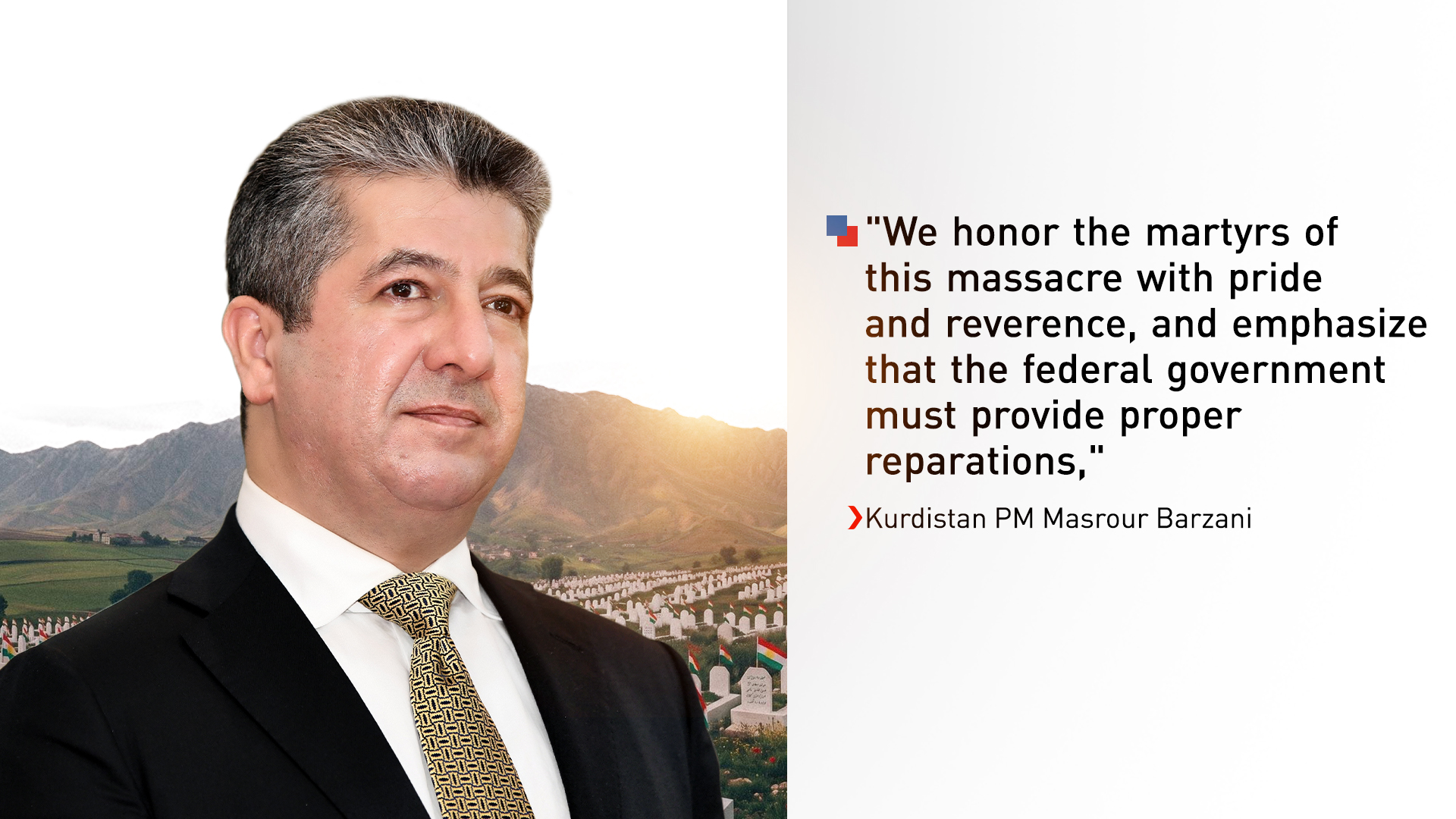
ERBIL (Kurdistan24) — Kurdistan Region Prime Minister Masrour Barzani on Thursday commemorated the 39th anniversary of the chemical attacks on Balisan, Sheikh Wasanan, and the Khoshnawati Valley, renewing calls for Baghdad to fulfill its obligations to compensate victims of the atrocities and the broader Anfal genocide campaigns.
In a statement published on Facebook, Barzani paid tribute to the victims, describing them as martyrs whose sacrifice remains a defining chapter in the Kurdish struggle.
“On the 39th anniversary of the chemical attacks… we honor the martyrs of this massacre with pride and reverence,” he said, while expressing “deep appreciation for the struggle and sacrifice of the resilient people of these areas.”
Barzani underscored that justice remains incomplete, stressing that “the federal government must provide proper reparations to the brave families of the martyrs and the Anfal genocide campaign.”
On the 39th anniversary of the chemical attacks on Balisan, Sheikh Wasanan, and Khoshnawati Valley, we honor the martyrs of this massacre with pride and reverence, and express deep appreciation for the struggle and sacrifice of the resilient people of these areas.
— Masrour Barzani (@masrourbarzani) April 16, 2026
We emphasize… pic.twitter.com/I5pwrlMS6v
The attacks on Balisan, Sheikh Wasanan, and the Khoshnawati Valley in April 1987 were among the earliest instances of chemical weapons use by the dictator Saddam Hussein’s regime against Kurdish civilians, preceding the more widely known assault on Halabja in 1988.
Mustard gas and nerve agents were deployed against unarmed villagers, killing and injuring scores, displacing communities, and leaving long-term health and environmental consequences that persist to this day.
These attacks formed part of the Anfal campaign, a systematic military operation targeting Kurdish populations across northern Iraq between 1987 and 1988. The campaign resulted in the destruction of thousands of villages, the disappearance of an estimated 182,000 Kurds, and has been internationally recognized as genocide.
Despite the formal recognition of Anfal as genocide by Iraq’s parliament in 2008, successive Iraqi governments have been widely criticized for failing to fully implement compensation mechanisms for survivors and victims’ families.
Kurdish officials and advocacy groups have repeatedly pointed to bureaucratic delays, insufficient budget allocations, and a lack of political will in Baghdad as key obstacles to delivering reparations.
Families affected by the chemical attacks and Anfal operations continue to seek not only financial compensation, but also comprehensive medical care, social support, and formal acknowledgment of their suffering. For many, the anniversary serves as both a moment of remembrance and a reminder of unfulfilled promises.
Barzani’s statement reflects ongoing tensions between Erbil and Baghdad over historical accountability and the rights of victims, as Kurdish leaders continue to press for concrete measures to address what they describe as decades of neglect and injustice.