Prime Minister Barzani, Iraqi Premier Seek Constitutional Deal on Erbil-Baghdad Disputes
Kurdistan Region Prime Minister Masrour Barzani met Iraqi Prime Minister Ali Falih al-Zaidi in Baghdad on Saturday to advance constitutional solutions for disputes between Erbil and Baghdad, with both sides emphasizing cooperation, revenue-sharing, and government stability.
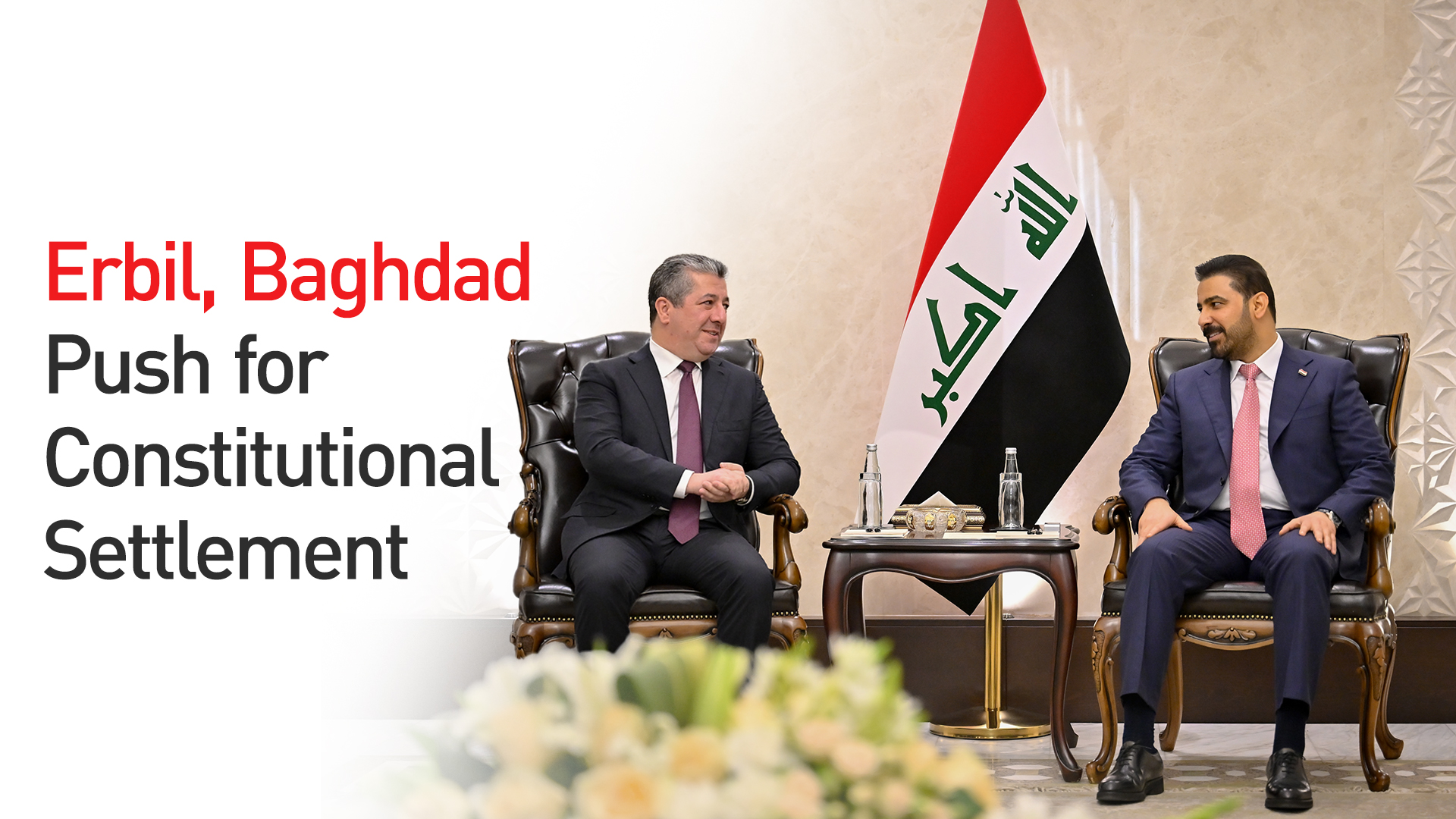
ERBIL (Kurdistan24) - Kurdistan Region Prime Minister Masrour Barzani met with Iraqi federal Prime Minister Ali Falih al-Zaidi at the Government Palace in Baghdad on Saturday to discuss a definitive resolution to long-standing disputes and to strengthen the strategic partnership between Erbil and the federal government.
The high-level meeting, held during the first day of Prime Minister Barzani's official two-day visit to the capital, centered on establishing constitutional solutions for revenue-sharing, governance, and security coordination.
According to a statement from the Kurdistan Regional Government (KRG), the Prime Minister congratulated al-Zaidi on assuming office and expressed the KRG's full support for the success of the new federal administration.
We arrived in Baghdad for a two-day visit focused on discussing ways to resolve outstanding issues and strengthen cooperation and coordination to overcome challenges.
— Masrour Barzani (@masrourbarzani) May 23, 2026
In my meeting with Federal Prime Minister @AliFalihAlzaidy, we emphasized the importance of resolving issues on…
A Framework for Constitutional Cooperation
During the talks, Prime Minister Barzani emphasized that the success of the federal government should benefit "all components and citizens of Iraq without discrimination."
He underscored the importance of resolving outstanding problems fundamentally and constitutionally, while maintaining strict respect for the federal status of the Kurdistan Region.
Prime Minister al-Zaidi welcomed the Kurdistan Region delegation, stating that all political sides in Iraq are partners in the nation's governance.
He reiterated that the federal government's goal is to reach sustainable agreements that serve all citizens.
Both leaders agreed on enhancing cooperation to overcome existing obstacles and challenges that have historically hindered Erbil-Baghdad relations.
The KRG delegation entered the negotiations with the position that the Kurdistan Region has fulfilled its legal and administrative obligations.
Consequently, Prime Minister Barzani emphasized that the Region must receive its full constitutional rights and financial guarantees in return.
Linking Cabinet Stability to Erbil Coordination
The meeting carries significant weight beyond bilateral relations.
A broad political consensus is emerging in Baghdad, with major parliamentary blocs emphasizing that the stability of Prime Minister al-Zaidi's cabinet is fundamentally tied to successful coordination with the Kurdistan Region.
As political parties navigate the complexities of government formation, leaders across the sectarian spectrum have warned that a functional administration is impossible without a resolution of the disputes regarding oil, salaries, budget transfers, and Article 140.
Salahuddin al-Dulaimi, a leader in the Hasm Alliance, told Kurdistan24 that Prime Minister Barzani's influence is indispensable to the process, noting that the new cabinet will struggle to succeed without resolving these core issues.
This sentiment was echoed by Abbas al-Moussawi, an advisor to State of Law Coalition leader Nouri al-Maliki, who stated that current policy within the Coordination Framework is focused on re-strengthening relations with Erbil as a foundation for federal success.
Aqeel al-Rudaini, spokesperson for the Nasr Alliance, characterized Prime Minister Barzani's presence as a demonstration of "good faith" intended to facilitate definitive understandings on technical and constitutional files.
Leaders from the Siyada, Badr, and Azm alliances, including Salah al-Kubeisi, Abu Mithaq al-Masari, and Mudhaffar al-Karkhi, similarly stressed that a stable Iraqi government requires the resolution of oil and gas disputes and the fulfillment of constitutional obligations toward the Kurdistan Region.
Broad Political Outreach
The meeting with Prime Minister al-Zaidi is the centerpiece of an expansive two-day itinerary designed as a goodwill effort to normalize relations.
Parallel to the bilateral discussions, the leaders addressed the ongoing delay in completing the federal cabinet, as nine ministers have yet to receive parliamentary confidence.
Prime Minister Barzani's schedule includes meetings with a wide array of Iraqi political, judicial, and security leaders.
On Saturday, the Prime Minister met with the Speaker of Parliament, Haibat al-Halbousi, and the President of the Supreme Judicial Council, Faiq Zidan.
His consultations also included prominent figures such as Hadi al-Amiri, Haider al-Abadi, Mohammed al-Halbousi, Falih al-Fayadh, and Ahmed al-Asadi.
The second day of the visit is expected to include sessions with Nouri al-Maliki, Khamis al-Khanjar, Qais al-Khazali, and Mohammed Shia al-Sudani, alongside other veteran political figures like Ayad Allawi and Adel Abdul-Mahdi.
By engaging with this diverse spectrum of political forces, the Kurdistan Region delegation seeks to foster a political environment conducive to long-term stability.
The discussions reflect a renewed institutional push to move past previous stalemates by focusing on transparent, constitutionally-grounded solutions for the administrative and financial concerns of both Erbil and Baghdad.