Iran Threatens Red Sea Blockade as Ceasefire Talks Falter and Regional Tensions Mount
A warning about one sea lane could have consequences far beyond the Middle East. The report explores how a single strategic chokepoint may become the next front in a conflict with global economic implications.
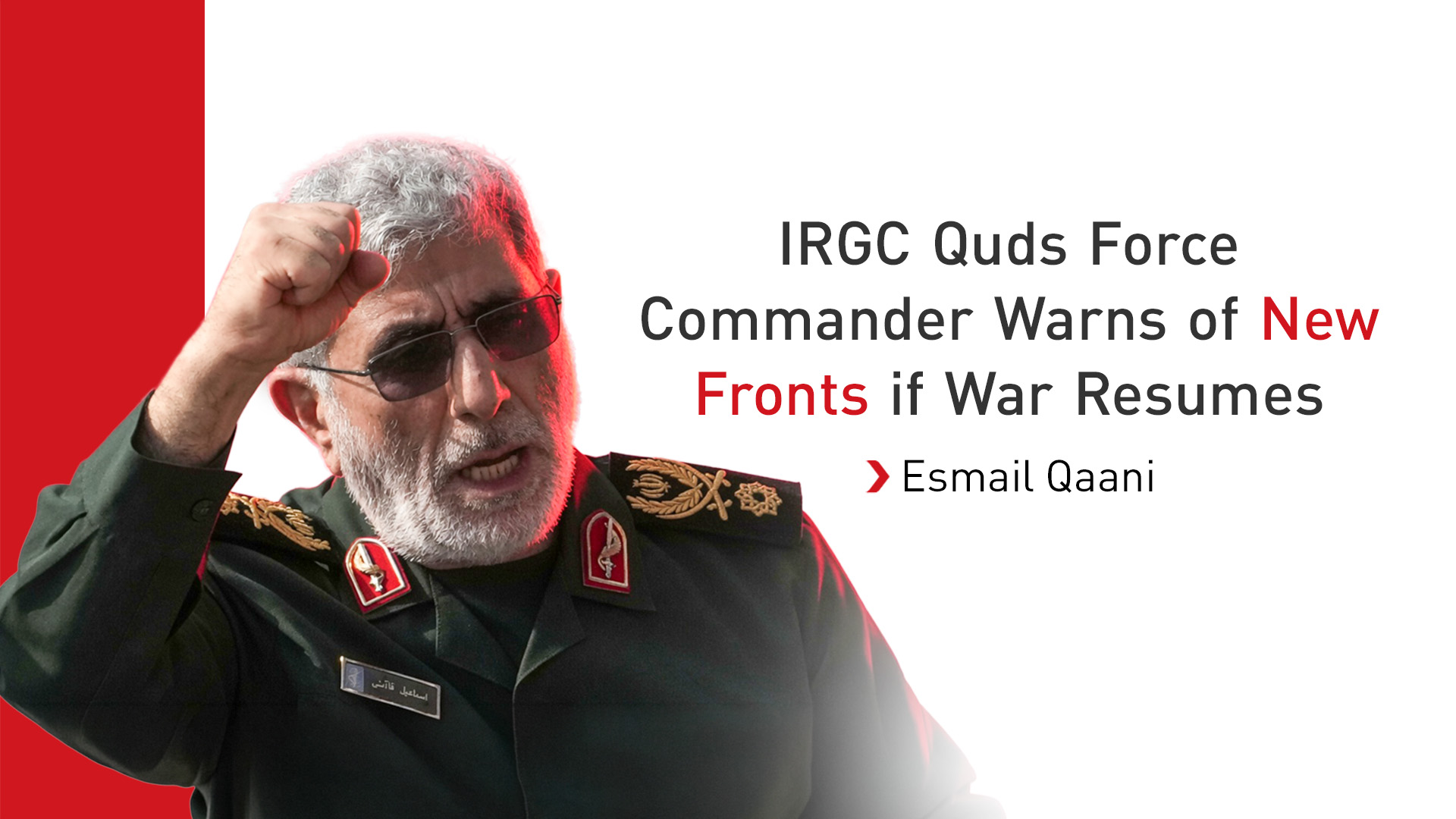
ERBIL (Kurdistan24) - Iran has drastically raised the stakes in its ongoing military standoff with the United States and Israel, threatening to expand its maritime blockade beyond the Persian Gulf to encompass the Red Sea's most critical chokepoint.
In a stark message directed at Washington and Jerusalem, Esmail Qaani, Commander of the Islamic Revolutionary Guard Corps (IRGC) Quds Force, warned that Tehran and its allied "Axis of Resistance" are preparing to fundamentally alter the regional balance of power.
Should hostilities resume, Qaani declared, Iran would move to close the Bab al-Mandab Strait, mirroring the crippling conditions currently restricting traffic through the Strait of Hormuz.
The warning underscores a significant shift in Iran's deterrence strategy, suggesting a willingness to weaponize global trade routes to counter what Tehran views as aggressive American and Israeli military maneuvers.
Qaani asserted that Israel's ongoing operations in Lebanon and Gaza are conducted with direct U.S. backing, a reality he claims has prompted the Resistance Front to activate new operational theaters.
He warned that simultaneous military action in Southern Lebanon and Gaza would trap Israel in a "whirlwind" of Hezbollah attacks and a "storm" of Palestinian resistance.
The Strategic Value of the Bab al-Mandab
Qaani's threat to seal the Bab al-Mandab Strait represents a severe risk to international commerce.
Situated between Yemen and the Horn of Africa, the strait serves as the southern gateway to the Red Sea and the Suez Canal.
Approximately 15 percent of global maritime trade passes through this narrow corridor annually, including critical shipments of manufactured goods and energy supplies destined for European and Asian markets.
The threat is not merely rhetorical. Since the outbreak of the Gaza war, the Houthi movement in Yemen, which operates in close alignment with Iran's Quds Force, has relentlessly targeted commercial shipping in the Red Sea.
A coordinated closure of both the Bab al-Mandab and the Strait of Hormuz would effectively sever two of the world's most vital maritime arteries simultaneously.
The economic implications are immense.
According to reporting by Jon Gambrell of The Associated Press, Iran's existing chokehold on the Strait of Hormuz has already severely disrupted global energy supplies and driven up global fuel prices.
The AP reports that transit through Hormuz, which once accommodated a fifth of all globally traded oil and natural gas, has slowed to a trickle.
Only 36 ships transited the waterway in a recent seven-day period, compared to an average of more than 130 ships per day prior to the conflict.
Beyond crude oil, the AP notes that the closure has squeezed the export of chemical fertilizers, of which the Gulf region produces 30 percent of the globally traded supply, generating international fears of food shortages.
Expanding this disruption to the Bab al-Mandab would likely cause freight insurance rates to soar, forcing shipping companies to reroute vessels around the Cape of Good Hope and cascading delays throughout the global supply chain.
Pessimism and Escalation
The Iranian threat to expand the maritime conflict emerges against a backdrop of deep pessimism regarding ongoing diplomatic negotiations.
While Washington and Tehran are ostensibly engaged in back-channel talks to formalize a ceasefire, the diplomatic process appears stalled, prompting increasingly bellicose signaling from Iranian military leadership.
Underscoring this hardening stance, Mohammad Jafar Assadi, deputy head of Iran's Khatam al-Anbiya central military command, recently suggested that renewed conflict is highly probable.
"The United States demands our total surrender, and the Iranian nation will never surrender," Assadi stated, according to reporting by Agence France-Presse. "Without surrender, war is inevitable."
This rhetoric is matched by escalating violence on the ground. The AP reports that the nominal ceasefire has been repeatedly tested by back-and-forth attacks.
Over the weekend, U.S. Central Command struck Iranian radar installations, a ground control station, and attack drones around the city of Geruk and on Qeshm Island, responding to the Iranian shootdown of an American MQ-1 Predator drone.
Iran retaliated forcefully. According to the AP, U.S. forces subsequently shot down two ballistic missiles launched by Iran toward bases housing American troops in Kuwait.
Iranian state television broadcast footage of the missile launch, which featured a graphic of a bruised U.S. President Donald Trump overlaid on a closed Strait of Hormuz, captioned: "Until the last American soldier leaves the region."
The Risk of Regional Spillover
The confrontation is further complicated by the deteriorating security environment in the Levant. As the AP reports, fighting between Israel and Hezbollah has intensified, with Israel extending its occupation deep into Lebanon while Hezbollah continues to launch drones into Israeli territory.
While President Trump recently expressed optimism on his Truth Social platform that Israel and Hezbollah had agreed to dial back their fighting, Israel detected missile launches from Lebanon moments later, warning residents in northern Israel to take cover.
Iran has insisted that any comprehensive ceasefire agreement with the U.S. must include a resolution in Lebanon.
Iranian Foreign Ministry spokesperson Esmail Baghaei recently accused the U.S. of constantly changing its negotiating positions, telling journalists, "We are negotiating in an atmosphere of mistrust," according to the AP.
The complex interplay between the battlefields in Gaza, Lebanon, and the Gulf highlights the severe risk that an isolated military incident could unravel the fragile diplomatic process.
With U.S. negotiators reportedly attempting to strike general terms regarding Iran's nuclear program, which possesses highly enriched uranium capable of being upgraded to weapons-grade, the margin for error remains exceedingly narrow.
As Qaani's warning indicates, Tehran is increasingly willing to leverage its proxy networks and geographic advantages to pressure Washington and its allies.
For global shipping and international energy markets, the threat to the Bab al-Mandab Strait serves as a stark reminder that the conflict's economic and strategic epicenter is shifting decisively toward the sea.
|
Summary The commander of Iran's Quds Force warned that Tehran could close the Bab al-Mandab Strait, escalating the strategic confrontation with the United States and Israel as diplomatic efforts stall. Iran's Quds Force Commander Esmail Qaani has threatened to close the Bab al-Mandab Strait if hostilities with the U.S. and Israel resume. The warning escalates maritime risks as ceasefire negotiations stall and proxy clashes across the region increasingly target global shipping and energy routes. |