'They Should Have a Country of Their Own': US Senators Declare Unwavering Support for Kurdistan
Three American lawmakers from both parties tell Kurdistan24 that the Kurds are among America's most valued partners — and that the relationship must endure.
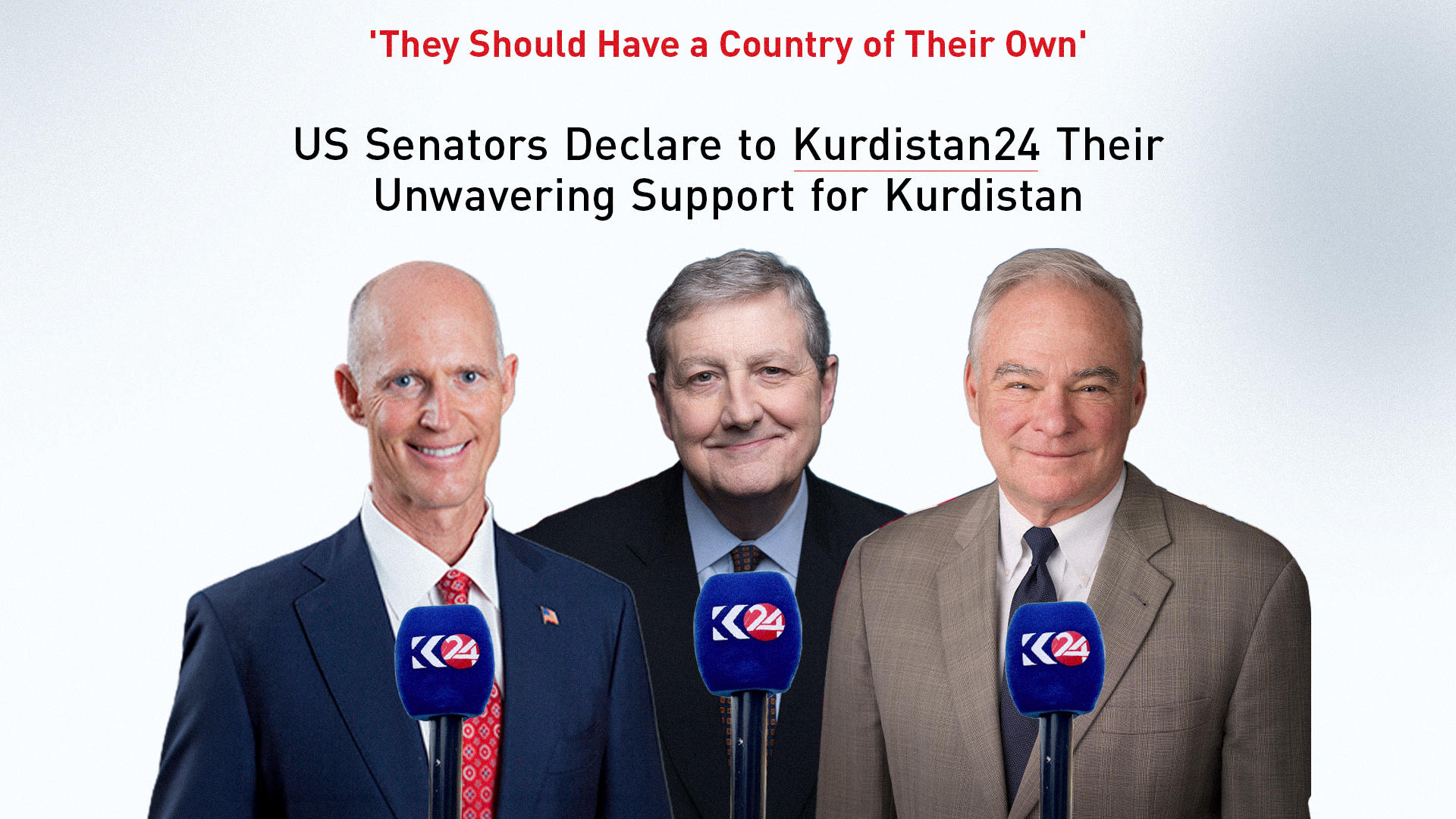
ERBIL (Kurdistan24) - Three sitting United States senators, speaking from across the political aisle, have delivered some of the most direct and personal endorsements of the Kurdish people heard in recent memory, including an unambiguous call for Kurdish statehood from one of the Senate's most prominent voices.
In exclusive interviews with Kurdistan24's Washington, D.C., bureau chief Rahim Rashidi, Senators John Kennedy, Tim Kaine, and Rick Scott each offered their reflections on the US-Kurdish relationship, a partnership forged in some of the most consequential conflicts of the past two decades and now reaffirmed at the highest levels of American legislative power.
'They should have a country of their own'
It was Senator John Kennedy, Republican of Louisiana, who offered the most expansive remarks.
"I love the Kurdistani people," he told Kurdistan24. "They should have a country of their own. I've said that for a long time. They've been good friends of America. I know that, and we're very grateful to call 'em friends."
Kennedy went further, describing the Kurdish people in terms that went beyond the language of alliance. "My Kurdish friends are spread all over five different countries," he said. "They're smart, they're clear-headed, they're thoughtful, they read books, they know stuff." The remark, informal in register but striking in its warmth, was a rare moment of personal candor from a senior American lawmaker on the question of Kurdish political aspirations.
A bond forged in the fight against ISIS
For Senator Tim Kaine, Democrat of Virginia, the US-Kurdish partnership is inseparable from the memory of shared sacrifice, above all, the campaign to defeat ISIS across Iraq and Western Kurdistan (Northern Syria), in which Kurdish forces bore a disproportionate share of the burden and the bloodshed.
"The Kurds have been some of the great allies of this country," Kaine said. "I'll never forget my visits to Erbil many years ago and my dialogue with Kurdish leaders and also our partnership with Kurds to defeat ISIS in Northern Syria."
Kaine's framing situated the relationship not merely as a matter of current policy but of lived history, a history he has witnessed firsthand. "Kurds are wonderful partners with the US," he said, adding that this was the message he wished to convey. That a senator who has traveled to Erbil and met personally with Kurdish leadership would speak in those terms reflects a depth of engagement that goes beyond the transactional.
'An ally for freedom'
Senator Rick Scott, Republican of Florida, was more concise but no less firm. "They've been an ally to the United States," Scott said of the Kurdish people. "They've been an ally for freedom. And so we've got to continue to work with them."
A chorus across party lines
What is perhaps most significant about the three statements, taken together, is not any single remark but their convergence.
Senator Kennedy is a conservative Republican; Senator Kaine ran as the Democratic vice-presidential nominee in 2016; Senator Scott leads the Republican Senate caucus.
That all three, speaking independently, arrived at essentially the same conclusion — that the Kurdish people are valued, trusted, and deserving of American commitment — suggests the US-Kurdish relationship enjoys a rare bipartisan consensus at a moment when almost nothing else in Washington does.
That consensus has practical implications. The Kurdish people, as Senator Kennedy noted, remain divided across five nations — Türkiye, Iraq, Syria, Iran, and Armenia — without a sovereign state of their own.
The Kurdistan Region of Iraq has functioned as the most stable and institutionalized expression of Kurdish self-governance, and it is with this entity that Washington has maintained its closest ties.
Whether the sentiments expressed by senators like Senator Kennedy translate into concrete policy movement on questions of Kurdish political status remains, as it has for decades, the open and unanswered question at the heart of the relationship.
For now, three of the most powerful legislators in the world have made their personal positions clear. Whether history will meet them where they stand is another matter entirely.