Prime Minister Barzani Calls for Expanded Coordination Between Peshmerga and Iraqi Army
Kurdistan Region Prime Minister Masrour Barzani met Iraqi Army Chief Lt. Gen. Yarallah, stressing stronger Peshmerga–Iraqi Army coordination to counter threats and protect oil infrastructure, pledging full security cooperation.
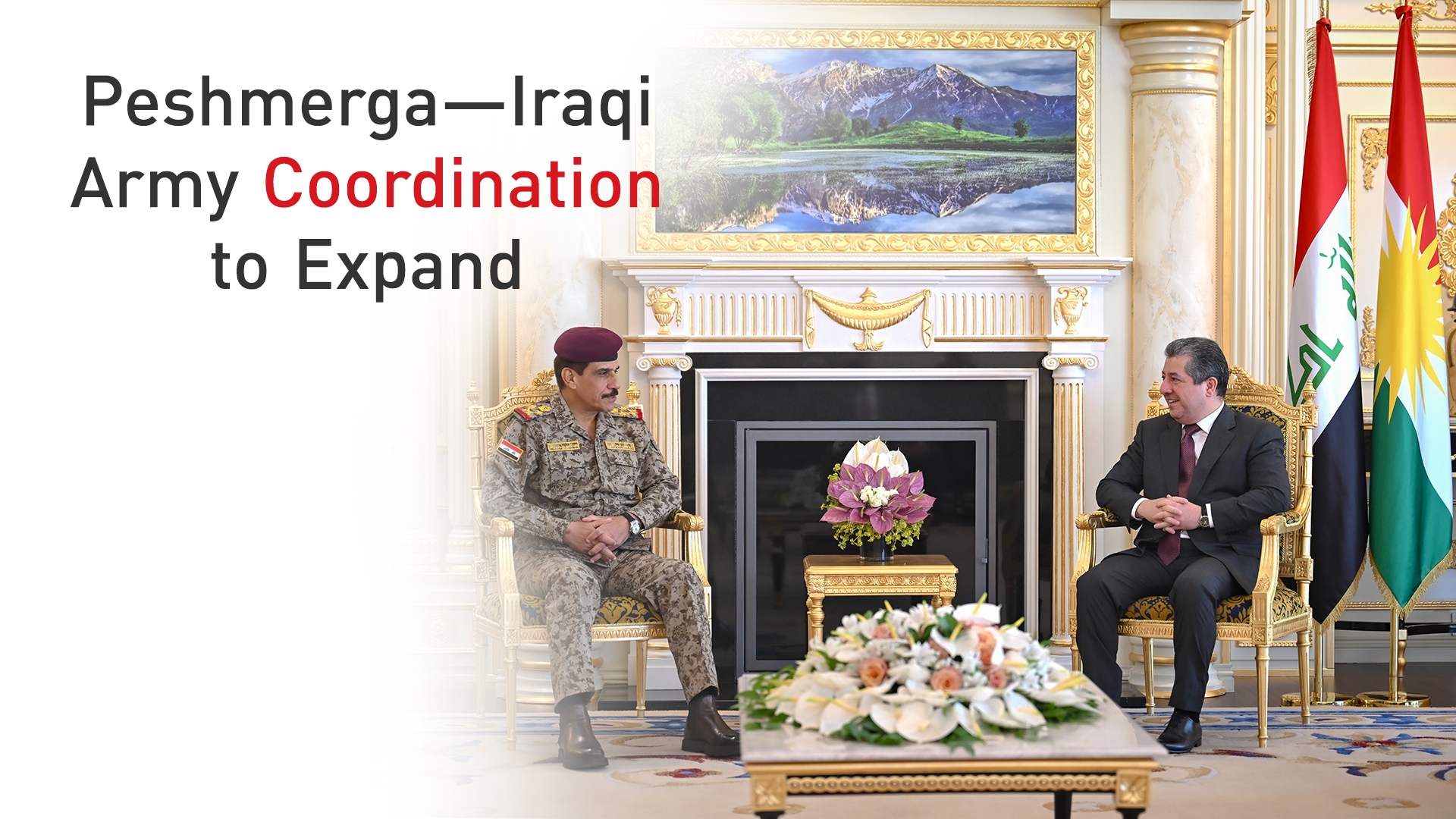
ERBIL (Kurdistan24) - Kurdistan Regional Government Prime Minister Masrour Barzani has called for a significant expansion of military coordination between Kurdish Peshmerga forces and the Iraqi Army, framing joint security operations as a strategic necessity to confront escalating regional threats and protect the nation's vital energy infrastructure.
The urgent call for closer military alignment came on Sunday during a high-level meeting in Erbil between Prime Minister Barzani and a federal military delegation led by Lieutenant General Abdul Amir Rashid Yarallah, Chief of Staff of the Iraqi Army.
According to an official statement released by the Kurdistan Regional Government (KRG), Prime Minister Barzani emphasized the “paramount importance of strengthening coordination and cooperation between the Peshmerga and the Iraqi Army to effectively confront ongoing security and military threats.”
The meeting underscores a critical moment in Erbil-Baghdad relations, prioritizing unified defense strategies over historic administrative divisions.
The KRG statement noted that Gen. Yarallah’s visit was conducted under the direct instruction of Iraqi Prime Minister Ali al-Zaidi, with a specific mandate to follow up on regional stability and to eliminate the persistent threats targeting international oil companies and energy infrastructure in the Kurdistan Region.
Read More: Iraq Army Chief Visits Erbil to Discuss Kurdistan Oil Field Security
Prime Minister Barzani expressed his appreciation for the federal government’s commitment to securing the region.
According to the KRG statement, Prime Minister Barzani lauded the federal Prime Minister’s follow-up efforts to ensure tranquility, pledging Erbil’s full cooperation in dismantling the networks responsible for the recent attacks on the energy sector.
The high-level military consultation in Erbil is driven by a period of intense anxiety within Iraq’s broader energy landscape.
As reported by Kurdistan24 previously, a sophisticated campaign of drone and missile strikes has repeatedly targeted oil and gas facilities across the Kurdistan Region in recent months, notably accelerating during the conflict between the United States and Iran that erupted in late February.
These aerial bombardments have forced periodic suspensions of extraction and export activities, severely eroding the confidence of foreign investors and threatening the economic stability of both the Kurdistan Region and the broader Iraqi state.
The deployment of Iraq’s highest-ranking military officer to Erbil appears to be a direct response to mounting pressure from the private sector.
According to Kurdistan24 findings, recent consultations between the KRG and representatives of international oil companies (IOCs) culminated in formal requests directed at Prime Minister al-Zaidi to provide firm and actionable security guarantees.
For multinational operators, restoring production and expanding export volumes are now entirely contingent upon a robust defense umbrella that relies on seamless federal and regional coordination.
Gen. Yarallah’s presence in Erbil highlights a growing recognition in Baghdad that safeguarding these sprawling, vulnerable facilities requires resources that transcend traditional operational boundaries.
Deterring non-state actors equipped with advanced weaponry will demand sophisticated air defense networks, comprehensive intelligence-sharing mechanisms, and joint deployments involving both federal forces and the Peshmerga.
The economic implications of prolonged disruption are severe for both capitals. The Kurdistan Region’s oil output remains a vital component of Iraq’s overall energy portfolio.
Extended shutdowns not only deprive the KRG of the essential revenues required to fund public services, but they also broadcast a signal of instability to global energy markets already rattled by wider Middle Eastern conflicts.
By pushing to solidify a joint security architecture, Prime Minister Barzani and the federal military leadership are attempting to close existing security gaps and establish a unified defensive posture.
This tactical alignment demonstrates a shared determination to prevent armed factions from exploiting political divisions, ultimately signaling to the international community that Iraq remains a secure and viable environment for long-term foreign direct investment.
|
Summary KRG Prime Minister Masrour Barzani called for strengthened coordination between the Peshmerga and the Iraqi Army during a meeting with Iraq’s Army Chief in Erbil. The high-level talks focused on securing vulnerable oil infrastructure, protecting foreign investments, and deepening cooperation. |