NATO Chief Welcomes US-Iran Deal, Says Hormuz Reopening a ‘Massive Step Forward’
Rutte dismisses concerns over U.S. force reductions in Europe, says allies are prepared to assume greater conventional defense responsibilities ahead of NATO summit
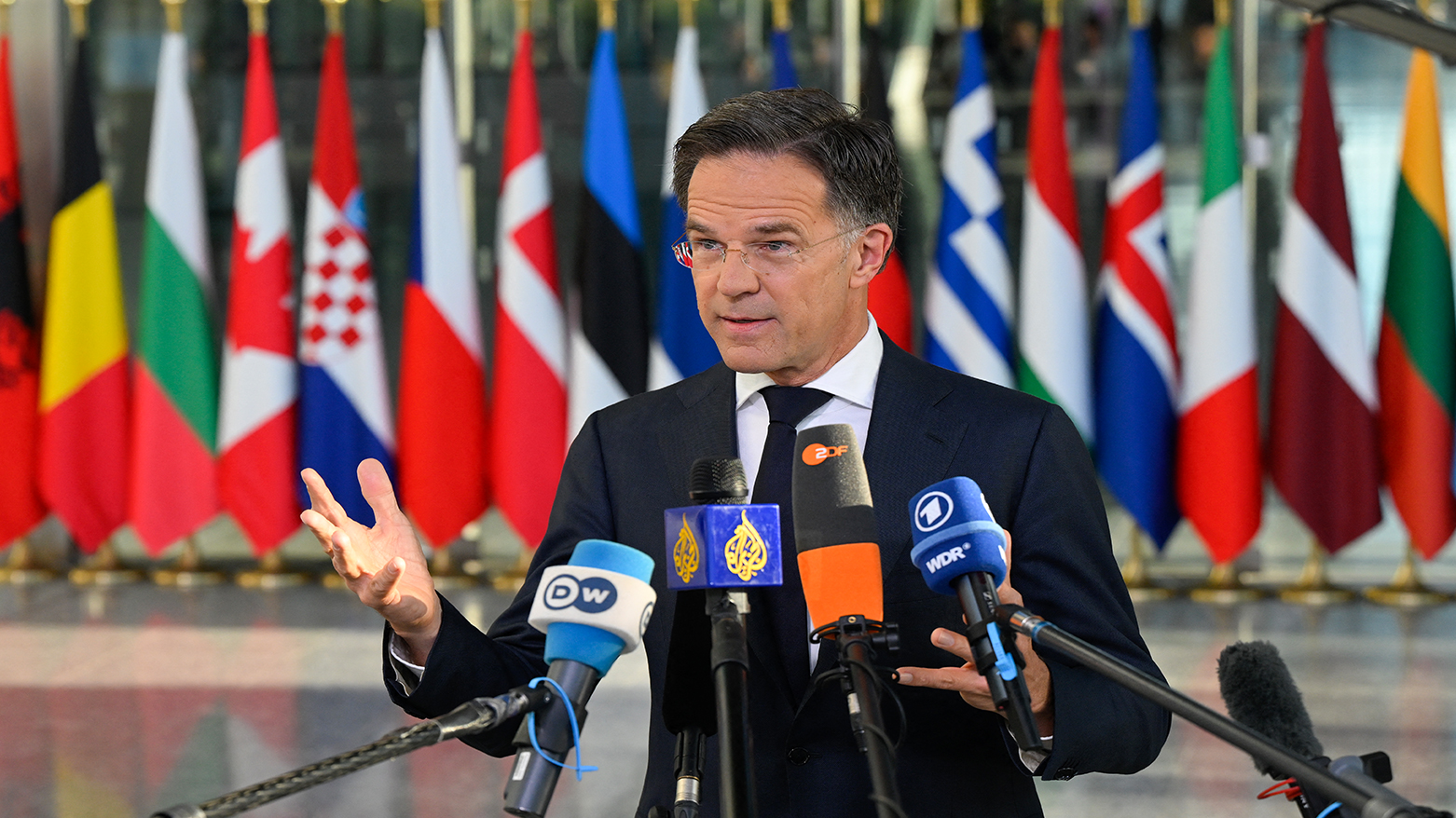
ERBIL (Kurdistan24) — NATO Secretary General Mark Rutte on Wednesday welcomed the agreement reached between the United States and Iran to end the recent Middle East war, describing the planned restoration of free navigation through the strategically vital Strait of Hormuz as a major breakthrough for global security and trade.
Speaking at a press conference in Brussels ahead of a meeting of NATO defense ministers, Rutte said the reopening of the waterway would mark “a massive step forward” and noted that several NATO allies were prepared to contribute to efforts aimed at safeguarding maritime security in the region.
“The restoration of free passage through the Strait of Hormuz will be a massive step forward, and I know that many allies, through the initiative led by France and the United Kingdom, are ready to support,” Rutte said.
The NATO chief also praised the accord brokered by U.S. President Donald Trump, saying it created an opportunity to ensure that Iran does not obtain a nuclear weapon while helping to stabilize a region shaken by weeks of conflict.
“The deal President Trump struck has created an opportunity to ensure Iran never obtains a nuclear weapon,” Rutte said.
His remarks came as NATO seeks to maintain unity ahead of a leaders’ summit in Ankara next month, where European allies hope to demonstrate progress toward increasing defense spending and strengthening their military capabilities.
Rutte used the occasion to address growing concerns over Washington’s decision to reduce some of the military assets it makes available to NATO commanders. He rejected suggestions that the move signaled a weakening of the United States’ commitment to European security.
“In some cases, this has been cast as a problem—as the U.S. pulling away from its allies. But that is not the reality,” he said.
According to Rutte, the changes reflect a broader effort to encourage European allies to assume greater responsibility for their own conventional defense while allowing the United States to balance commitments in other regions.
“The U.S. has adjusted its pledges to the NATO Force Model,” he said, emphasizing that the changes concern the allocation of forces under NATO contingency plans rather than the immediate deployment of troops and equipment in Europe.
Recent reports by U.S. and German media indicated that Washington plans to reduce a portion of the approximately 150 U.S. F-16 and F-15 fighter aircraft assigned to NATO missions, along with certain refueling and reconnaissance aircraft, bombers, drones, and naval assets. The reports also suggested that a cruise missile-capable submarine and one of two aircraft carrier strike groups designated for NATO operations would be withdrawn from alliance force commitments.
The reductions have prompted concerns among some European officials that the continent could become more vulnerable to potential threats from Russia, particularly amid ongoing uncertainty over long-term U.S. defense priorities.
However, several European diplomats have argued that NATO’s European members are increasingly capable of replacing the capabilities being reduced by Washington, provided they are given sufficient time to expand their defense capacities.
“Historically, this was overly reliant on the U.S. Now the U.S. has adjusted its pledged contributions—and other allies have stepped up to contribute more,” Rutte said.
He also stressed that the United States had reaffirmed its commitment to NATO’s nuclear deterrence posture.
“The U.S. nuclear deterrent is solid,” Rutte said. “It is crucial that Europe and Canada do more on the conventional front, understanding that the U.S. has obligations around the globe that it needs to account for.”
The NATO summit in Ankara is expected to focus heavily on burden-sharing and defense spending commitments, issues that have been central to Trump’s approach toward the alliance.
European officials had expressed concern that the recent conflict involving Iran could overshadow the gathering and deepen transatlantic disagreements.
With the U.S.-Iran agreement now paving the way for a ceasefire and the reopening of the Strait of Hormuz, diplomats hope the focus can shift back to alliance priorities, including strengthening NATO’s deterrence posture and demonstrating greater European responsibility for collective defense.
The Strait of Hormuz, through which a significant share of the world's oil and liquefied natural gas shipments pass, is widely regarded as one of the most strategically important maritime chokepoints.
Its closure during the conflict raised fears of disruptions to global energy supplies and renewed volatility in international markets. The agreement's provisions for restoring free navigation are therefore seen by NATO allies as a critical step toward regional stability and economic security.