Lebanon Vows to Extend State Authority to Israeli Border Under U.S.-Backed Deal
President Joseph Aoun tells CENTCOM chief Beirut will assert sovereignty nationwide as Hezbollah rejects disarmament agreement
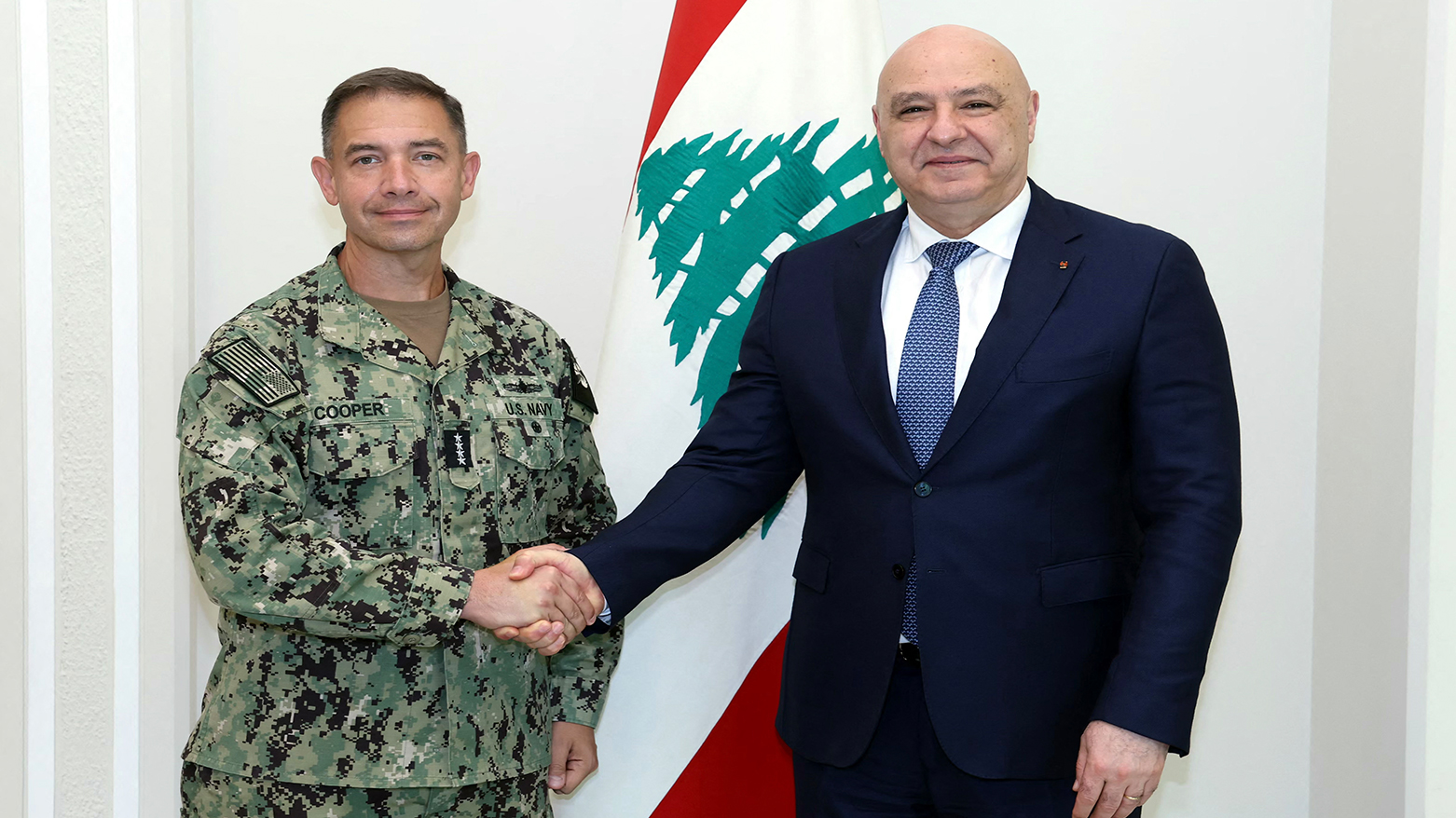
ERBIL (Kurdistan24) — Lebanese President Joseph Aoun on Monday reaffirmed his government's commitment to extending state authority across the entire country, telling the commander of U.S. Central Command that the Lebanese army would deploy to the Israeli border as part of a U.S.-brokered agreement aimed at ending hostilities with Israel.
Aoun made the remarks during a meeting in Beirut with Adm. Brad Cooper, commander of U.S. Central Command (CENTCOM), where the two discussed the framework agreement reached last week between Lebanon and Israel with U.S. mediation.
According to the Lebanese presidency, Aoun stressed that Lebanon intends to "assert its sovereignty over all its territory," with the Lebanese Armed Forces assuming responsibility for security up to the southern border with Israel.
Cooper also met Lebanese Army Commander Gen. Rodolphe Haykal to discuss the latest developments in Lebanon and the wider region, as well as the implementation of the agreement's security provisions.
In a statement, the Lebanese army said Haykal and Cooper emphasized the importance of successfully carrying out the security annex of the framework agreement while exploring ways to strengthen future military cooperation.
CENTCOM said in a post on X that Cooper, Aoun and Haykal discussed "the path forward" for implementing the agreement. The U.S. commander also visited Israel as part of his regional trip.
Under the U.S.-brokered framework, Lebanon has committed to restoring full state sovereignty by ensuring the verified disarmament of non-state armed groups and dismantling their military infrastructure. The agreement envisions a gradual withdrawal of Israeli forces from southern Lebanon as these steps are verified.
The U.S. State Department said the details of the process would be outlined in a separate security annex prepared with Washington's support, although the document has not yet been made public.
To support implementation, U.S. Secretary of State Marco Rubio announced on Friday that Washington would reimburse the Lebanese army with $30 million to enhance its operational capabilities. The United States has long been the principal international backer of Lebanon's armed forces.
The agreement places primary responsibility for disarming Hezbollah on the Lebanese army. Israeli officials have said their forces will continue occupying parts of southern Lebanon until the group's military capabilities have been dismantled.
Hezbollah, however, has firmly rejected the deal. Secretary-General Naim Qassem declared the agreement "null and void," arguing that Lebanon should instead adhere to the U.S.-Iran memorandum of understanding that helped halt the broader regional conflict and which Tehran insisted should also cover Lebanon.
The Iran-backed group has warned that any attempt to impose the agreement by force could trigger internal conflict. On Monday, Hezbollah said it reserved the right to defend itself following what it described as multiple Israeli attacks in southern Lebanon the previous day, accusing Israel of committing a "blatant violation of the ceasefire."
The latest diplomatic efforts follow months of conflict that began when Hezbollah launched rocket attacks into northern Israel in March in support of Iran during the wider Middle East war. Israel responded with extensive airstrikes and a ground offensive inside Lebanon.
Although the U.S.-Iran memorandum of understanding brought about a temporary lull in fighting, Washington later pursued separate negotiations between Israel and Lebanon aimed at addressing bilateral security concerns independently of the broader Iran agreement.
Israeli troops remain deployed in a self-declared security zone extending roughly 10 kilometers (six miles) inside Lebanese territory along the border. Lebanese authorities say Israeli military operations since the outbreak of the war on March 2 have killed more than 4,200 people.