Oil Prices Extend Rally as U.S.-Iran Conflict Escalates, Global Markets Brace for Economic Impact
Brent crude tops $85 as renewed fighting around the Strait of Hormuz fuels supply concerns and weighs on investor sentiment
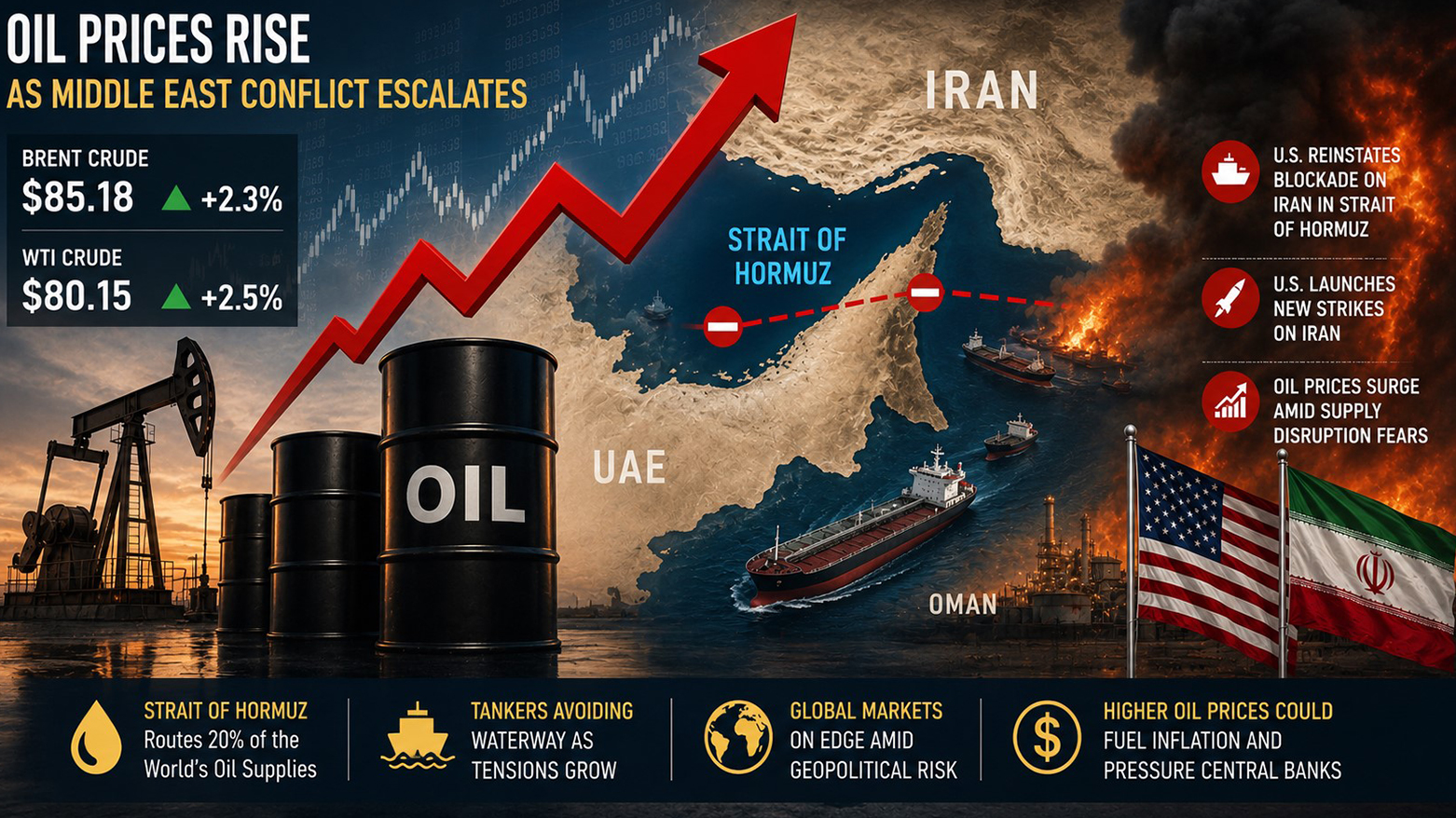
ERBIL (Kurdistan24) — Global oil prices extended their sharp gains on Tuesday as renewed military clashes between the United States and Iran heightened fears of supply disruptions through the Strait of Hormuz, while Asian stock markets delivered a mixed performance amid growing uncertainty over the global economic outlook.
Brent crude, the international benchmark, climbed more than 2.3% to $85.18 per barrel, building on Monday's nearly 10% surge. U.S. benchmark West Texas Intermediate (WTI) crude rose 2.5% to $80.15 per barrel.
Although oil remains below its wartime peak of nearly $120 per barrel, investors are increasingly concerned about the security of global energy supplies as Washington and Tehran each claim authority over the Strait of Hormuz, one of the world's most important shipping lanes for crude exports.
The latest rise in oil prices followed another round of U.S. military strikes against Iranian targets after President Donald Trump announced that Washington would reinstate a blockade on Iranian ports and impose new measures aimed at securing the strategic waterway.
The renewed conflict has disrupted commercial shipping, with oil tankers increasingly avoiding the Strait of Hormuz due to escalating military threats. The reduced flow of crude through the Persian Gulf has added upward pressure on global fuel prices.
Asian markets mixed
Asian equity markets recovered from early losses, although investor sentiment remained cautious as geopolitical tensions and rising energy costs continued to dominate trading.
Japan's Nikkei 225 advanced 0.7% to 67,743.50, supported by gains in technology shares.
SoftBank Group rose 2.3% after Chairman Masayoshi Son rejected suggestions that the rapid expansion of artificial intelligence investment represented a financial bubble during a company event in Tokyo.
South Korea's Kospi gained 0.7% to 6,856.83, while China's Shanghai Composite Index climbed 1.1% to 3,958.54.
Chinese markets received an additional boost after official data showed exports surged 27% year-on-year in June, driven largely by strong international demand for semiconductors and other artificial intelligence-related technologies.
Investors are now awaiting China's quarterly economic growth figures, scheduled for release on Wednesday.
Elsewhere, Hong Kong's Hang Seng Index rose 0.3% to 24,301.71, while Australia's S&P/ASX 200 slipped marginally, edging down less than 0.1% to 8,804.70.
Wall Street retreats as AI stocks decline
U.S. markets closed lower Monday as investors reassessed the high valuations of major technology companies while monitoring developments in the Middle East.
The S&P 500 fell 0.8%, the Dow Jones Industrial Average declined 0.3%, and the Nasdaq Composite dropped 1.6%.
Technology stocks led the declines.
Micron Technology lost 4.4%, trimming gains after its remarkable 243.1% rally earlier this year.
Nvidia, the world's most valuable publicly traded company, fell 3.5%, making it the largest single drag on the S&P 500 as investors questioned whether booming artificial intelligence investments will ultimately generate the profits needed to justify current valuations.
Analysts have increasingly warned that enthusiasm surrounding AI-related stocks may have driven share prices beyond sustainable levels if expected productivity gains fail to materialize.
Investors await earnings season
Attention is now shifting to the U.S. corporate earnings season, with several of the country's largest financial institutions—including Bank of America, Citigroup, JPMorgan Chase, Goldman Sachs, and Wells Fargo—scheduled to release quarterly results on Tuesday.
According to FactSet, analysts expect S&P 500 companies to report overall earnings growth of 23.6% for the quarter, compared with the same period last year, marking a second consecutive quarter of profit growth exceeding 20% if forecasts are met.
Strong earnings are widely seen as necessary to support equity markets, which remain near record highs despite recent volatility driven by concerns over artificial intelligence valuations and geopolitical risks.
Inflation concerns return
Economists also warn that sustained increases in oil prices could reignite inflationary pressures worldwide, potentially prompting the U.S. Federal Reserve and other major central banks to maintain higher interest rates for longer.
While elevated interest rates can help contain inflation, they also tend to slow economic growth, increase borrowing costs, and weigh on financial markets.
In currency trading early Tuesday, the U.S. dollar eased slightly to 162.35 Japanese yen from 162.46 yen, while the euro strengthened modestly to $1.1387 from $1.1382.