Trump Says U.S. Hitting Iran 'Very Hard' to Honor Fallen American Troops
The U.S. President Donald Trump says renewed U.S. strikes honor fallen service members as the Iran conflict escalates, with mounting casualties and growing regional instability.
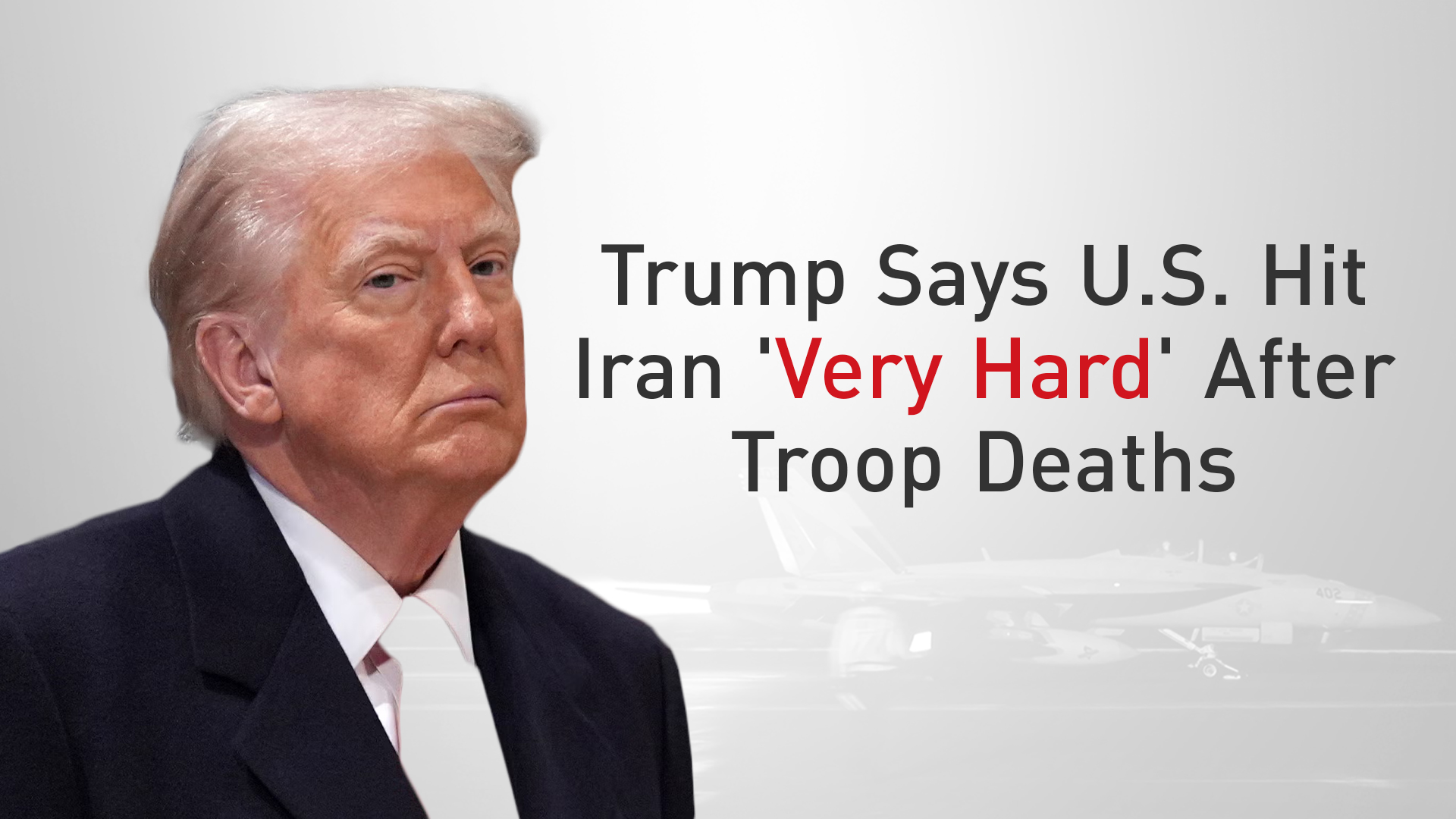
ERBIL (Kurdistan24) - President Donald Trump said the United States launched another round of military strikes against Iran to honor American service members killed in recent days, linking the latest operations to both the human cost of the conflict and Washington's stated objective of preventing Tehran from acquiring a nuclear weapon.
Speaking to reporters after returning to Washington from the World Cup final, Trump said U.S. forces had struck Iranian targets "very hard" once again, describing the operation as a tribute to what he called "probably three great patriots."
He also expressed sympathy for the families of those killed, adding that the fallen troops had been serving in a mission intended to ensure that "Iran cannot have a nuclear weapon," according to Agence France-Presse (AFP).
His remarks came at a moment when the military confrontation between Washington and Tehran is entering a more volatile stage.
The latest exchanges reflect a widening conflict in which additional American fatalities have been followed by expanded U.S. military operations, while Iran has broadened its retaliation by targeting Gulf states allied with Washington.
According to Associated Press reporting, the renewed cycle of attacks is pushing both sides farther from diplomacy, increasing pressure on regional security, disrupting maritime traffic through the Strait of Hormuz and contributing to renewed volatility in global energy markets.
Trump's comments therefore served not only as a response to recent battlefield losses but also as a public explanation for why the administration intends to sustain military pressure despite mounting risks.
The latest U.S. strikes marked the ninth consecutive night of military operations against targets inside Iran.
According to the U.S. military, the campaign has focused on command facilities, missile and drone launch sites, air defense systems, maritime capabilities and communications infrastructure, reflecting an effort to degrade Iran's ability to conduct further attacks.
The renewed offensive followed confirmation of another American military death connected to the conflict.
According to U.S. Central Command (CENTCOM), a U.S. service member was killed on July 18 in the Kurdistan Region while conducting the controlled detonation of unexploded ordnance recovered from a downed Iranian one-way attack drone.
A second service member sustained a minor injury during the same operation and continues to receive medical treatment.
Read More: CENTCOM Mourns Fallen Troops in Kurdistan Region and Jordan
CENTCOM said it is withholding the identities of both personnel while family notification procedures continue.
The announcement followed an earlier CENTCOM update confirming that two American service members were killed in Jordan after an Iranian attack on July 17.
The command also said a search operation later recovered unidentified remains at the scene that are undergoing examination, while additional information remains withheld pending verification and notification procedures.
Together, the incidents underscore the increasingly complex nature of a conflict in which casualties are occurring not only during direct combat but also through hazardous recovery operations, missile attacks and drone warfare across multiple countries.
According to the Associated Press, the latest fatality raises the number of U.S. service members killed since the conflict began on Feb. 28 to 17.
The cumulative losses illustrate how a war fought largely through missiles, drones, aircraft and regional deployments continues to carry lethal consequences for American personnel stationed across the Middle East.
Fatal incidents have occurred in Kuwait, Saudi Arabia, Iraq, Jordan, the Arabian Sea and, most recently, the Kurdistan Region, reflecting the increasingly broad geographic footprint of the conflict.
At the same time, the battlefield has continued to expand beyond direct exchanges between Washington and Tehran.
According to the Associated Press, Iran responded to the latest U.S. strikes by launching attacks targeting Bahrain, home to the U.S. Navy's Fifth Fleet, as well as Kuwait.
Iranian state media also reported explosions inside Iran following the latest American operations, while separate maritime incidents were reported in and around the Strait of Hormuz, one of the world's most strategically important energy corridors.
The disruption of shipping through the waterway has added another dimension to the conflict, with implications extending beyond military planning to global trade and energy supplies.
Despite the continuing escalation, senior U.S. officials have maintained that diplomacy remains possible under the right conditions.
Secretary of State Marco Rubio said Washington remains prepared to negotiate with Tehran if meaningful talks become possible, while acknowledging that current circumstances offer little indication of an immediate diplomatic breakthrough, according to the Associated Press.
For now, however, military operations continue to define the relationship between the two countries.
Trump's latest remarks encapsulate that reality. By presenting renewed strikes as both a strategic necessity and a tribute to fallen service members, the president tied the administration's military campaign to its broader security objectives while acknowledging the growing human cost borne by U.S. forces.
As casualties continue to rise and the conflict stretches across an expanding regional battlefield, prospects for de-escalation remain uncertain.
With American troops operating across multiple fronts, Iranian retaliatory attacks extending beyond Iraq, and critical maritime routes increasingly affected, the confrontation has evolved into a broader regional crisis whose consequences now reach well beyond the immediate military exchanges between Washington and Tehran.
|
Summary President Donald Trump said renewed U.S. strikes on Iran were carried out to honor fallen American service members as the conflict entered a more dangerous phase. Mounting casualties, including a death in the Kurdistan Region, underscore the widening regional impact of the war. |