LoGerfo Tells Kurdistan24 Peshmerga Remain Key Partners in Counterterrorism Fight
Responding to Kurdistan24, Ambassador Gregory LoGerfo details the indispensable role of the Peshmerga in the ongoing fight against extremism, while outlining the United States' robust approach to countering digital recruitment, political violence, and terror financing.
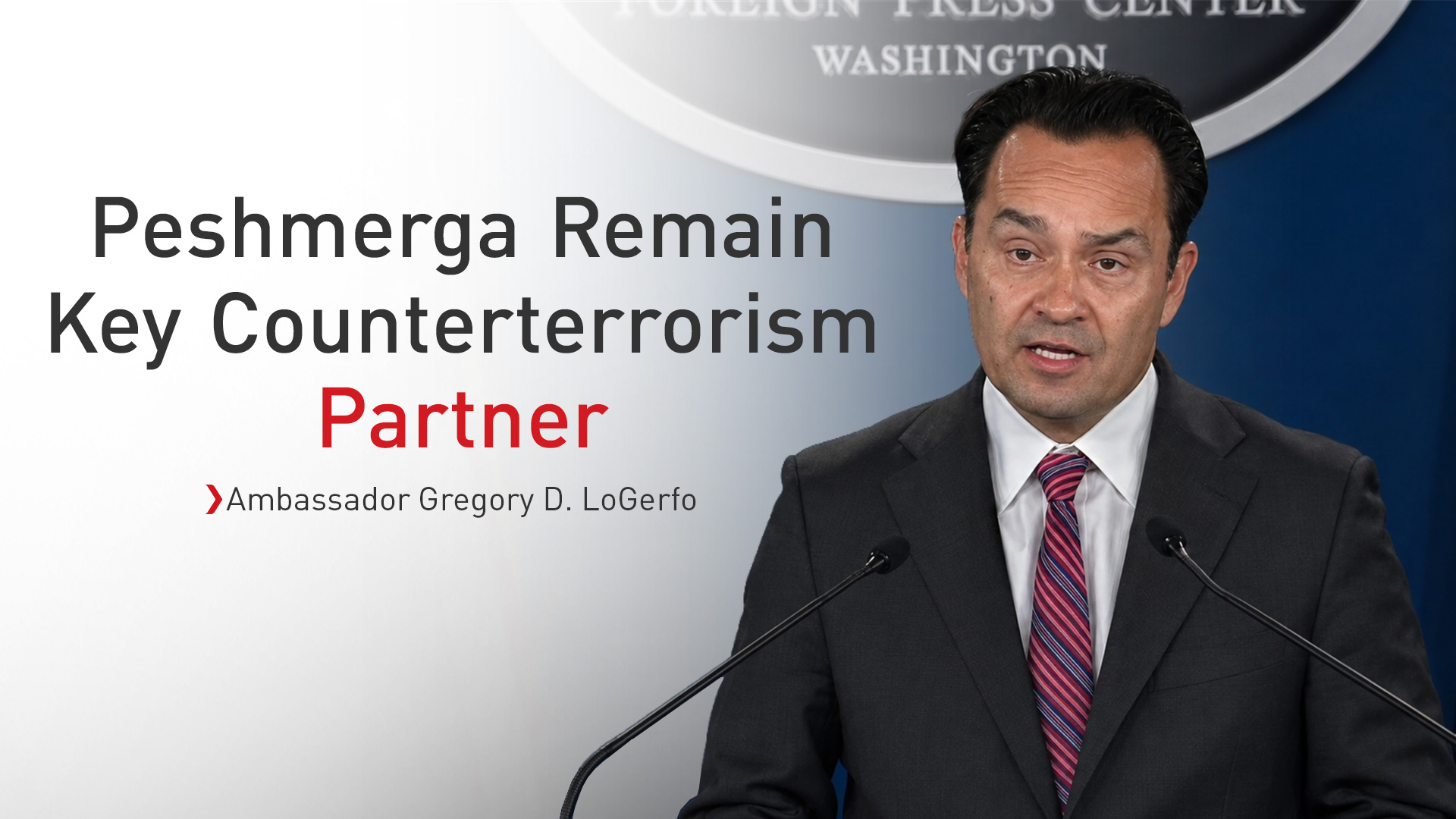
ERBIL (Kurdistan24) - Responding to Kurdistan24 Washington Bureau Chief Rahim Rashidi during a briefing at the Foreign Press Center on Monday, the United States' senior counterterrorism official offered a clear-eyed view of long-standing security cooperation in the Middle East and the necessity of sustained effort against evolving threats.
Gregory D. LoGerfo, Coordinator and Ambassador-at-Large for Counterterrorism, spoke directly about the Peshmerga's contributions. Having served twice in Iraq, in 2010 and again in 2021 as Deputy Chief of Mission, he met Kurdish security leaders, Peshmerga, traveled to Erbil, and observed operations firsthand.
"They're a great partner," he said. "We've relied on them and also I would just say the Peshmerga have sacrificed quite a bit in our shared terrorist objectives."
LoGerfo's direct remarks anchored a comprehensive discussion on the evolving architecture of global security.
As violent extremist organizations adapt to the loss of physical territory, they are increasingly exploiting digital platforms, artificial intelligence, and sophisticated financial networks to rebuild their ranks and project influence across international borders.
Against this rapidly shifting backdrop, the ambassador articulated a strategic vision that demands relentless vigilance in the Middle East while simultaneously confronting the growing specter of politically motivated violence and digital radicalization.
Throughout the exchange, the ambassador underscored that the enduring security of the region, and the prevention of an extremist resurgence in Iraq and Syria, remains inextricably linked to the sacrifices and continued operational readiness of the Peshmerga forces.
Forged in the Levant: A Partnership Built on Sacrifice
For Ambassador LoGerfo, the strategic alliance between the United States and the Kurdistan Region is far more than an abstract policy talking point; it is grounded in extensive personal experience in the field.
Having observed the regional security architecture during pivotal periods over the past decade and a half, LoGerfo possesses a deep, institutional understanding of the complex dynamics defining the Middle East.
His familiarization with the terrain, from the command posts in Erbil to the forward lines of the anti-ISIS campaign, informs his assessment of today's counterterrorism requirements.
When asked by Kurdistan24 to evaluate the role of the Peshmerga in neutralizing the physical and ideological footprint of extremism in Iraq and Syria, his recognition of their operational importance was immediate and absolute.
That shared objective, the eradication of a ruthless insurgency that once threatened to destabilize the entire region, required an unprecedented level of tactical and strategic coordination.
The territorial defeat of the Islamic State's self-proclaimed caliphate in the Levant stands as a landmark military achievement of recent history, but LoGerfo was careful to frame this success not as a final victory, but as a critical phase requiring continued vigilance.
"This is where we, with a sustained effort with our partners on the ground... and also from around the world, defeated the territorial caliphate of ISIS," LoGerfo explained.
However, he quickly cautioned against any inclination toward momentum loss or complacency. "That was a tremendous accomplishment, but there's always more to be done, and there's more vigilance that we need to maintain."
The ambassador's observations reflect a firm consensus within U.S. diplomatic and defense establishments: while the territorial sanctuary of the caliphate has been dismantled, the residual networks and underlying conditions that permitted extremism to spread demand constant pressure.
In this delicate security ecosystem, the counterterrorism infrastructure of Iraq, Syria, and specifically the Kurdistan Region functions as an indispensable frontline shield against a potential insurgent resurgence.
Confronting the Menace of Political Terrorism
Beyond the physical battlefields of the Middle East, the United States is concurrently navigating a diversified global threat matrix marked by the resurgence of political terrorism. Extremist violence is increasingly manifesting as organized, targeted efforts to intimidate civic institutions and subvert democratic processes worldwide.
During the Foreign Press Center briefing, LoGerfo explicitly connected the core pillars of American counterterrorism strategy to the protection of democratic norms.
Whether threats originate from transnational organized criminal cartels, persistent jihadist cells, or radical domestic fringes, the core intent frequently converges on coercion through fear and violence.
"With respect to political terrorism, any act that is done to intimidate, any act that is done to deter people from participating in the democratic process or in the processes in their country is something that we would stand against," LoGerfo emphasized in his response to Kurdistan24.
This clear-cut framing illustrates a holistically updated approach by the State Department's Bureau of Counterterrorism, broadening its operational focus to address actors who resort to violence to manipulate political outcomes or suppress citizen participation.
The ambassador's remarks signal that the essential tools of counterterrorism, disrupting violent plots before execution, dismantling financial pipelines, and ensuring public safety, must be applied forcefully to counter any group seeking to subvert democratic stability through terror.
The Digital Battlefront: AI, Propaganda, and Terror Financing
While regional stability in the Levant remains a paramount focus, a borderless battlefront has expanded across cyberspace.
Extremist organizations, state-backed proxies, and radical networks are increasingly leveraging digital technologies to circumvent traditional law enforcement barriers. From utilizing artificial intelligence to craft sophisticated propaganda to deploying encrypted messaging platforms for fundraising and recruitment, the online realm represents an urgent operational priority.
Kurdistan24 pressed the counterterrorism coordinator on the expanding presence of hostile threat actors in digital spaces, specifically pointing to instances where individuals residing in Western societies publicly utilize online platforms to propagate anti-American sentiment, disseminate radical propaganda, or openly express affinity for designated terrorist entities.
In response, LoGerfo emphasized a zero-tolerance legal standard, making clear that digital mediums provide no safe harbor for illegal acts or material support to terrorism.
"If someone is acting in any forum, committing a crime, terrorist financing, anything that's against US laws, whatever forum they're in, if they're breaking the law, they're breaking the law," LoGerfo stated firmly.
The ambassador reassured that federal authorities maintain active mechanisms to investigate and prosecute those who cross the boundary from protected speech into actionable criminal conspiracy, illegal financing, or material support for terror entities.
He highlighted the vital role of international intelligence sharing and legal alignment in dismantling covert online financial networks.
"When people threaten the United States, whatever the mode of communication is, if it's terror financing, if it's conspiring for acts of terrorism or anything that would hurt the United States, we'll take action on that," he added, delivering a stern warning to individuals attempting to exploit online platforms to facilitate real-world violence.
The Washington Ministerial
The ambassador's remarks to Kurdistan24 at the Foreign Press Center provided crucial contextual detail regarding the broader strategic framework currently guiding Washington's national security apparatus.
The briefing followed the Ministerial on the Resurgence of Political Terrorism, an international summit hosted at the State Department by Secretary of State Marco Rubio.
Read More: Rubio Opens 60-Nation Ministerial on Resurgence of Political Terrorism
The summit convened delegations from 66 nations, including cabinet ministers, intelligence chiefs, and law enforcement practitioners, to confront a complex and shifting international security terrain.
The administration has laid out a three-pillar counterterrorism strategy systematically targeting narco-terrorist organizations, persistent jihadist networks, and the violent activities of far-left extremist groups.
The ministerial reinforced that countering these interconnected threats demands an unprecedented level of international coordination.
Key outcomes from the summit focused on actionable mechanisms, including the alignment of international legal frameworks to ensure designated terrorists cannot easily cross borders or relocate operations.
By implementing stringent travel restrictions, enhancing real-time data sharing, and offering substantial monetary rewards through the Rewards for Justice program to disrupt terror finance networks, the U.S. and its partners are aggressively working to choke off the resources that fuel global violence.
Delegates also focused heavily on safeguarding critical infrastructure, particularly transportation and energy systems, from acts of ideological sabotage.
The shared conclusion among participating nations was unequivocal: violent extremism, regardless of its ideological backing, poses an unacceptable threat to international stability that requires a unified, proactive response.
An Enduring Alliance for Future Challenges
As the global counterterrorism landscape shifts toward high-tech radicalization, online finance, and transnational political violence, the fundamental principles of regional security remain constant.
Success ultimately depends on dedicated, capable partners operating on the ground.
Ambassador LoGerf'’s detailed remarks at the Foreign Press Center demonstrate that while the tactics and tools employed by terrorist organizations continue to evolve, the American commitment to its key security alliances remains resolute.
The territorial defeat of ISIS was achieved through severe trial and close tactical coordination, with forces like the Peshmerga bearing an enormous physical burden to secure shared victories.
Today, as extremist actors attempt to regroup online or exploit political instability, the lessons of the Middle Eastern campaign continue to shape U.S. strategy.
The vigilance advocated by Ambassador LoGerfo requires integrating advanced digital tracking, robust financial sanctions, and the firm backing of trusted regional partners.
In this ongoing effort to secure the Middle East and prevent the resurgence of political terrorism, the partnership between Washington and Erbil remains a cornerstone of regional peace, built upon shared values, mutual security interests, and the remembered sacrifices of the Peshmerga.
|
Summary Speaking exclusively to Kurdistan24's Rahim Rashidi, U.S. counterterrorism chief Gregory LoGerfo praised the Peshmerga's sacrifices. Amid rising online and transnational threats, LoGerfo outlined America's counterterrorism priorities while affirming the enduring U.S.-Kurdistan partnership. |