President Barzani Marks 43rd Anniversary of the Barzani Anfal With Call for Justice
President Masoud Barzani says the Barzani Anfal launched the Kurdish genocide and urges Iraq to provide reparations, recognition and accountability.
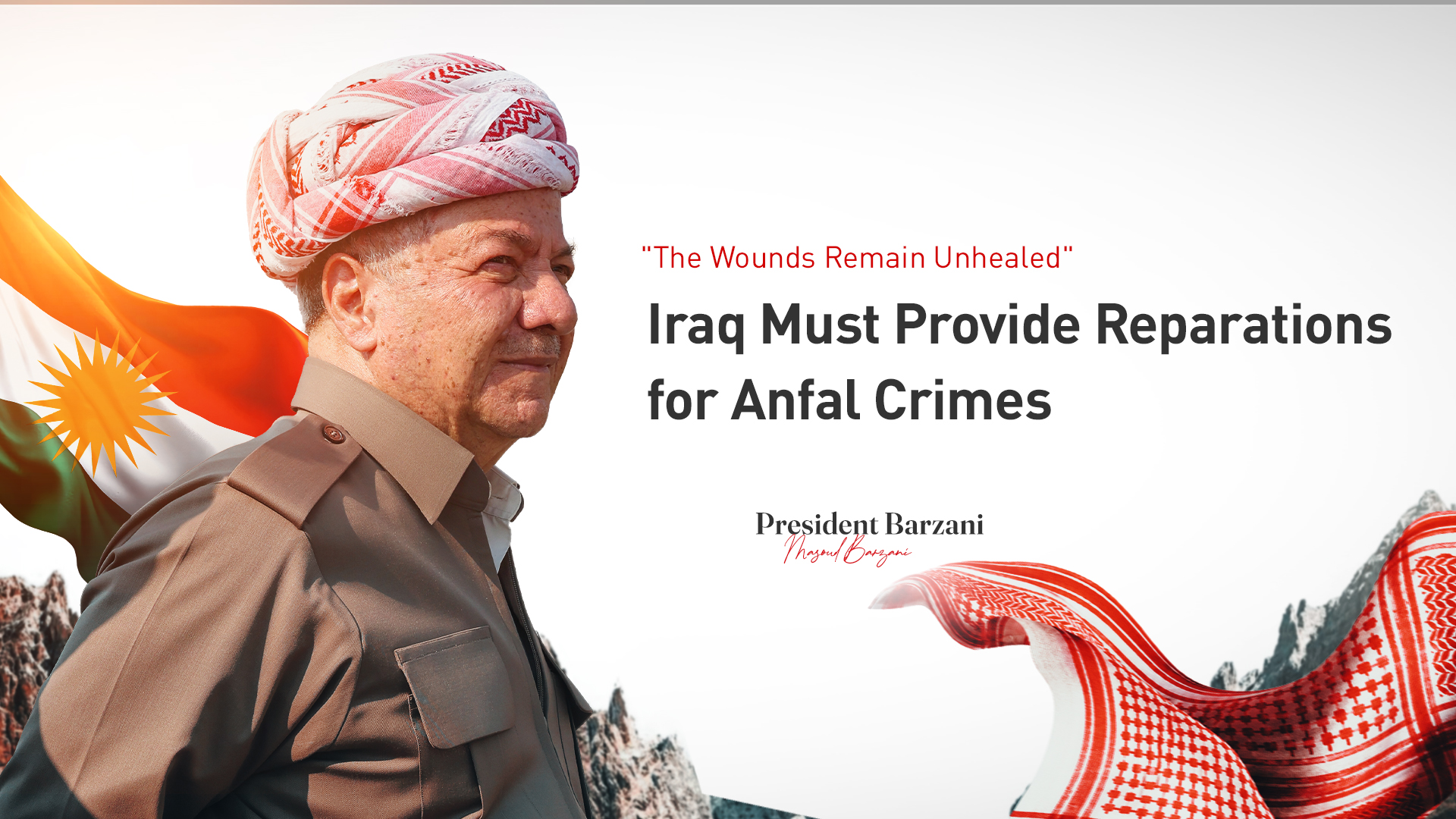
ERBIL (Kurdistan24) - On the 43rd anniversary of the Barzani Anfal campaign, President Masoud Barzani issued a message on Friday that was at once a memorial and an indictment: a remembrance of mass killing and a renewed demand that Iraq confront the legacy of one of the darkest crimes committed against the Kurdish people.
President Barzani described the 1983 campaign as the opening chapter of a systematic campaign of organized crimes against the Kurdish people.
He linked the Barzani Anfal to the forced disappearance of 12,000 Faili Kurdish youths, the Anfal campaigns in Garmian and Badinan, the chemical bombardment of Halabja and other parts of Kurdistan, Arabization policies, forced displacement, and dozens of other abuses that he said were intended to erase Kurdish identity and crush the Kurdish people's aspiration for freedom.
The message framed those crimes not as a closed chapter of history but as an unresolved moral and legal question that continues to shape Kurdish politics more than four decades later.
"The Barzani Anfal atrocity, launched on July 31, 1983, marked the beginning of a systematic chain of organized crimes."
President Barzani said those crimes were orchestrated by the former Iraqi regime "with the sole objective of erasing the Kurdish identity and breaking the freedom-seeking will of our people."
He said 8,000 Barzani men, from the elderly to the very young, were detained solely because of their Barzani and Kurdish identity. Under what he described as baseless pretexts, they were deported and massacred in the deserts of southern Iraq.
The statement underscored that the campaign was not an isolated act of repression, but part of a broader machinery of violence that sought to destroy Kurdish society through disappearances, forced displacement, fear, and mass execution.
President Barzani also argued that the consequences of those crimes remain unresolved more than four decades later.
"It is deeply distressing that, to this day, the wounds of these massacres and acts of genocide remain unhealed."
He reiterated that it remains "the moral and legal obligation of the Iraqi state to provide comprehensive material and moral reparations for all the crimes and injustices perpetrated against the people of Kurdistan over the past century."
That language placed the anniversary beyond remembrance, turning it into a renewed call for restitution, recognition, and accountability. It also reflected the long-standing Kurdish position that the legacy of Anfal cannot be considered settled without justice for victims and their families and a formal reckoning with the policies that enabled the atrocities.
President Barzani devoted a significant portion of his message to those who stood alongside the Barzanis during the campaign.
He thanked the people of the Erbil Plain, Harir, and Soran for what he described as their immense solidarity and the vital assistance they provided to Barzani families during one of the darkest periods in Kurdish history.
He also paid tribute to the resilience of the victims' families, particularly Barzani mothers and women, describing them as symbols of endurance whose courage helped preserve Kurdish society despite decades of loss.
"For decades, they endured the excruciating pain of separation and the loss of their loved ones, yet they never bowed down. Instead, they stood tall and reared thousands of proud, patriotic children for our nation."
The statement portrayed those women not only as witnesses to tragedy but as guardians of collective memory whose determination ensured that attempts to erase Kurdish identity ultimately failed.
Historical context gives the anniversary its enduring significance.
The Barzani campaign is widely regarded as the opening phase of the wider Anfal campaign that later devastated Kurdish regions across Iraq during the 1980s.
According to Kurdistan24's historical account, mass arrests began in July 1983 after earlier waves of forced relocation had displaced Barzani families from their ancestral homeland into collective settlements under strict government surveillance.
Read More: Anniversary of Barzani Anfal Marks First Chapter of Kurdish Genocide
The campaign unfolded in successive stages, with further arrests in August and October targeting those who had escaped the initial sweep.
Over time, official Iraqi records and subsequent investigations revealed the scale of the crime. More than 8,000 Barzanis were forcibly disappeared and killed. Documents from the former Iraqi regime described executions, fabricated accusations, and secret transfers of detainees.
Years later, mass graves were uncovered in Iraq's Busayyah Desert, and the remains of victims were gradually returned to the Kurdistan Region. Yet those recoveries could not restore the fathers, sons, brothers, and children who had been taken, nor repair the social fabric deliberately torn apart by the campaign.
The legal legacy remains equally incomplete.
In 2011, the Iraqi High Tribunal formally ruled that the crimes committed against the Barzanis constituted genocide, providing judicial recognition of the atrocity. However, as Kurdistan24's historical reporting notes, Iraq's federal parliament has yet to fully recognize the genocide, while comprehensive compensation for many victims' families remains unfinished.
That gap between judicial recognition and political accountability has kept the issue alive in Kurdish public life, where the Barzani Anfal is remembered not only as a historical tragedy but as an enduring test of Iraq's willingness to confront its past.
President Barzani's message returned to that question with renewed force.
By linking remembrance with legal responsibility, he argued that the anniversary should serve not only as a day of mourning but also as a reminder that justice remains unfinished.
He concluded by paying tribute to the victims whose memory continues to shape Kurdish national consciousness.
"On this somber occasion, we pay tribute to the pure souls of the Barzani victims, all the martyrs of the Anfal campaigns, and all those who laid down their lives on the path to Kurdistan's freedom."
More than four decades after the disappearance of thousands of Barzani men, President Barzani's message reaffirmed that preserving the memory of the genocide is inseparable from pursuing justice. His statement argued that the victims deserve more than annual commemoration—they deserve recognition, reparations, and a state willing to fully reckon with one of the darkest chapters in Iraq's modern history.
The full text of President Barzani's message:
The Barzani Anfal atrocity, launched on July 31, 1983, marked the beginning of a systematic chain of organized crimes. This campaign spanned from the forced disappearance of 12,000 Faili Kurdish youths to the brutal Anfal operations in Garmian and Badinan, the chemical bombardment of Halabja and other regions of Kurdistan, as well as Arabization, forced displacement, and dozens of other inhumane acts. These crimes were orchestrated by the former Iraqi regime with the sole objective of erasing the Kurdish identity and breaking the freedom-seeking will of our people. During the Barzani Anfal, the former Iraqi regime apprehended 8,000 Barzani men—ranging from the elderly to the very young—simply for their Barzani and Kurdish identity. Under baseless pretexts, they were deported and subsequently massacred in the deserts of southern Iraq.
It is deeply distressing that, to this day, the wounds of these massacres and acts of genocide remain unhealed. I reiterate that it is the moral and legal obligation of the Iraqi state to provide comprehensive material and moral reparations for all the crimes and injustices perpetrated against the people of Kurdistan over the past century.
On this 43rd anniversary of the Barzani Anfal, I extend my heartfelt gratitude to the people of the Erbil Plain, Harir, and Soran, who showed immense solidarity and provided vital assistance to the Barzanis during those moments of profound agony. I also wish to express my deepest respect for the unparalleled resilience of the families of the victims, particularly the courageous and steadfast Barzani mothers and women. For decades, they endured the excruciating pain of separation and the loss of their loved ones, yet they never bowed down. Instead, they stood tall and reared thousands of proud, patriotic children for our nation.
On this somber occasion, we pay tribute to the pure souls of the Barzani victims, all the martyrs of the Anfal campaigns, and all those who laid down their lives on the path to Kurdistan's freedom.
|
Summary President Masoud Barzani marked the 43rd anniversary of the Barzani Anfal with a call for justice, reparations and remembrance, saying the 1983 campaign began a broader genocide against Kurds and that Iraq still owes victims and families recognition. |