Mir Hazim Tahsin Beg: ISIS Could Not Erase Ezidis' 4,000-Year Heritage
Ezidi Mir calls for reconstruction, justice, and implementation of the Sinjar Agreement as the community marks 12 years since the genocide
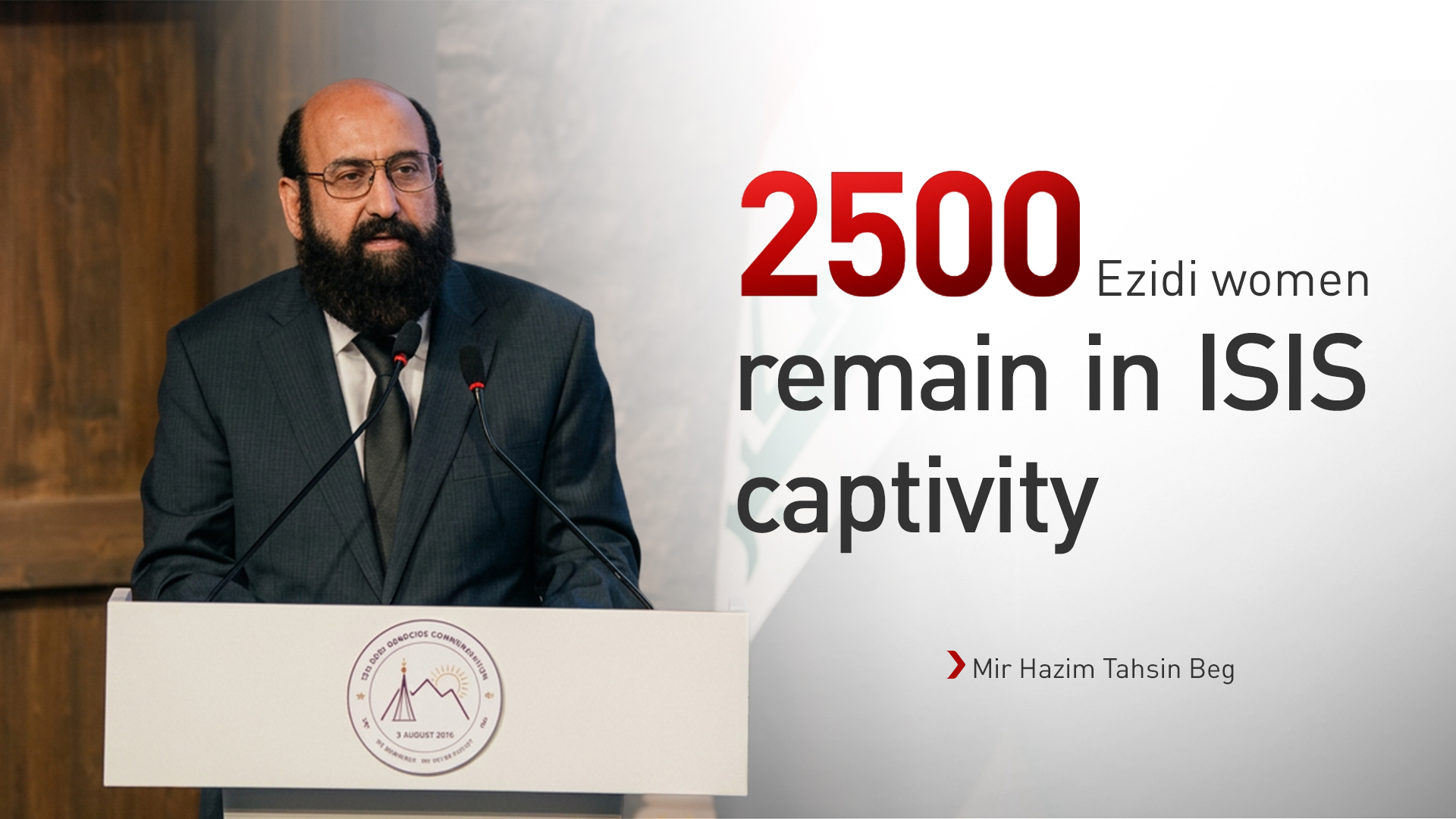
ERBIL (Kurdistan24) - Mir Hazim Tahsin Beg, the spiritual leader of the Ezidi (Yazidi or Yezidi) community, said Monday that ISIS failed in its attempt to destroy a civilization spanning four millennia, but warned that the survival of the Ezidi people must now be matched by meaningful political action to rebuild Sinjar, secure justice for survivors, and enable displaced families to return home.
Addressing the official ceremony marking the 12th anniversary of the Ezidi genocide, the Mir portrayed the anniversary as both a solemn act of remembrance and a call to confront the unresolved consequences of the 2014 ISIS assault.
While praising the resilience of the Ezidi community, he said many of the wounds inflicted during the genocide remain open as thousands continue to live in displacement, many victims remain missing, and key recovery initiatives have yet to be fully implemented.
"In the 21st century, ISIS sought to erase 4,000 years of Ezidi history in a single day," he said. "But by the will of God and the resilience of our people, those plans failed."
The anniversary, he argued, should serve not only to honor those who were killed but also to accelerate efforts to restore normal life in Sinjar, where reconstruction, governance, and security continue to lag more than a decade after ISIS was driven from the district.
The Mir outlined a series of priorities that he said require urgent action from Baghdad.
Among them were the full implementation of the Ezidi Survivors Law, activation of the Sinjar Reconstruction Fund, establishment of a legitimate local administration, continued efforts to rescue those still missing, and the effective implementation of the 2020 Sinjar Agreement.
He also urged closer coordination between the Kurdistan Regional Government and Iraq's federal authorities to resolve the longstanding political and administrative challenges facing Sinjar, describing stability in the district as an issue that extends beyond the Ezidi community and affects the wider Kurdistan Region and Iraq alike.
Twelve years after ISIS overran Sinjar, the anniversary remains more than a historical milestone.
Although the extremist group was militarily defeated years ago, its legacy continues to shape public policy through unresolved questions surrounding reconstruction, security, governance, accountability, and the return of displaced families.
For survivors, remembrance has become inseparable from demands for practical measures that allow communities to rebuild their lives.
The genocide began on Aug. 3, 2014, when ISIS advanced into Sinjar after capturing Mosul, carrying out mass killings, systematic kidnappings, and the enslavement of Ezidi women and girls.
As villages collapsed under the assault, thousands of civilians fled to Mount Sinjar, where many remained stranded before humanitarian corridors enabled them to reach the Kurdistan Region.
The attack devastated the community's social and cultural fabric.
According to official figures, more than 5,000 Ezidis were killed and approximately 2,745 children were orphaned. Years later, investigators continue recovering evidence of the crimes, with more than 85 mass graves identified in and around Sinjar.
Military operations led by Kurdish Peshmerga forces under the command of President Masoud Barzani liberated Sinjar in November 2015 with support from the International Coalition. Yet liberation marked the beginning, not the end, of the recovery process.
Today, large numbers of Ezidis remain displaced despite years of reconstruction efforts. According to UN-verified figures, most of Iraq's Ezidi population has yet to return permanently to Sinjar.
Many survivors continue to cite damaged infrastructure, limited public services, fragmented security arrangements, and the continued presence of illegal armed groups as reasons they remain reluctant to go back.
Those conditions have also complicated implementation of the Sinjar Agreement, signed in 2020 by Baghdad and the Kurdistan Regional Government to reorganize local governance, restructure security, remove illegal armed groups, recruit local security personnel, and advance reconstruction.
Despite broad agreement on its objectives, implementation has remained limited, reinforcing concerns that long-term stability cannot be achieved without sustained political cooperation.
The Mir's address also drew attention to the ongoing search for those abducted during the genocide, particularly women and children whose fate remains unknown.
He said approximately 270,000 Ezidis are still displaced and noted that around 2,500 Ezidi women remain in ISIS captivity, while many mass graves have yet to be fully excavated.
He further argued that Iraq itself should formally recognize the atrocities as genocide, observing that while 13 countries have taken that step internationally, such recognition has yet to be adopted at the national level.
Recognition, he suggested, should be accompanied by concrete policies that improve the lives of survivors rather than remaining solely symbolic.
Alongside his policy appeals, the Mir expressed appreciation for the support extended to the Ezidi community over the past twelve years. He thanked the people of the Kurdistan Region, particularly the residents of Duhok and Zakho, for sheltering displaced families during the crisis.
He also praised President Masoud Barzani for his role in the liberation of Sinjar. He extended his deepest gratitude to President Masoud Barzani, whom he described as the "Marja'" (ultimate authority) of Kurdistan and Ezidi Kurds, for his steadfast support and pivotal role in the liberation of Sinjar.
Mir Hazim also acknowledged President Nechirvan Barzani's continued efforts to secure the release of abducted Ezidis, and commended Prime Minister Masrour Barzani for supporting female survivors and the Lalish Cultural Center.
His address ultimately returned to a single, overarching message: ISIS failed to destroy the Ezidi people or erase their ancient heritage, but preserving that legacy now depends on translating years of promises into measurable progress.
Twelve years after the genocide, he suggested, the future of Sinjar will be determined not by remembrance alone, but by the success of reconstruction, justice, accountable governance, and the dignified return of those who still cannot call their homeland home.