Maliki Pushes to Delay Militia Disarmament Until After US Withdrawal
A proposal linked to Nouri al-Maliki’s State of Law Coalition would separate the Sept. 30 weapons deadline from the scheduled US military withdrawal, reflecting growing preference for a negotiated transition.
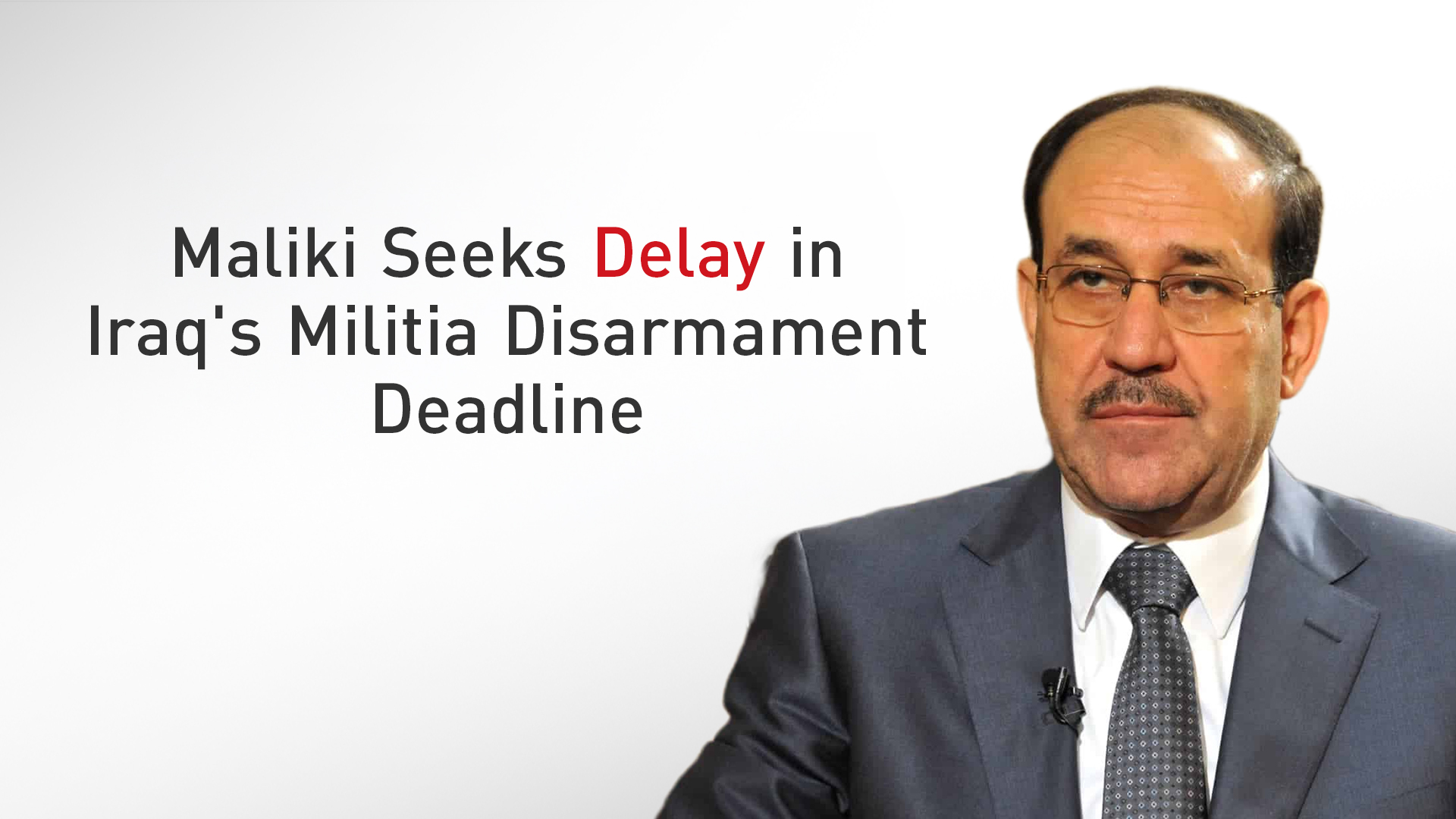
ERBIL (Kurdistan24) - A proposal attributed to former Iraqi Prime Minister Nouri al-Maliki's State of Law Coalition would separate the planned withdrawal of US forces from Baghdad's drive to bring armed factions under state control, according to Iraqi political sources, as the Sept. 30 deadline for restricting weapons to state institutions approaches.
The proposal would effectively create more space for negotiations with factions that have resisted surrendering their weapons while preserving the agreed timetable for the departure of US forces.
The initiative comes as Iraq's political leadership faces a difficult choice: enforce the weapons deadline against powerful factions and risk a confrontation, or seek a gradual arrangement that could postpone the most contentious stage of the process.
The proposal, according to the sources, remains under consideration and does not represent a final government decision.
A Push for Gradualism
The core idea is to avoid implementing two highly sensitive transitions at exactly the same time.
Iraqi political sources said the State of Law proposal calls for the US withdrawal and the disarmament process to be treated as separate tracks, potentially with a short interval between them.
The rationale, according to the sources, is to provide "reassurance" and build trust among armed factions that have long argued that their weapons are necessary as long as foreign troops remain in Iraq.
The distinction could become politically important because the presence of US forces has repeatedly been cited by Iran-aligned factions as one of the principal reasons for maintaining military capabilities outside conventional state structures.
Separating the two deadlines could therefore give political leaders a way to tell factions that disarmament would not be enforced while American troops are still present.
But it could also create a new window for delay if the transitional period is extended or if no firm timetable is attached to the second stage.
Baghdad's Sept. 30 Deadline
Prime Minister Ali Falih al-Zaidi has set Sept. 30 as the government's deadline for bringing all weapons under state authority.
Baghdad has presented the policy as part of a broader effort to consolidate sovereignty, strengthen state institutions and prevent Iraqi territory from being used to launch attacks against neighboring countries.
Government officials have also stressed that the policy should be implemented through constitutional and legal mechanisms.
But the response among armed factions has been mixed.
Some groups have reportedly considered formulas under which weapons could be placed under official supervision. Others, including factions associated with the so-called Islamic Resistance, have rejected disarmament outright or tied it to the complete withdrawal of foreign forces.
That divergence has made a uniform implementation of the September deadline increasingly difficult.
Maliki's Proposal Comes After Qaani's Baghdad Visit
The proposal follows a reported visit to Baghdad by Esmail Qaani, commander of Iran's Islamic Revolutionary Guard Corps Quds Force.
According to an informed source previously cited by Kurdistan24, Qaani met senior leaders of the Coordination Framework and commanders of several armed factions, including Badr Organization leader Hadi al-Amiri.
The discussions reportedly focused on the future of weapons held by Iraqi armed groups and other issues connected to Iraq's regional position.
The visit drew attention because Iran maintains close political and security relationships with several factions affected by Baghdad's weapons policy.
There has been no official confirmation that Qaani instructed factions to reject a specific government formula, and claims about the substance of individual meetings remain based on sources familiar with the discussions.
Nevertheless, his reported involvement illustrates the wider regional dimension of what Baghdad formally presents as a domestic question of state authority.
The Factions' Political Weight
The government's dilemma is intensified by the fact that armed factions are not isolated from Iraq's political system.
Several powerful groups maintain political parties, parliamentary representation, social organizations and economic networks alongside their military structures.
That makes any attempt to use force against non-compliant factions potentially more than a security operation.
It could become a confrontation between the executive branch and political forces that are themselves part of the parliamentary and governing system.
The government therefore faces a fundamental contradiction: it needs the political support of major Coordination Framework forces to remain stable, yet it is simultaneously trying to curtail the military power of some of the networks linked to those same forces.
This helps explain why gradualism and political compromise are becoming increasingly prominent in discussions surrounding the Sept. 30 deadline.
Could Weapons Be Stored Rather Than Surrendered?
One possible compromise discussed in political circles would involve transferring factional weapons to the Popular Mobilization Forces (PMF) for official storage and supervision.
Such an arrangement would allow the government to argue that weapons had been brought under a formal state institution without immediately dismantling the organizational structures of the factions holding them.
But that would solve only part of the problem.
If Baghdad's ultimate objective is simply to ensure that weapons are registered and physically held by a recognized institution, a PMF storage formula could offer a workable middle ground.
If the objective is to eliminate the independent military capabilities of political factions—including drones, missiles, heavy weapons and separate chains of command—the issue becomes considerably more difficult.
The distinction between ownership, custody and operational control could ultimately determine whether an agreement represents genuine disarmament or merely a change in where weapons are stored.
Al-Wala'i Frames the Dispute as Sovereignty
The debate also helps explain recent statements by Abu Ala al-Wala'i, secretary-general of Kata'ib Sayyid al-Shuhada.
Al-Wala'i has accused the United States of exercising excessive influence over Iraq's economy and financial system and called for independent banking and trade networks.
"Sovereignty is not completed merely by controlling territory, but by owning political, economic, and financial decision-making, free from the hegemony of any external power," he wrote on X.
His remarks connect the economic and security disputes in a single argument: that Iraq must reduce its dependence on Washington while retaining the ability to defend itself against external threats.
The US has designated Kata'ib Sayyid al-Shuhada as a terrorist organization, while Washington has also accused al-Wala'i of involvement in attacks against US interests.
For factions like his, the continued presence of American forces remains closely linked to the broader question of whether armed resistance should continue.
A Broader Debate Over Parallel Power
The dispute has increasingly exposed a deeper problem in Iraq: the existence of military capabilities that operate alongside, rather than entirely under, the state's conventional security structure.
The incorporation of many armed formations into the PMF has given them formal status within Iraq's security architecture, while some retain separate political identities and ideological commitments.
That creates what analysts have described as a structural duality.
The government can declare a monopoly over weapons, but implementing that principle requires determining who gives orders, who controls advanced weapons and whether political organizations can maintain independent military capabilities.
The issue is therefore about more than rifles or ammunition.
It concerns the relationship between armed power and political influence.
The Economic Dimension
The weapons dispute also intersects with Iraq's informal economy.
Armed networks have accumulated influence in areas such as border crossings, commercial activity and revenue-generating networks.
That means dismantling parallel military structures could have economic consequences for political organizations that depend on those networks.
A durable state-control policy would consequently require more than a weapons law. It would require stronger financial controls, customs oversight and enforcement against parallel sources of revenue.
Al-Wala'i's criticism of US economic influence demonstrates how the concept of sovereignty is being used by both sides, although with very different meanings.
US Withdrawal Adds Another Variable
Iraq and the United States agreed in 2024 to end the military mission of the US-led International Coalition against ISIS through a phased transition toward a bilateral security relationship.
The first stage ended in September 2025. The remaining phase is scheduled to conclude by the end of September 2026, according to the supplied background.
The Coalition was established in 2014, when ISIS controlled large areas of Iraq and Syria. Its role subsequently evolved from direct combat support to training, intelligence and advisory assistance to Iraqi forces.
Baghdad now says its security forces are capable of assuming primary responsibility for national security.
The simultaneous timing of the withdrawal and the weapons deadline has nevertheless created political uncertainty.
For factions opposed to the US presence, the argument remains that their weapons cannot be discussed separately from foreign troops.
For the government, separating the two issues may be an opportunity to reduce confrontation.
Postponement or a Path to Resolution?
The Maliki-linked proposal may therefore be less about abandoning the principle of disarmament than about changing the sequence in which it is implemented.
A short delay could give Baghdad time to negotiate guarantees, clarify the future role of the PMF and reassure factions that the withdrawal of US forces is proceeding as agreed.
But there is also a clear risk: postponement could become indefinite.
That would weaken the credibility of the Sept. 30 deadline and potentially leave the government facing the same dispute at a later date, but with even less political leverage.
The coming weeks will therefore test whether the Coordination Framework can produce a formula that reconciles political reality with the government's stated goal of state control.
For Prime Minister al-Zaidi, the challenge is not simply to declare that weapons belong to the state.
It is to convince powerful armed factions that surrendering independent military authority will not leave them politically or strategically exposed.
For the factions, meanwhile, the question is whether the US withdrawal will remove the principal justification they have used for retaining their arsenals—or whether new regional threats will be cited in its place.
With Sept. 30 approaching, the emerging push for gradualism suggests Baghdad may prefer negotiation to confrontation.
Whether that strategy produces a genuine transition toward a state monopoly on force, or merely buys more time, could become one of the defining political questions of Iraq's current government.