Kuwait Condemns Drone Strike on KRG Prime Minister Masrour Barzani's Office, Calls for Respect of Iraqi Sovereignty
Kuwait's Foreign Ministry rejects any actions that violate the sovereignty, security, and stability of brotherly Iraq, emphasizing the necessity of respecting state sovereignty and territorial integrity under international law
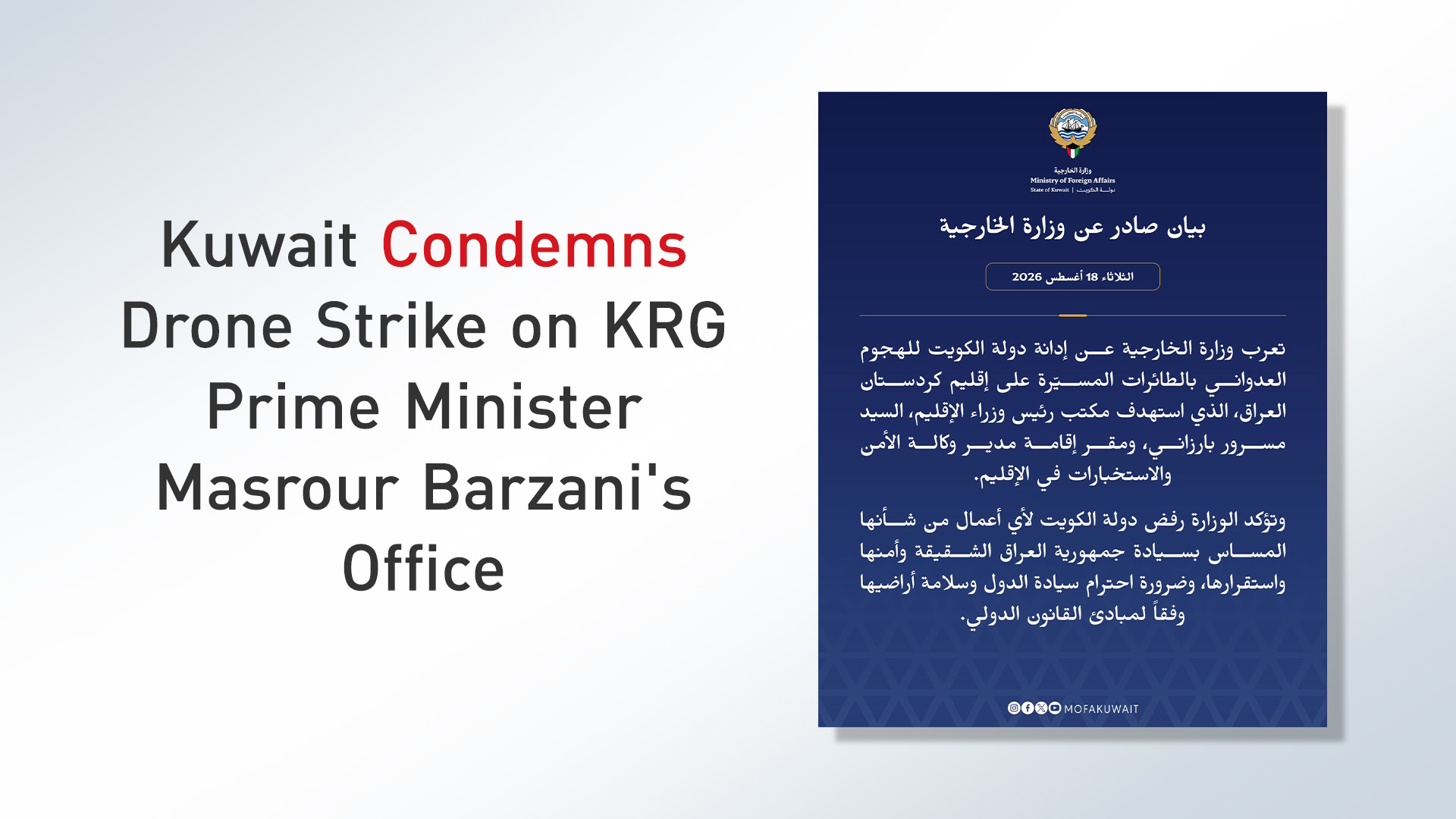
ERBIL (Kurdistan 24) - Kuwait's Ministry of Foreign Affairs issued an official statement on Tuesday condemning the hostile drone attack on the Kurdistan Region of Iraq that targeted the office of Prime Minister Masrour Barzani and the residence of the Director of the Security and Intelligence Agency in the Region.
The ministry affirmed Kuwait's rejection of any actions that would violate the sovereignty, security, and stability of the brotherly Republic of Iraq, and stressed the necessity of respecting the sovereignty of states and the integrity of their territories in accordance with the principles of international law.
Kuwait's condemnation adds a significant Gulf voice to the growing international front against Monday's predawn attack, in which two Hadid-110 drones launched from within Iranian borders struck the KRG Prime Minister's private office and the Kurdistan Protection Agency Director's landing site in Pirmam district, Erbil governorate, at 00:28 a.m. on Monday, according to the Kurdistan Counter-Terrorism Directorate. No casualties were reported.
Kuwait's statement carries particular weight given that the country has itself been one of the most frequent targets of Iranian drone and missile attacks throughout the six-month conflict. Kuwait International Airport was struck by Iranian drones on June 3, 2026, in an attack that killed one person and wounded more than 60, and Kuwait City has absorbed multiple barrages of Iranian ballistic missiles and drones throughout the war, with the country's air defenses repeatedly activated to intercept incoming projectiles.
Kuwait's condemnation of the strike on KRG government sites therefore comes not only as a diplomatic gesture of solidarity but as a statement rooted in its own direct experience of Iranian aerial aggression against civilian and governmental infrastructure, giving its words a resonance that extends beyond the formal language of diplomatic protocol.
Prime Minister Masrour Barzani responded to the attack on Monday with resolve, stating: "These attacks cannot stop us. We will continue our duties and the protection of our citizens." Iraqi Federal Prime Minister Ali al-Zaidi called Masrour Barzani on Tuesday to condemn the strikes, declaring that any violation of the Kurdistan Region's security is a violation of Iraq's national security, and committing to a formal investigation and legal prosecution of those responsible.
Kuwait's statement joins official condemnations from Saudi Arabia, Qatar, the UAE, and the Iraqi federal government, as well as from the Independent Human Rights Commission of the Kurdistan Region and the Kurdistan Rawendi Confederation, forming the broadest international response to a single Iranian strike on Kurdistan Region territory since the conflict began on Feb. 28, 2026.