Prime Minister Barzani Calls for Stronger Air Defense as Drone Attacks on Kurdistan Region Mount
Masrour Barzani tells Al-Monitor the region has faced more than 1,000 drone and missile attacks and urges allies to help build defensive capabilities.
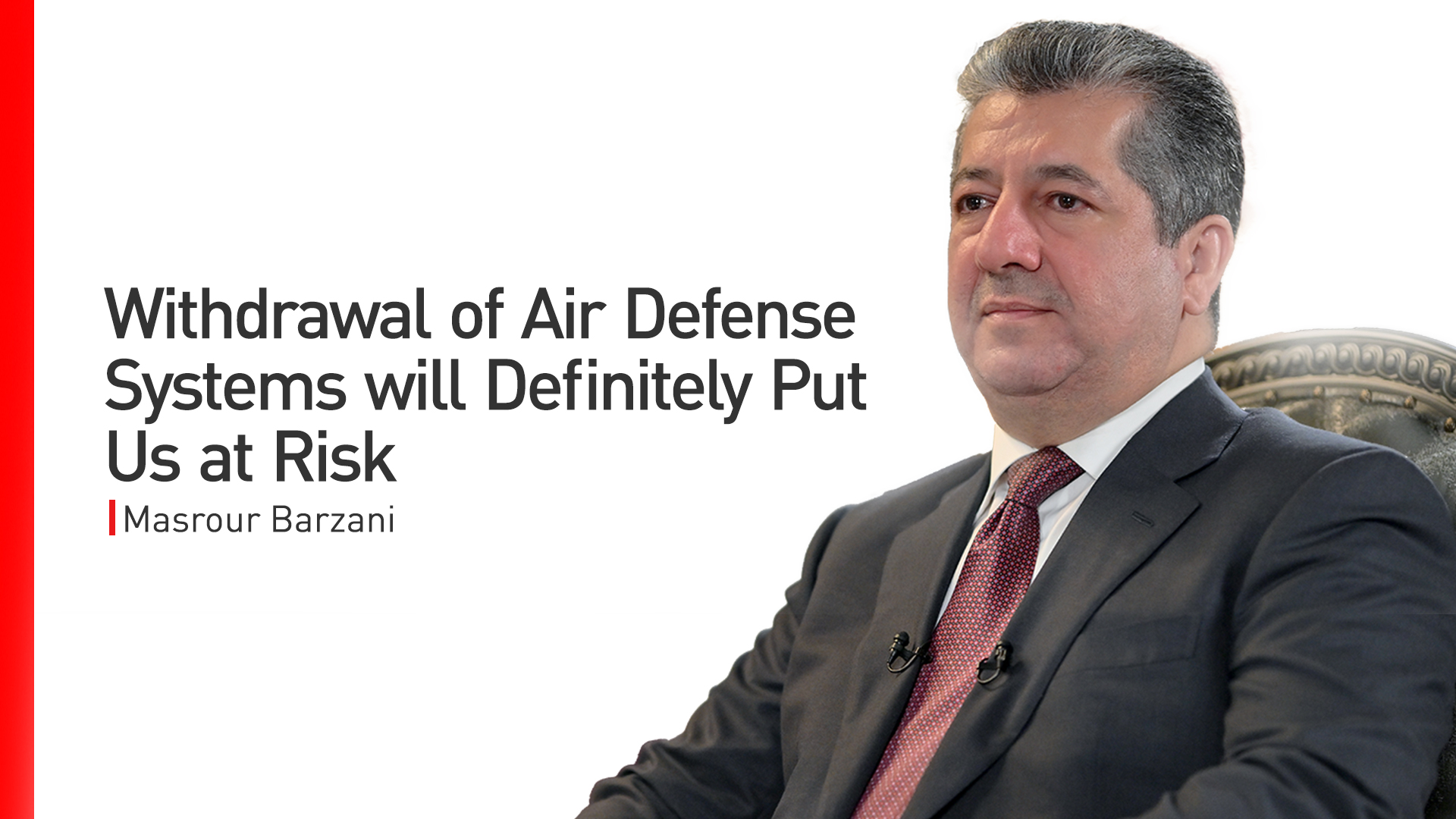
ERBIL (Kurdistan24) - In a wide-ranging and exclusive interview with Al-Monitor’s Andrew Parasiliti on Wednesday, Kurdistan Regional Government (KRG) Prime Minister Masrour Barzani has called on international partners to help the Kurdistan Region acquire stronger air defense capabilities, warning that the withdrawal of US Patriot systems from the region comes as attacks by Iran-linked drones continue to escalate.
The most recent attack, on Aug. 17, struck both Prime Minister Barzani's private office and the residence of the director of the KRG Security Council. Prime Minister Barzani said the Kurdistan Region has been hit by more than 1,000 such attacks since the US-Israel war with Iran began on Feb. 28, striking American bases, regional infrastructure, the energy sector, and, more recently, residential properties.
"We condemn these unjustifiable, unprovoked attacks," Prime Minister Barzani said. "Our position has been very clear from day one: that we did not want to be a part of this conflict. We have not provoked or threatened the security of any of our neighbors. We also need explanations. We need clarification from their side why these attacks are happening against Kurdistan when Kurdistan has not been a threat to the security of any of the countries in the region."
He said the Kurdistan Region has sought explanations for the attacks. "Why they're attacking us is a question that I think has to be addressed to them," he said, referring to Iran. "The way that we see it, they're just trying to intimidate us and maybe drag us into something that we strongly resist, and we don't want to be a part of this conflict."
Prime Minister Barzani said Iran's foreign minister and the vice president of Iran have both officially denied responsibility for the strikes, but he noted the drones used were identified as Iranian-made Hadid-110 turbo models. "Then who has fired them? Who is behind them? Who is responsible for them?" he said. "I think that's for the Iranian authorities to find out how such drones that nobody else has could be used by someone else, and they can launch them inside Iraq against targets outside the country."
Asked whether Iran's parliament speaker, Mohammad Bagher Ghalibaf, would raise the attacks during his visit to Iraq, Prime Minister Barzani said he expected the issue to come up, noting that Iraqi PM Ali al-Zaidi had already condemned the attacks and called for an investigation.
Prime Minister Barzani also addressed the prolonged delay in forming a new KRG, which has not been established more than 20 months after the October 2024 regional elections. He said the delay was not by his party's choice. "It is very unfortunate that we have not been able to form the government after more than 20 months. But that was not our desire. Personally, it has been my will to form the government immediately," he said.
He said the KRG had sought an inclusive government from the outset, with the Patriotic Union of Kurdistan (PUK) as its main partner, but that the PUK wanted to wait until after the Iraqi federal elections. "They had different expectations, but after the election results, it was our party that received the largest votes, not just in Kurdistan but in all of Iraq," Prime Minister Barzani said, adding that the outcome did not lead to government formation as hoped.
Prime Minister Barzani said the delay has had a negative impact and that Kurdistan's international partners have also encouraged the parties to move forward. "Personally, I’m very disappointed and frustrated that up until now the parliament has not been activated and we don’t have government formation. We had elections, and the parliament should have convened and started to operate," he said. "Those preventing that from happening and holding the parliament hostage should be held accountable."
He said he remains committed to forming a government. "I will continue to do everything I can to form the next government. I hope that all of our friends, partners and other parties will look to the greater national interest of the Kurdistan people above their personal or party interests. I will continue to extend my hand of friendship and ask everyone to come and join us to form the government, which is in the best interest of the people of Kurdistan."
Prime Minister Barzani expressed concern over the drawdown of remaining US training and support forces in the Kurdistan Region and the planned withdrawal of Patriot air defense systems ahead of a Sept. 30 target date. He said the attacks have caused casualties and damage to regional infrastructure and facilities, and that existing defenses have not been sufficient to intercept every incoming threat.
"We haven't been able to acquire effective systems that can protect us against these threats," he said. "So far we've been relying on the support that our friends, the Americans, thankfully, have been providing for the region, which has been very successful in intercepting most of the incoming missiles and drones."
He said the limited protected perimeter meant not every attack could be stopped. "We are vulnerable, and these attacks can't continue," he said. "Withdrawal of these air defense systems will definitely put us at risk."
Prime Minister Barzani called for international support in building independent defensive capacity. "We hope that we can find a way with our friends that we can possess and acquire air defense systems, early warnings, anti-drones and some sort of defensive capabilities... I'm using this opportunity to call on our friends, all of our friends, to help us build these capabilities so that we can defend ourselves."
He confirmed that discussions on enhancing these capabilities are already underway with the US government. "The US is a friend; they are our partners... we've asked and raised this issue with them and will continue to ask for their support so that we can be provided with adequate defensive systems."
Asked about US Ambassador to Türkiye and envoy to Iraq and Syria Tom Barrack's description of him as "our friend and a valued partner" and of the KRG as "our trusted Kurdish ally," Prime Minister Barzani said the relationship remains highly valued on both sides.
"Of course, our relationship is very valuable. We are very proud to be US allies and partners, and I'm very grateful to Ambassador Barrack and his statement and support," he said, adding that Barrack "has been a wonderful friend, an ally" who "knows the region very well" and has worked to help stabilize Iraq, Syria and the wider region.
Prime Minister Barzani acknowledged that US forces in the region will be reduced but said the relationship would continue in other forms. "We know that there is going to be a reduction of the American forces in the region, but we hope that our relationship will go beyond that point and will continue in different forms," he said. "I cannot emphasize enough the value of the relationship that we have with our American friends."
Prime Minister Barzani voiced strong support for Iraqi Prime Minister Ali al-Zaidi, calling him "a genuine and trusted leader and friend" who is "doing the right thing for the country." He said the KRG backs Zaidi's efforts to tackle corruption and bring armed groups under the rule of law.
"We have expressed our full support for him... we've been unconditionally supporting him until now and will continue to do so to hopefully bring more stability to the country and provide more security to all of Iraq's peoples, including in Kurdistan." Prime Minister Barzani noted that PM Zaidi is "trying to bring Iraq out of the, you know, all these miseries and all of these problems and challenges that it faces."
On the Sept. 30 deadline Zaidi has set for armed militias to hand over their weapons, Prime Minister Barzani said he hopes all sides comply. "I hope that everybody will abide by the law and the decrees of the prime minister... I don't think that anybody wants to see a military confrontation or any sort of chaos in the country." He added that without full cooperation, "it will be a very difficult mission."
Asked whether militia compliance depends on the broader US-Iran dynamic, Prime Minister Barzani said Iraq's national interest must come first. "People always link the issues in Iraq with what's going on in Iran, which for some obvious reasons is true," he said. "But this is an Iraqi issue, and the Iraqis need to first of all think of their own national interest and the security and stability of their own country, regardless of how the conflict with Iran continues or unfolds."
Prime Minister Barzani said the Kurdistan Region has built constructive relations with both Türkiye and the new government of Syria, describing "historical relations with the peoples on both sides of the border" and "long experience" in the region. "We have been trying to be a constructive, positive element to help the process of the peace initiative in Türkiye and also reintegration and, let's say, a whole new system in Syria," he said. "Our role has been to support those countries, and so far, I think we are happy with what we've been doing and what we've achieved."
Prime Minister Barzani reaffirmed the KRG's support for the Trump administration's push for regional economic integration among Iraq, Türkiye and Syria, including expanded pipeline networks. He specifically referenced a major conference hosted by Al-Monitor on the Kurdistan Region’s energy potential, which featured Prime Minister Barzani alongside Secretary of Energy Chris Wright and various business leaders.
"We strongly share the policy of President Trump of commerce and not conflict," Prime Minister Barzani said. "We do believe that economic strength will help the security and stability of the region." He said the KRG has worked to expand trade with neighboring countries and attract US companies beyond the energy sector, including in agriculture, infrastructure and technology.
"We’ve always been very welcoming to American companies, and it has actually been our initiative, from the start, to sign contracts with US firms, which encouraged Baghdad to do the same," he said. He added that protecting those investments is equally important: "We need to not only bring more companies, but to provide an environment where their investments, their staff and their interests are protected in our region."
Prime Minister Barzani said past trade with Türkiye had been reduced under the previous government in Baghdad and that the KRG hopes to resume full trade with both Türkiye and Syria. He said progress has been "consistently interrupted" by drone and missile attacks and "deliberate decisions to limit the growth of the economy in Kurdistan."
Prime Minister Barzani closed by underscoring the importance of the Kurdistan Region's relationship with the United States amid the planned troop withdrawal from Iraq. "I know the US has decided to withdraw its troops from Iraq, and we support the US to make its own decisions," he said. "We only hope that the withdrawal will not leave a security vacuum in the region. We want to continue our strong relationship with the United States beyond security cooperation. We want to expand our economic partnership and political relations."
"The Kurdistan Region will remain America's most trusted and reliable partner in the region," he said.
You can find the full interview through here.