Sidakan Villager Turns Stone Into a Living Kurdish Heritage
In Duramelk village, Omar Bazid Qadir has turned an old stonecraft tradition into a livelihood while keeping tools of Kurdish rural life alive.
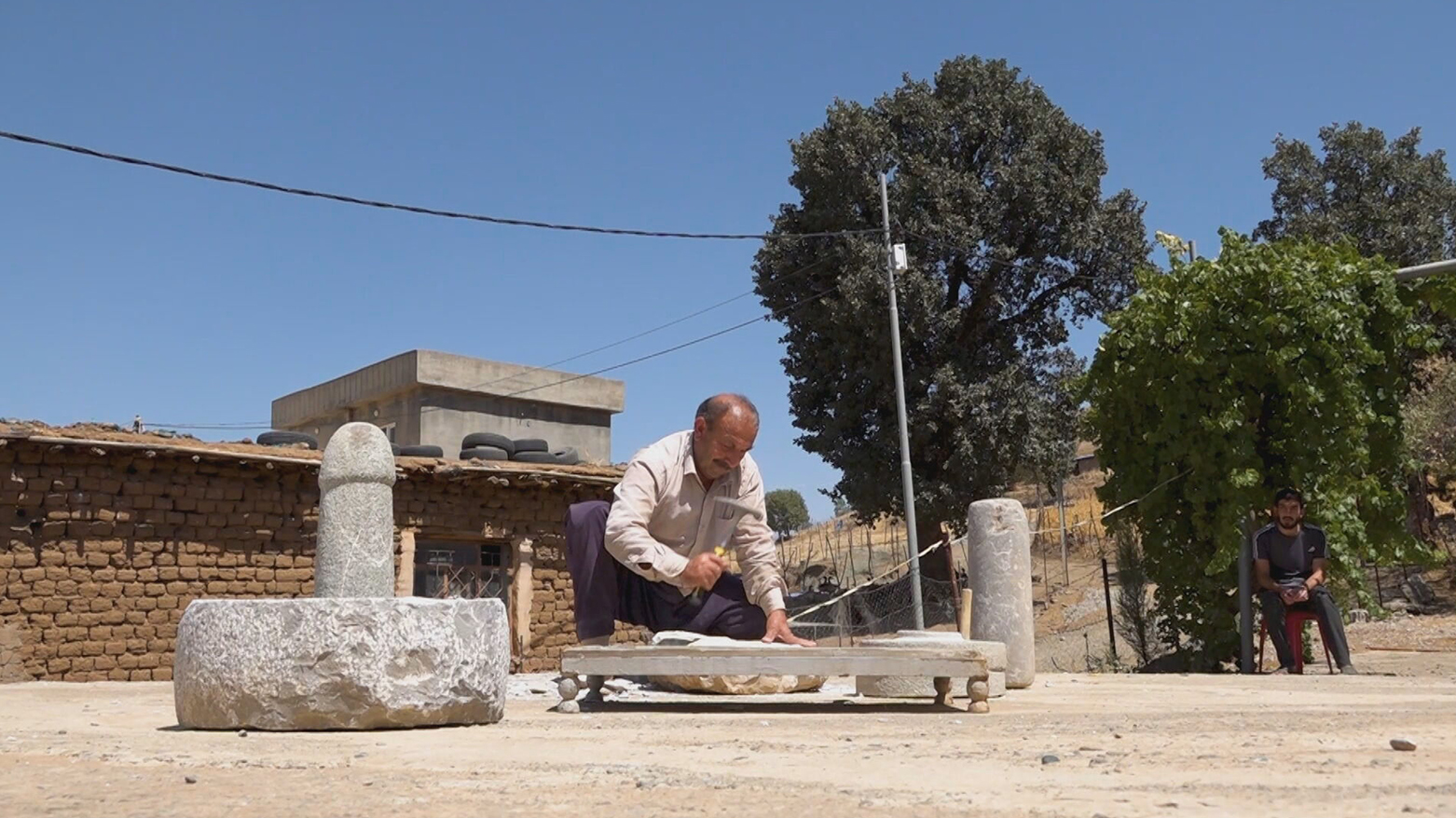
ERBIL (Kurdistan24) - In the mountain village of Duramelk in Sidakan, stone is more than raw material for Omar Bazid Qadir. It is a link to a way of life that is slowly disappearing, and over the past several years he has built a livelihood by carving that heritage by hand.
Qadir, born in 1972, has spent the last five or six years making traditional stone tools and household objects, including bagurdan roof rollers, destar hand mills, joni mortars and pestles, and stone bases for traditional stoves.
"I didn't learn this from anyone; it was my own idea," Qadir told Kurdistan24. "Neither my father, my brothers, nor my uncles ever did this work."

What began as an individual craft has increasingly attracted customers from across the Kurdistan Region. Demand, Qadir said, is now far greater than when he started, as people increasingly buy his work not only for practical use but also as a way of preserving and displaying their heritage.
"Demand is much, much higher than it used to be," he said. "It's meticulous work, it's like working with a needle, exactly like that."
The objects he makes once played an essential role in everyday rural life.

The destar, for example, was traditionally used to grind cracked wheat and bulgur, as well as finer grains known locally as pirpekheni. The joni was used to crush ingredients such as sumac, qazwan or terebinth, pounded wheat and rice.
The bagurdan carries a different kind of memory. Before modern roofing materials became common, families used heavy stone rollers to compress flat mud roofs and seal cracks against rainwater.
"In the past, if you didn't use a roof roller, your house wouldn't be habitable," Qadir explained. "People would roll them back and forth across the flat mud roofs to seal the cracks so rain wouldn't leak in."

Some of Qadir's creations, however, are his own adaptations. He designed a stone base for traditional stoves that can continue holding heat after the fire has been extinguished.
"Even after the stove is turned off, that stone continues to work, holding the heat for an hour and a half," he said.
Today, many buyers use the pieces differently from previous generations. Customers travel from Duhok, Amedi and Sulaymaniyah, Qadir said, with many purchasing the objects as decorative reminders of rural Kurdish life.

Prices vary according to size, ranging from about 300,000 or 400,000 Iraqi dinars to around 1 million dinars.
Yet for Qadir, the value of the work is not measured only in money.
"When someone comes and truly appreciates this craft, it makes the work even more rewarding for us," he said.

In a region where many traditional skills have disappeared with modernization, Qadir's workshop offers a small but tangible example of how heritage can survive, not simply in museums or photographs, but through the hands of people who continue to make the objects that once formed part of everyday life.