Hawramani Artisans Keep the Centuries-Old Klash Tradition Alive
Hawramani klash embodies generations of Kurdish craft, landscape and identity, linking Hawraman’s mountain heritage with contemporary Kurdish culture.
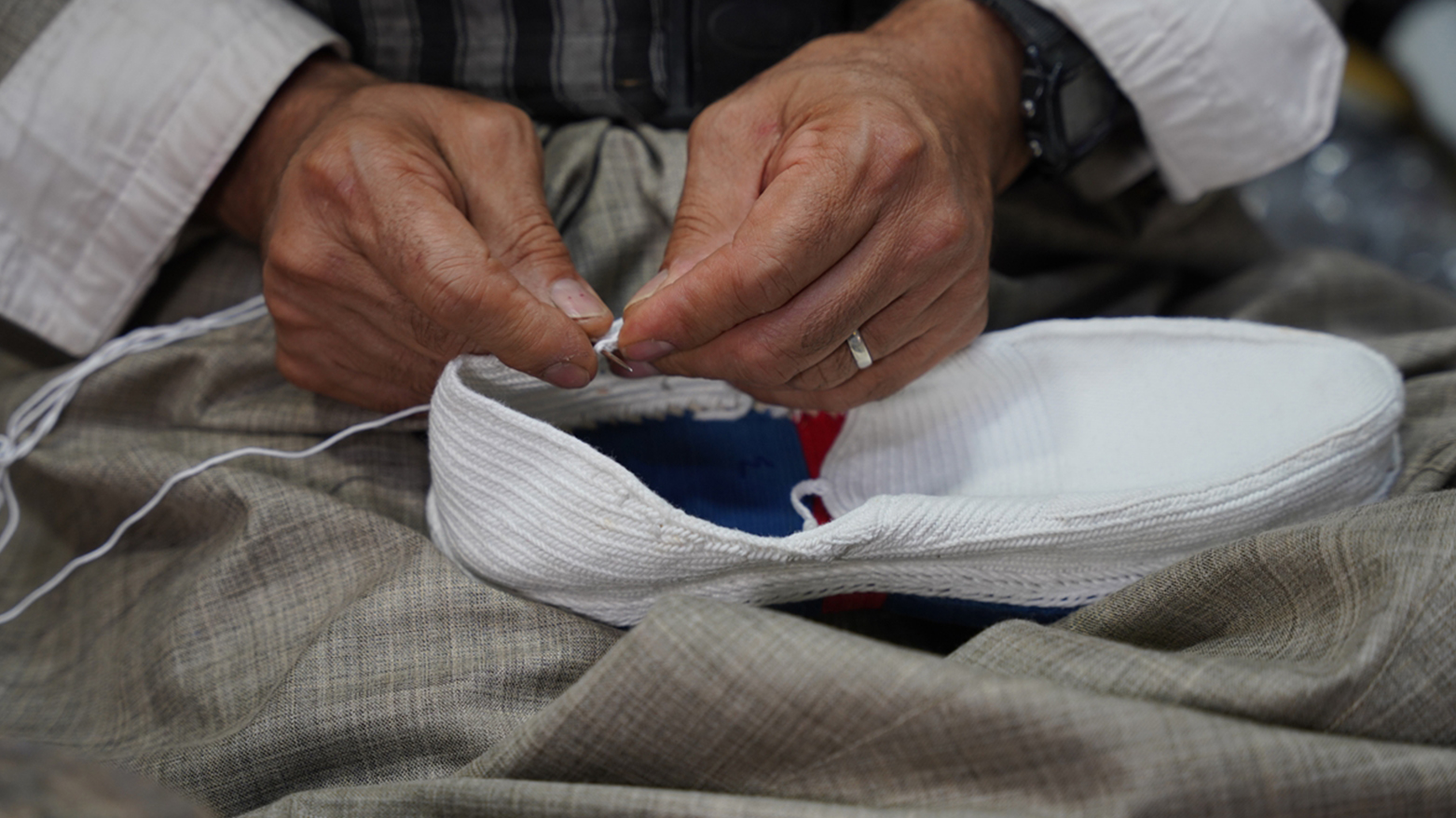
ERBIL (Kurdistan24) - A pair of Hawramani klash can look deceptively simple: a light, handmade shoe, traditionally white, with a knitted upper and a sole built layer by layer from cotton fabric. Yet behind that modest form lies a body of knowledge shaped over generations by the mountains of Hawraman.
For Kurdish communities in the Kurdistan Region, klash (traditional Kurdish shoe) is more than footwear. It carries the memory of household labor, village craftsmanship and adaptation to a landscape where steep paths, orchards and mountain settlements demanded clothing and shoes suited to everyday movement.
The craft remains closely associated with Hawraman, including communities around Halabja and villages such as Tawella and Byara. Research on the area has treated western Hawraman as a distinctive cultural and ecological zone, where language, material traditions and local knowledge developed in close relationship with the environment.
That relationship helps explain why klash acquired its recognizable form.

Research by Arman Ovla, published in Springer Nature proceedings on design, describes the shoe as a product of Kurdish mountain culture, developed for communities whose lives were shaped by slopes, narrow paths and agricultural work.
Traditional klash are lightweight and breathable.
Their uppers are knitted by hand from cotton thread, while the soles are made from compressed layers of cotton fabric, reinforced through laborious manual work and, in traditional examples, supplemented with leather.
Unlike most modern footwear, a traditional pair has no fixed left and right shoe when first made; the shoes gradually acquire their shape through use.
They can also be washed, although the cotton-based sole is vulnerable to excessive water. That detail complicates romantic portrayals of klash as universal mountain footwear. Its ingenuity lies less in being suitable for every condition than in using familiar materials to answer particular needs of movement, climate and everyday life.

A craft made by many hands
The making of klash also reveals how heritage can reside in a process rather than in a single object.
Historically, production was divided among specialists. Women often knitted the upper, while men commonly constructed the sole. Other artisans might join the two parts and finish the shoe. A single pair could therefore embody the work of several people, sometimes within one household and sometimes across a wider network of craftspeople.
Every stage depends on knowledge difficult to capture in instructions alone: how tightly the cotton must be folded, how the sole should be compressed, how the upper should be shaped and how the different elements should be joined so that the finished shoe remains durable and comfortable.
That knowledge traditionally passed from one generation to the next through observation and practice.

A contemporary account by Kurdistan Chronicle describes klash making as both work and art for Hawramani craftspeople, noting that a pair can take around a week to complete depending on its design and the maker’s experience. The same report points to continuing demand among Kurdish communities abroad, extending the craft far beyond Hawraman.
The deeper history of klash is harder to date precisely. Popular accounts sometimes assign the craft an age of more than 1,500 years, but the academic evidences do not establish such an exact chronology.
Ovla’s research instead notes that there is no precise historical date for the first klash. Traditions connected with Pir Shaliar and Kusay Hajij refer to old soles associated with figures believed locally to have lived roughly 700 to 1,000 years ago.
The most defensible description is therefore that klash is a centuries-old Hawramani craft with deep historical roots.
One important modern chapter belongs firmly to the Kurdistan Region. Research and contemporary reporting identify Wasta Abubakr Tawellayi, a Hawramani master craftsman from Tawella who lived from 1901 to 1984, as an influential innovator. He is associated with changes in technique and materials, including strengthened soles and the use of silk thread.
That history matters because Hawramani culture cannot be neatly confined by the modern Iran-Iraq frontier. Tawella, Byara, Halabja and neighboring communities form part of the living Hawramani cultural landscape within the Kurdistan Region, while Sulaymaniyah has long provided an urban market and social space through which Hawramani communities and their products circulate.

From mountain necessity to Kurdish signature
The role of klash has changed as Kurdish society has changed.
Once valued primarily as practical footwear, it is now also worn as a visible marker of cultural belonging. Klash appears with Kurdish clothing at Newroz celebrations, weddings, national occasions and other public events, while some wearers combine it with contemporary clothing.
The white shoe remains the form most strongly associated with traditional Hawramani aesthetics, but artisans now work with different colors, threads and styles. In diaspora communities, a pair can carry another meaning: a portable connection to Kurdistan and to a cultural landscape that may be geographically distant but remains present through clothing.
That evolution does not necessarily make the craft less authentic. Living traditions survive because communities continue to use, adapt and reinterpret them.

For klash, that means preservation cannot stop at displaying an old pair in a museum.
The greater challenge is keeping alive the knowledge required to make the next pair: the vocabulary of the craft, preparation of cotton, construction of the sole, knitting techniques, finishing methods, histories of individual masters and the relationships through which those skills are transmitted.
That chain is under pressure.
Contemporary reports point to rising material costs, fewer skilled artisans and difficulties attracting younger people to a profession requiring patience, manual skill and considerable time.
The economic future of klash is therefore inseparable from its cultural future. A craft is more likely to endure when the people practicing it can earn sustainable livelihoods from their work.
Exhibitions, workshops and cultural festivals can increase visibility, while apprenticeships could transfer specialist knowledge to younger makers.
Museums and universities can document techniques and oral histories, and stronger branding based on Hawramani provenance could help distinguish genuine handmade klash from industrial imitations.

There is also space for collaboration with Kurdish designers, provided experimentation does not erase the techniques that make the footwear culturally distinctive.
Klash may additionally offer an example of environmentally conscious traditional design. Its historic construction relies heavily on cotton, thread, leather and manual labor rather than complex industrial production. But its environmental value should not be romanticized: sustainability also depends on how materials are sourced, whether modern replacements are introduced and whether production remains economically viable.
What gives klash its enduring importance is not simply its age.

It continues to be made, purchased, repaired, redesigned and worn. It connects Hawraman’s villages with Sulaymaniyah’s markets, traditional Kurdish dress with contemporary fashion, household skills with small enterprise, and local craftsmanship with a global Kurdish diaspora.
In that sense, each handmade pair is an artifact of culture in the fullest meaning of the term: not a relic removed from everyday life, but a living object carrying the memory of landscape, labor and identity.
Preserving Hawramani klash therefore means preserving more than a shoe. It means protecting the knowledge and human relationships that allow Kurdish culture to remain visible not only in museums and monuments, but in the hands of people still capable of making it.


