Trump Hits Back at Canada After Carney Announces Retaliatory Tariffs
Trump accuses Canada of seeking US benefits without statehood as trade tensions escalate between the longtime allies
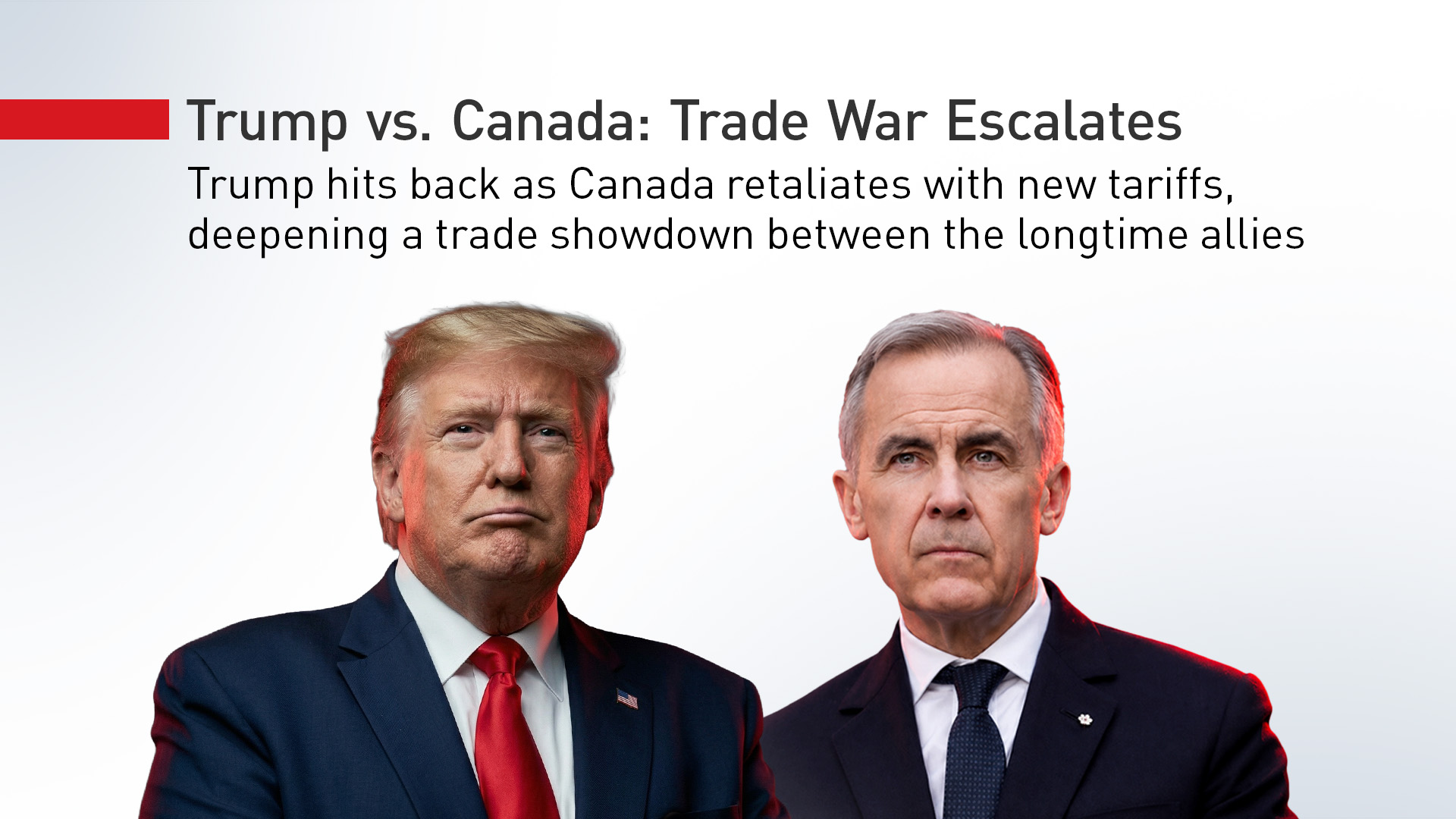
ERBIL (Kurdistan24) — US President Donald Trump hit back at Canada on Sunday after Prime Minister Mark Carney announced retaliatory tariffs on American goods, escalating a trade dispute that has strained relations between the two longtime allies.
“Canada wants the benefits of being a State, without being one!!!” Trump said in a post on Truth Social, renewing his repeated suggestion that Canada should become the 51st US state.
“They have also charged our great farmers, for many years, massive amounts of Tariffs. No more!!!” he added.
Trump’s comments came a day after Carney said Canada would impose new tariffs on US products, particularly steel and dairy goods, beginning September 8.
The move followed the collapse of trade negotiations between Ottawa and Washington, with Carney rejecting what he described as “uneconomic” and “unfair” terms proposed by the Trump administration.
New US tariffs of 50 percent on a range of Canadian goods took effect Saturday, affecting approximately $20 billion worth of products, or about 5.5 percent of Canada’s exports to the United States. The affected goods include products ranging from hockey sticks to cement.
Carney said the Canadian government could not accept the terms presented by Washington and vowed to protect Canadian workers and businesses.
“We cannot accept what they’ve offered, and we will not give what they’ve asked,” Carney said Saturday.
Trade dispute deepens
The latest escalation marks a sharp deterioration in one of the world's most economically integrated bilateral relationships.
The United States is by far Canada’s largest trading partner, accounting for roughly 70 percent of Canadian exports. The two economies are deeply intertwined across the automotive, energy, steel, agriculture and manufacturing sectors, meaning tariffs imposed by either side risk raising costs and disrupting supply chains in both countries.
Canada has been seeking relief from US tariffs on automobiles, steel and aluminum while attempting to negotiate a broader trade arrangement with Washington.
According to Carney, the latest round of negotiations broke down after US officials introduced last-minute demands that Ottawa considered unacceptable, including restrictions on Canada’s ability to pursue trade agreements with other countries.
Carney also said US negotiators had made demands concerning the French language and Quebec culture that Canada could not accept.
The Canadian prime minister has increasingly argued that Washington’s trade policy represents a fundamental change in the relationship and that Canada must reduce its economic dependence on the United States by expanding trade with other countries.
“We recognize that sometimes its signature was written in pencil,” Carney said, referring to the reliability of US trade commitments.
Energy ties complicate dispute
Despite the escalating tariff confrontation, the two countries remain heavily dependent on each other, particularly in the energy sector.
Carney has pointed to Canada’s role in supplying the United States with energy, saying Canada provides about 99 percent of US natural gas imports, 85 percent of its electricity imports and 60 percent of its crude oil imports.
“I don’t think they want us to stop sending any of that energy,” Carney said.
Canada has faced growing pressure domestically to use its energy exports as leverage against Washington, although Carney has so far stopped short of imposing measures targeting US energy supplies.
The economic risks of the dispute remain significant for Canada. Analysts at the Royal Bank of Canada have warned that even though the latest US tariffs cover a relatively small share of Canadian exports, their economic impact could be substantial, particularly in Ontario and Quebec.
University of Calgary economics professor Trevor Tombe has estimated that prolonged tariffs could ultimately result in the loss of up to 90,000 Canadian jobs.
Statehood remarks fuel tensions
Trump’s latest reference to Canada becoming a US state is also likely to further inflame public sentiment in Canada.
Since returning to the White House in January 2025, Trump has repeatedly raised the idea of Canada becoming the 51st US state, a proposal widely rejected by Canadian political leaders and the public.
The comments have contributed to a broader deterioration in Canadian perceptions of the United States, with some Canadian provinces removing American alcoholic products from store shelves and calls growing for Ottawa to diversify its trade relationships.
Carney has sought to project a tougher stance toward Washington while maintaining access to the US market, a difficult balance given the scale of bilateral trade.
The two countries also face the broader challenge of revising the United States-Mexico-Canada Agreement, or USMCA, which governs much of their trade along with Mexico.
With reciprocal tariffs now taking effect, pressure is likely to grow on both governments to find a way back to negotiations, even as political rhetoric on both sides hardens.
For Canada, the dispute has become more than a disagreement over individual tariffs. Carney has framed it as a test of his country's economic sovereignty and its ability to chart a more independent course amid a rapidly changing relationship with its most important trading partner.