China's Tiangong Ultra Robot Beats Usain Bolt's 100-Meter Record
Humanoid robots broke sprint records, boxed and played football at Beijing's World Robot Games, showcasing China's rapidly advancing robotics industry.
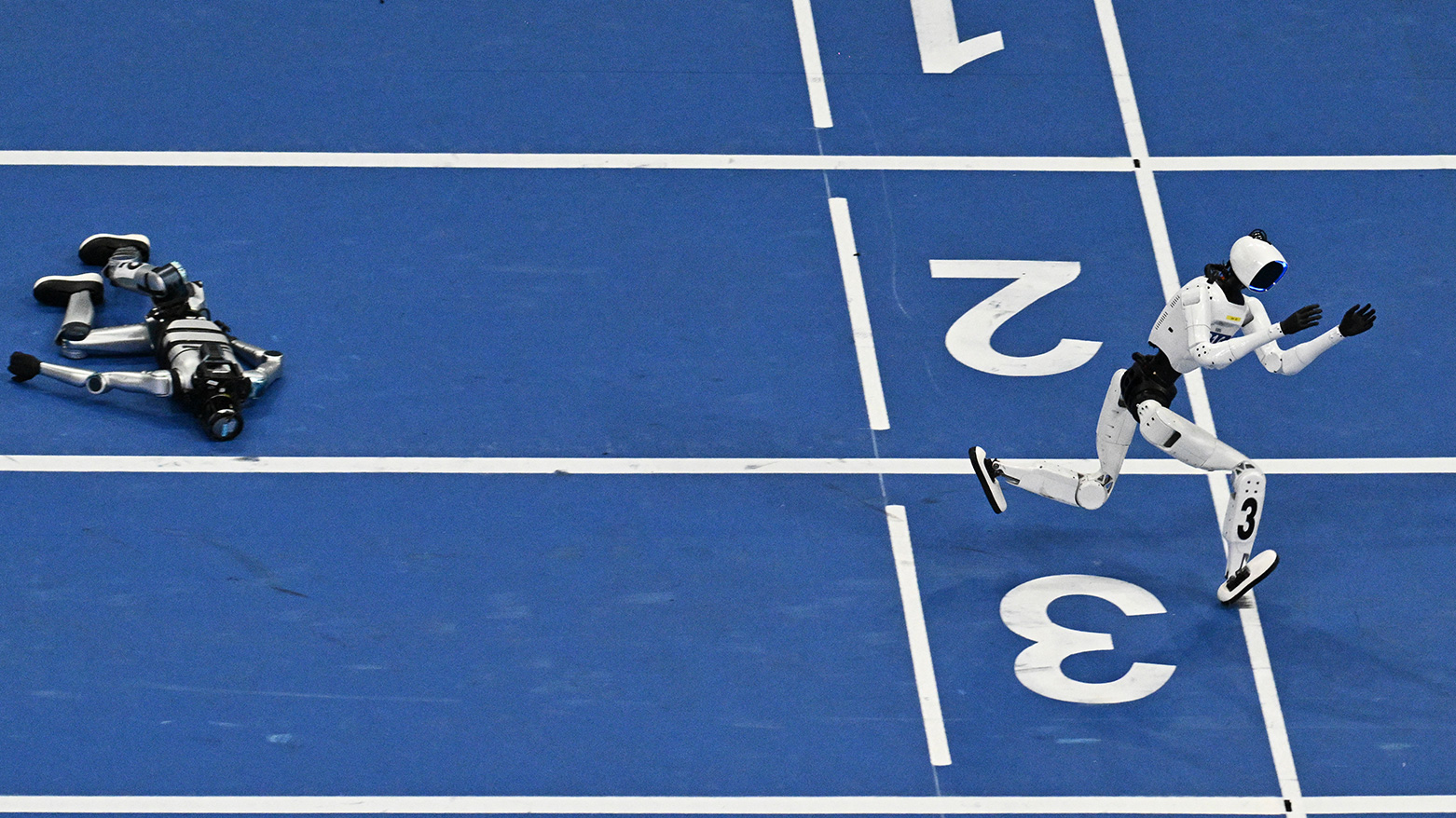
ERBIL (Kurdistan24) - Humanoid robots broke major human running records, boxed, played football and occasionally collapsed before cheering spectators at Beijing's World Robot Games over the weekend, as China displayed the rapid development of its humanoid robotics industry.
Dozens of humanoid machines and their human operators gathered at Beijing's Olympic speed skating arena on Sunday for competitions spanning athletics, boxing, football and martial arts, Agence France-Presse reported.
The standout performer was Tiangong Ultra, a white, headless humanoid developed by a Beijing local government-backed research center.
During Saturday's opening ceremony, the robot completed the 100-meter sprint in 9.39 seconds, according to Chinese state broadcaster CCTV.
The time was faster than Jamaican sprinter Usain Bolt's human world record of 9.58 seconds, set in 2009.

Tiangong Ultra followed that performance on Sunday by completing 400 meters in 38.15 seconds, breaking the human world record by nearly five seconds.
The comparisons demonstrate advances in robotic speed and balance, although the events do not represent direct competition under the same physical conditions governing human athletics.
Records - and plenty of falls
The weekend provided less polished evidence of how far humanoid robotics still has to develop.
During one 400-meter race, a white-shelled machine swung its arms dramatically while leaning forward as it moved around the track, appearing close to falling before successfully reaching the finish.
Other competitors never made it out of the starting position. Some moved around the track at little more than walking pace, while several collapsed moments after the race began.
The failures appeared to entertain spectators almost as much as the records.

Children and parents laughed as a toddler-sized robot playing football sent the ball over knee-high barriers surrounding the pitch, while spectators loudly applauded the slow-moving machines whenever they managed to score.
In a boxing event, one humanoid stumbled sideways and folded over the ropes, remaining motionless until human operators carried it away.
For 72-year-old Beijing resident Hou Yali, the performances raised a more important question than whether machines could simply run faster than people.
"We'll be able to see more clearly whether machines can surpass humans," she told AFP.
But Hou said speed alone offered only a limited measure of technological progress.

"Right now, this is just running, just a competition of speed. It's not a test of intelligence, or hiring someone to do household tasks or act as live-in help," she said.
Hou, who employs people to clean her home and prepare meals each week, said she would be interested in robots capable of performing those everyday tasks.
"With the development of our country's economy, people have more money in their pockets, and they may decide to use robots," she said.
The mixture of record-breaking performances and conspicuous failures offered a snapshot of the current state of humanoid robotics: machines increasingly capable of impressive physical feats, but still struggling with basic movements humans perform almost automatically.
For China, the Beijing competition also served as a public showcase for an industry in which the country is seeking to establish technological and commercial leadership.