Al-Araji: Decision for War and Peace Belongs Solely to Iraqi State
Iraq will begin a gradual arms-control process after the Sept. 30 Coalition withdrawal, as Baghdad negotiates with five armed factions over weapons.
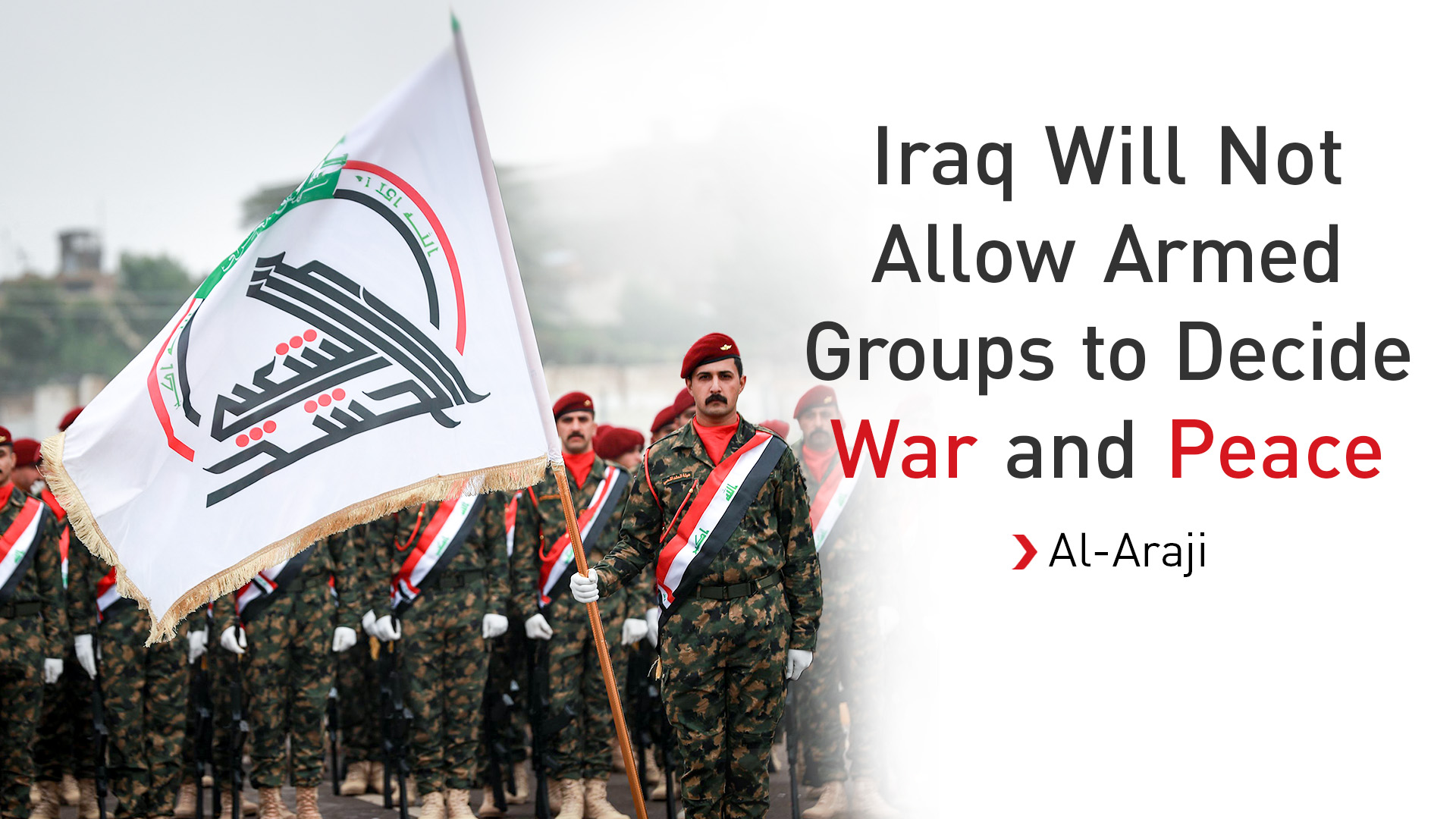
ERBIL (Kurdistan24) - Iraq will begin implementing a gradual program to bring weapons held by armed factions under exclusive state control following the scheduled Sept. 30 departure of international Coalition forces, Security Advisor to Iraq's Prime Minister Qasim al-Araji said, declaring that decisions over war and peace must belong solely to the Iraqi state.
Al-Araji described restricting weapons to state institutions as a strategic government decision and said Baghdad had established a mechanism and timetable for separating armed groups from political parties and facilitating the surrender of their weapons.
"The decision for war and peace lies solely with the state," al-Araji said, according to information provided to Kurdistan24.
He stressed that Iraqi sovereignty must be respected and that no political or armed actor would be permitted to make independent decisions capable of drawing the country into conflict.
The remarks represent one of the clearest descriptions yet of how Prime Minister Ali al-Zaidi's government intends to approach the politically sensitive weapons file after Sept. 30, a date that has increasingly become a dividing line in Iraq's debate over the future of armed factions.
Al-Araji said the process would be gradual and methodical rather than confrontational, with the government seeking to avoid provocations that could trigger internal instability.
He also sought to address one of the arguments repeatedly advanced by armed factions: that their weapons remain necessary while foreign forces operate in Iraq.
According to al-Araji, the military phase of the war against ISIS has largely ended, although terrorist cells and hideouts remain and the organization has not been completely eliminated.
The scheduled Coalition departure, he said, would therefore provide the starting point for a new phase in which the state seeks to consolidate control over armed force.
Sept. 30 becomes starting point
The significance of Sept. 30 extends beyond the withdrawal timetable.
For years, several Iran-aligned Iraqi factions have justified maintaining independent military capabilities partly on the grounds of resisting the presence of US and international forces. Their departure would remove one of the principal arguments those groups have used against surrendering their weapons.
Al-Araji said the government intends to ensure that surrendered weapons go exclusively to Iraqi state institutions rather than to any foreign party.
He also asserted that Baghdad has broad political support for the policy and possesses the capacity to implement it without producing a political crisis.
That assessment, however, contrasts with increasingly public warnings from several political and armed actors.
The Badr Organization, one of Iraq's most influential Shiite political and armed movements, has warned that forcibly disarming factions could trigger internal conflict.
Read More: Badr Warns Disarming Iraqi Armed Groups Could Trigger Civil War
Mohammad Naji, head of Badr's political office, previously argued that any weapons settlement should depend on the full withdrawal of US forces, the removal of strategic threats to Iraq and the rebuilding of the country's military capabilities, particularly air defenses.
Read More: After the Coalition: Iraq's Harder Fight Over Weapons and Power
The Nujaba Movement has been more explicit, publicly rejecting the surrender of its weapons.
Other factions have similarly tied any handover to the departure of foreign forces, making the Sept. 30 withdrawal date a critical test of whether those conditions were tactical negotiating positions or more fundamental resistance to state control.
Kurdistan24 previously reported that armed-group leaders and members of the Shiite Coordination Framework had been conducting negotiations aimed at preventing an armed confrontation as the deadline approaches.
Some political figures have nevertheless warned that failure to reach an agreement could produce internal violence.
Aqeel al-Rudaini, spokesman for the Nasr Alliance, previously told Kurdistan24 that an unresolved confrontation between the government and armed factions after the deadline could push Iraq toward civil conflict.
Read More: Iraq's Militia Disarmament Hits a Wall as Civil War Warning Shadows the September 30 Deadline
Five armed groups remain in talks
Al-Araji said the government is currently negotiating with five armed organizations that have yet to surrender their weapons: Harakat al-Nujaba, Kataib Sayyid al-Shuhada, Kataib Hezbollah in Iraq, Saraya Awliya al-Dam and Ashab al-Kahf.
The negotiations appear designed to produce voluntary compliance before Baghdad considers stronger enforcement measures.
According to al-Araji, three major groups have already surrendered their weapons to the state and shifted toward civilian political activity: Saraya al-Salam, led by Muqtada al-Sadr; Asa'ib Ahl al-Haq; and Kataib Imam Ali, led by Shibl al-Zaydi.
Al-Zaydi's position has already had political consequences.
Read More: Shibl al-Zaydi Joins Iraq’s Shiite Coordination Framework Leadership
Kurdistan24 reported Saturday that the Kataib Imam Ali commander had joined the leadership meetings of the Shiite Coordination Framework after announcing his readiness to surrender the group's weapons.
Abbas Ameri, secretary-general of the Coordination Framework, said all of the bloc's leaders had approved al-Zaydi's participation.
By contrast, Abu Ala al-Walai, head of Kataib Sayyid al-Shuhada, had been excluded from previous meetings after refusing to commit to weapons handover.
The differing treatment illustrates how the disarmament process is already reshaping political relationships within Iraq's dominant Shiite political camp.
The challenge facing Baghdad is particularly complicated because many armed factions developed political parties, parliamentary representation and economic networks alongside their military structures.
Some formations also operate within or alongside the Popular Mobilization Forces, which have formal status in Iraq's state security system, creating longstanding ambiguity over where official command ends and independent factional authority begins.
The government has therefore framed the issue not merely as weapons collection but as a restructuring of the relationship between political organizations and armed power.
Al-Araji's reference to separating armed groups from political parties is particularly consequential in that respect. If implemented, it would address a system in which military capability has sometimes functioned alongside political participation and influence.
A wider test of Iraqi sovereignty
The weapons debate has become more urgent amid intense regional tensions and repeated questions over whether Iraqi armed factions can independently conduct military operations without authorization from Baghdad.
Some Iran-aligned groups participated in attacks against US and regional interests during the recent US-Israel conflict with Iran, adding pressure on the Iraqi government to demonstrate that decisions involving military force originate from state institutions.
Baghdad has repeatedly insisted that Iraqi territory must not be used to launch attacks against neighboring states.
For al-Araji, that principle now appears inseparable from the disarmament policy: sovereignty cannot be complete if individual organizations retain the ability to make decisions over armed confrontation independently of the government.
Recent events have demonstrated the difficulty of translating that principle into practice.
The arrest this month of PMF intelligence official Abbas Yaqoubi triggered warnings of escalation from armed-group leaders, according to a PMF source cited by Kurdistan24. Yaqoubi was subsequently acquitted by a Baghdad court.
Read More: Baghdad Court Acquits PMF Intelligence Official After Two-Day Detention
The episode illustrated the degree of political and security leverage retained by factions connected to the broader PMF environment.
At the same time, Baghdad has begun practical measures intended to strengthen institutional control. The Interior Ministry previously said authorities had closed 71 unauthorized bases and registered more than 500,000 weapons as part of a national firearms database.
The PMF Commission denied that the closed facilities were formally affiliated with it, highlighting the government's effort to distinguish recognized security institutions from unauthorized armed structures.
Al-Araji's comments now place those measures within a broader political timetable.
If the Coalition withdrawal proceeds as scheduled, the government will lose the foreign-presence argument that has dominated much of the armed factions' justification for retaining weapons. What follows will test whether Baghdad can convert political declarations about sovereignty into actual command over the use of force.
Al-Araji expressed confidence that the process could proceed without producing a political crisis.
The negotiations with five holdout groups, warnings from Badr and other factions, and divisions already visible within the Coordination Framework suggest that implementing that policy may prove more difficult than announcing it.
Sept. 30 may therefore mark less the conclusion of Iraq's weapons dispute than the beginning of its most consequential phase: determining whether the authority to decide war and peace can finally rest with one state rather than with competing centers of armed power.