Duhok Farmer Grows 18 Grape Varieties as Province Leads Iraq
Duhok expects up to 80,000 tonnes of grapes this year as farmers cultivate 105 varieties and the KRG restricts imports to protect local production.
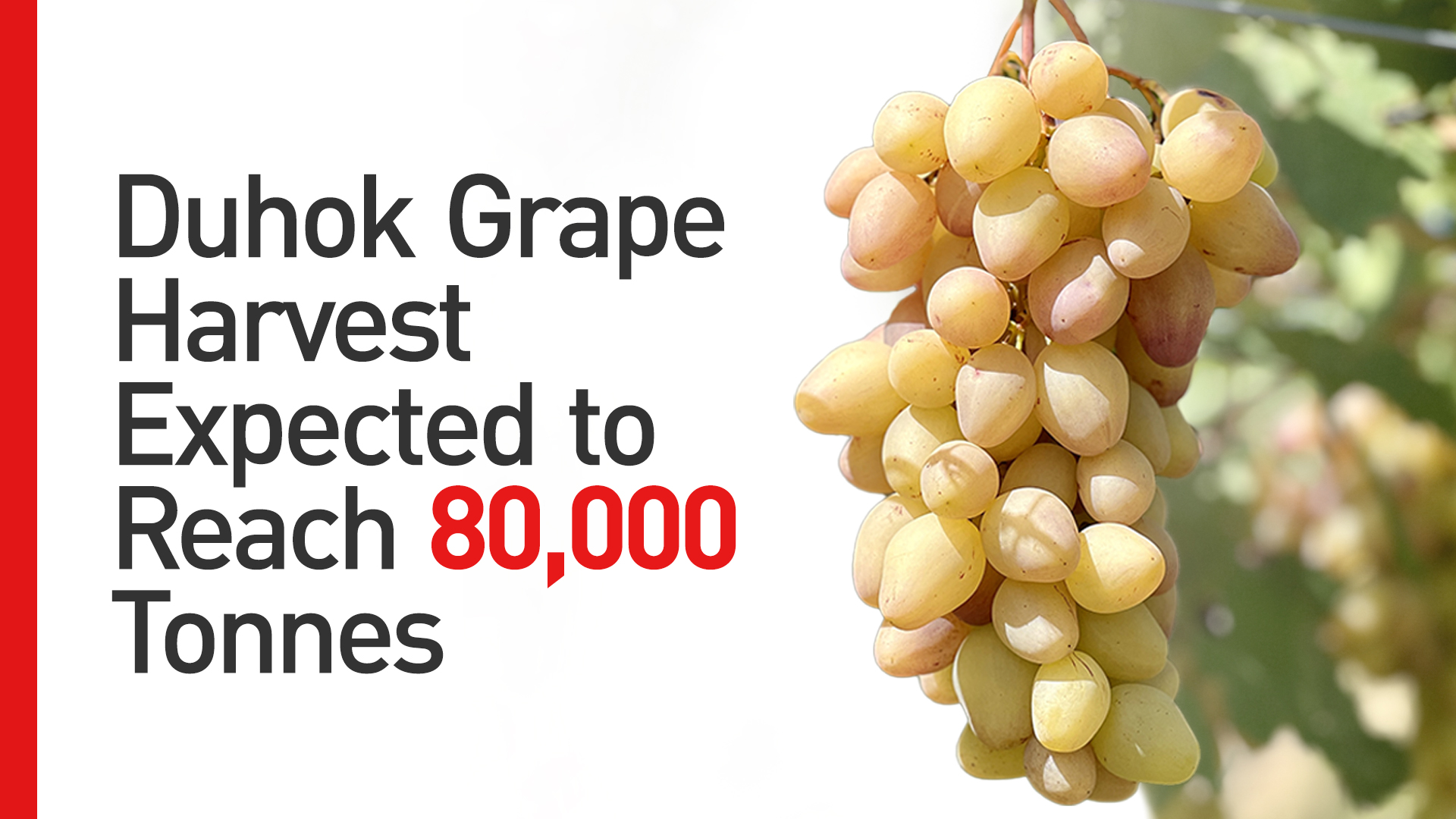
ERBIL (Kurdistan24) - In an orchard in Duhok province, farmer Hussein Dergazhniki is cultivating 18 different grape varieties this season, part of a growing agricultural industry expected to produce as much as 80,000 tonnes and reinforce Duhok's position as Iraq's leading grape-producing province.
For Dergazhniki, the diversity of the harvest is also an economic calculation. Consumer demand has strengthened, he says, while improvements in quality and access to markets are giving farmers greater confidence that their crops can generate a sustainable income.
"There is strong demand for grapes, particularly the French variety, which is excellent for both juice production and consumption," Dergazhniki told Kurdistan24 reporter Bewar Hilmi.
"We also grow other varieties. Halawani and Rish Glopi grapes are good, but demand for the French variety is higher than for all the others," he said.
His orchard reflects the extraordinary diversity of Duhok's viticulture. Farmers across the province cultivate around 105 grape varieties, ranging from long-established local types to varieties introduced or expanded to meet changing consumer and processing demand.
This year, vineyards cover around 25,000 dunams across Duhok, with officials projecting total production of between 75,000 and 80,000 tonnes.
If that forecast is reached, Duhok will maintain its standing as Iraq's largest grape-producing province.
Protecting the local harvest
The Kurdistan Regional Government has moved to protect that production during the main harvest period by suspending imports of foreign grapes from July 1 through Nov. 15.
The policy is designed to prevent cheaper imported produce from flooding markets while Kurdish farmers are harvesting and attempting to sell their own crops.
"No foreign grapes will be permitted to enter the Kurdistan Region," Ahmed Jamil, director-general of agriculture in Duhok province, told Kurdistan24.
The restriction is part of a broader KRG policy increasingly used for seasonal agricultural products: limiting or regulating imports when sufficient local production is available, with the aim of giving domestic farmers greater access to the market.
For grape growers, that protection is particularly important because large harvests can quickly create oversupply. Grapes are perishable, and without sufficient buyers, storage facilities or processing capacity, prices can fall sharply at the height of the season.
Officials are therefore also working to connect growers with buyers outside Duhok.
Jamil said Kavin Greenhouse Company would again purchase grapes directly from farmers and collect them through several designated centers.
"We also advise traders and farmers to send their produce to central and southern Iraq, where it commands a better price," he said. "This will also help prevent grape prices from falling."
Duhok grapes already have a strong market across Iraq, supported by their reputation for flavor, variety and quality.
Moving a greater proportion of the harvest to Baghdad and southern provinces could help absorb the expected increase in production while giving farmers access to larger consumer markets.
From 60,000 to as much as 80,000 tonnes
The latest projection represents a substantial rise from the approximately 60,000-tonne harvest reported during Duhok's grape season in 2025.
At last year's 18th Grape and Honey Festival, Kurdistan24 reported that 105 grape varieties were on display and that producers had maintained a strong harvest despite drought conditions.
Farmers had increasingly relied on improved irrigation and cultivation techniques to sustain output.
The festival also demonstrated how grape production in Duhok has evolved beyond a traditional household or village activity into a more organized commercial sector.
Growers used the event to meet buyers, exchange information and showcase varieties to traders and visitors from inside and outside the Kurdistan Region.
Some farmers have developed exceptionally diverse orchards. Previous Kurdistan24 reporting has documented growers cultivating dozens of different varieties on a single farm, preserving established types while experimenting with grapes suited for fresh consumption, juice production and other uses.
Dergazhniki's 18-variety orchard continues that tradition.
His experience also points to an important change in the market: farmers are increasingly deciding what to cultivate not simply according to tradition, but according to demand.
The stronger appetite for the French variety, for example, gives growers information that can influence future planting decisions and investment.
Processing creates another market
One of the longstanding challenges facing Duhok's grape industry has been what happens when production exceeds fresh-market demand.
In previous years, officials and farmers repeatedly called for processing facilities capable of converting surplus grapes into juice and other products rather than allowing excess harvests to lose value.
That gap has begun to narrow.
Kurdistan24 previously reported that a grape-processing factory in the Mangesh area had been completed, while a larger project was being developed in Semel.
Such facilities can give farmers an additional buyer during periods of abundant production and reduce dependence on the fresh-fruit market alone.
They also form part of the KRG's wider effort to build agricultural value chains in which crops are not only grown locally but processed, packaged and marketed commercially.
The same approach has increasingly been applied to products including potatoes, pomegranates, apples and honey.
Agriculture as economic diversification
Duhok's grape harvest fits into a broader push by the KRG to expand agriculture as an alternative source of income in an economy historically dominated by oil.
The government has sought to improve market access, regulate imports during domestic harvests, promote processing industries and encourage exports.
The Kurdistan Agriculture Export Initiative, launched in 2022, helped open foreign markets for products including Halabja pomegranates and was later expanded to other crops.
Agricultural produce from the Kurdistan Region is also increasingly shipped to markets across federal Iraq, making central and southern provinces an important outlet for Kurdish farmers.
For Duhok, where mountainous terrain and established agricultural traditions have supported grape cultivation for generations, the current challenge is turning that natural advantage into reliable income.
An expected harvest approaching 80,000 tonnes is a sign of production strength, but its success will ultimately depend on prices, processing capacity and the ability to move the fruit efficiently to consumers.
The seasonal import ban, direct purchasing arrangements and efforts to expand sales across Iraq are designed to address those vulnerabilities.
For farmers such as Dergazhniki, those policies matter at orchard level.
His 18 varieties represent both Duhok's long viticultural tradition and an increasingly market-oriented agricultural sector in which diversity, quality and commercial demand are becoming closely connected.
With 105 varieties cultivated province-wide and this year's harvest potentially reaching 80,000 tonnes, Duhok is not merely preserving its reputation for grapes. It is seeking to turn that reputation into a larger and more stable agricultural economy.