KRG Unveils 24-Year Strategy to Shift Kurdistan Toward Surface Water
The KRG has approved a 24-year strategy targeting 75% reliance on surface water by 2050, with 26 new projects adding 2.1 million cubic meters of daily capacity.
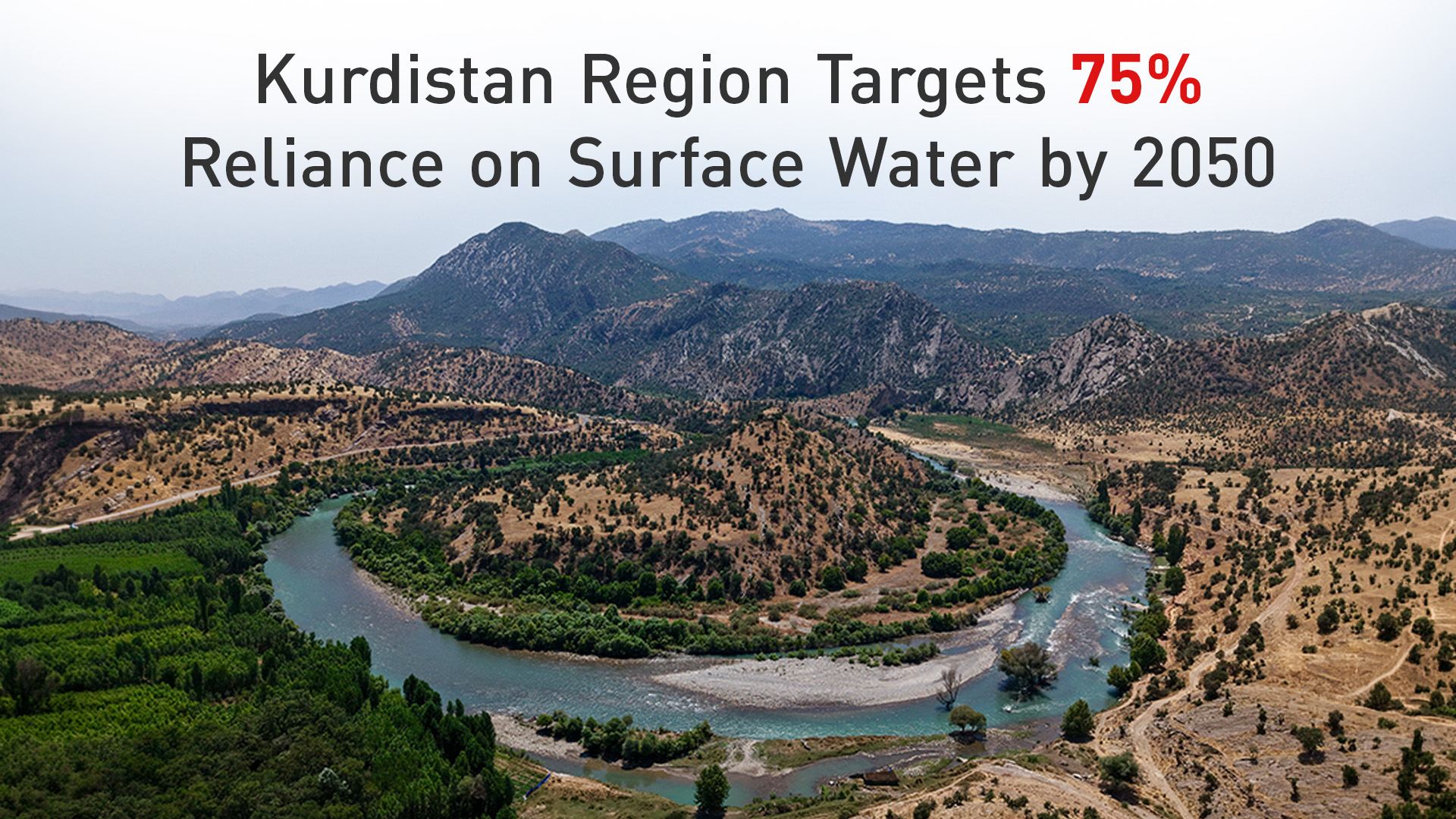
ERBIL (Kurdistan24) - The Kurdistan Regional Government has approved a 24-year water strategy aimed at fundamentally reducing dependence on groundwater and shifting the Kurdistan Region toward rivers, dams, lakes and springs as its principal sources of drinking water.
Ari Ahmed, the Kurdistan Region's director-general of water and sewerage, told Kurdistan24 on Sunday that the plan extends through 2050 and forms part of the Ninth KRG Cabinet's broader strategy to strengthen long-term water security.
Under the plan, surface water would eventually provide 75% of the Kurdistan Region's water supply, while groundwater would account for the remaining 25%.
The shift would mark a major change from decades of reliance on wells, with 5,810 groundwater wells currently operating across the Region.
Ahmed said the strategy would draw on major waterways including the Tigris, Greater Zab, Little Zab, Khabur and Sirwan rivers, as well as lakes, springs and dams.
26 new strategic projects
The Kurdistan Region currently operates 25 strategic drinking-water projects with a combined daily production capacity of 3,678,563 cubic meters.
"These projects have a combined daily production capacity of 3,678,563 cubic meters of water, averaging approximately 153,000 cubic meters per hour," Ahmed said.
The government plans to construct another 26 strategic surface-water projects across cities and towns over the coming 24 years.
Once implemented, the new schemes are expected to add approximately 2.1 million cubic meters of drinking-water production per day.
According to Ahmed, the long-term infrastructure is being planned to serve a population of approximately 11.66 million people.
The central objective is to meet population growth and urban demand without placing corresponding pressure on underground aquifers.
Reducing dependence on groundwater
The new strategy builds on a broader policy already underway to protect depleted groundwater reserves.
KRG officials have repeatedly warned that decades of intensive and, in some areas, poorly regulated well drilling have placed significant pressure on underground water.
Climate change, repeated drought and lower rainfall have compounded that challenge.
The government has therefore increasingly treated surface-water infrastructure and groundwater conservation as two parts of the same policy.
In Erbil, one of the clearest examples has been the Emergency Water Supply Project, which draws water from the Greater Zab and has treatment capacity of approximately 480,000 cubic meters per day.
Kurdistan24 previously reported that the expansion of surface-water schemes enabled authorities to close 930 groundwater wells across Erbil Governorate, including wells in Qushtapa and Barzan.
Similar projects are being developed elsewhere.
A third water line from Dukan is under implementation for Sulaimani, while projects have also advanced in Akre, Darbandikhan, Chamchamal and Bardarash. Other schemes have been approved for Khabat, Koya, Kalar and Soran, subject to funding and implementation requirements.
Dams and ponds form part of wider strategy
Surface-water expansion is also closely connected to the KRG's dam and pond construction program.
In October 2025, the government said nine dams had been constructed under the Ninth Cabinet at a cost of approximately 266 billion Iraqi dinars, providing combined storage capacity of around 253 million cubic meters.
The government had also completed 23 ponds, while another 58 were under construction.
Projects such as Bastora Dam, with storage capacity of 20 million cubic meters, and Gomaspan Dam, which can hold approximately 97 million cubic meters, have been designed to serve multiple purposes including water storage, irrigation, flood mitigation and groundwater replenishment.
The unfinished Dwin Dam is designed for approximately 100 million cubic meters of storage once completed.
Smaller ponds have also been promoted as a way to capture rainfall near agricultural communities, support irrigation and allow more water to seep back into depleted aquifers.
Improving supply also means cutting losses
Increasing production alone will not resolve the Region's water challenges if large quantities continue to be lost through distribution networks.
The KRG has therefore begun introducing digital monitoring and other measures designed to identify damaged pipes, leaks and unauthorized interference.
A pilot project launched in Qushtapa in July set a target of reducing water losses from around 40% to approximately 15%.
Authorities have said wider implementation could take around two years.
The combination of new supply infrastructure and reduced network losses reflects an increasingly integrated approach to water management: secure more surface water, preserve underground reserves and ensure that a greater share of treated water actually reaches consumers.
Implementation remains the key challenge
The scale of the new 2050 strategy also means that implementation will depend on sustained financing and construction.
Kurdistan Region officials have previously acknowledged that some dam projects have faced financial and political obstacles.
In June, dams director Rahman Khani said only six of 12 dams at various stages of implementation were actively under construction at that time.
The new 26-project program therefore represents a long-term target rather than water capacity immediately available to consumers.
If completed as planned, however, it would substantially alter the structure of the Kurdistan Region's water system.
Rather than continuing to expand groundwater extraction as cities grow, the government intends to meet future demand primarily through the Region's rivers and stored surface water.
By 2050, the KRG's objective is for three-quarters of the water supply to come from those sources, reducing pressure on thousands of wells and turning groundwater increasingly into a protected reserve rather than the backbone of everyday drinking-water provision.