Xi Jinping's Oil Stockpile Just Proved Its Worth Against the West
The Iran war has validated Xi Jinping's decade-long strategy of building the world's largest oil stockpile, giving Beijing unprecedented power over global energy markets and a critical new defense against Western pressure
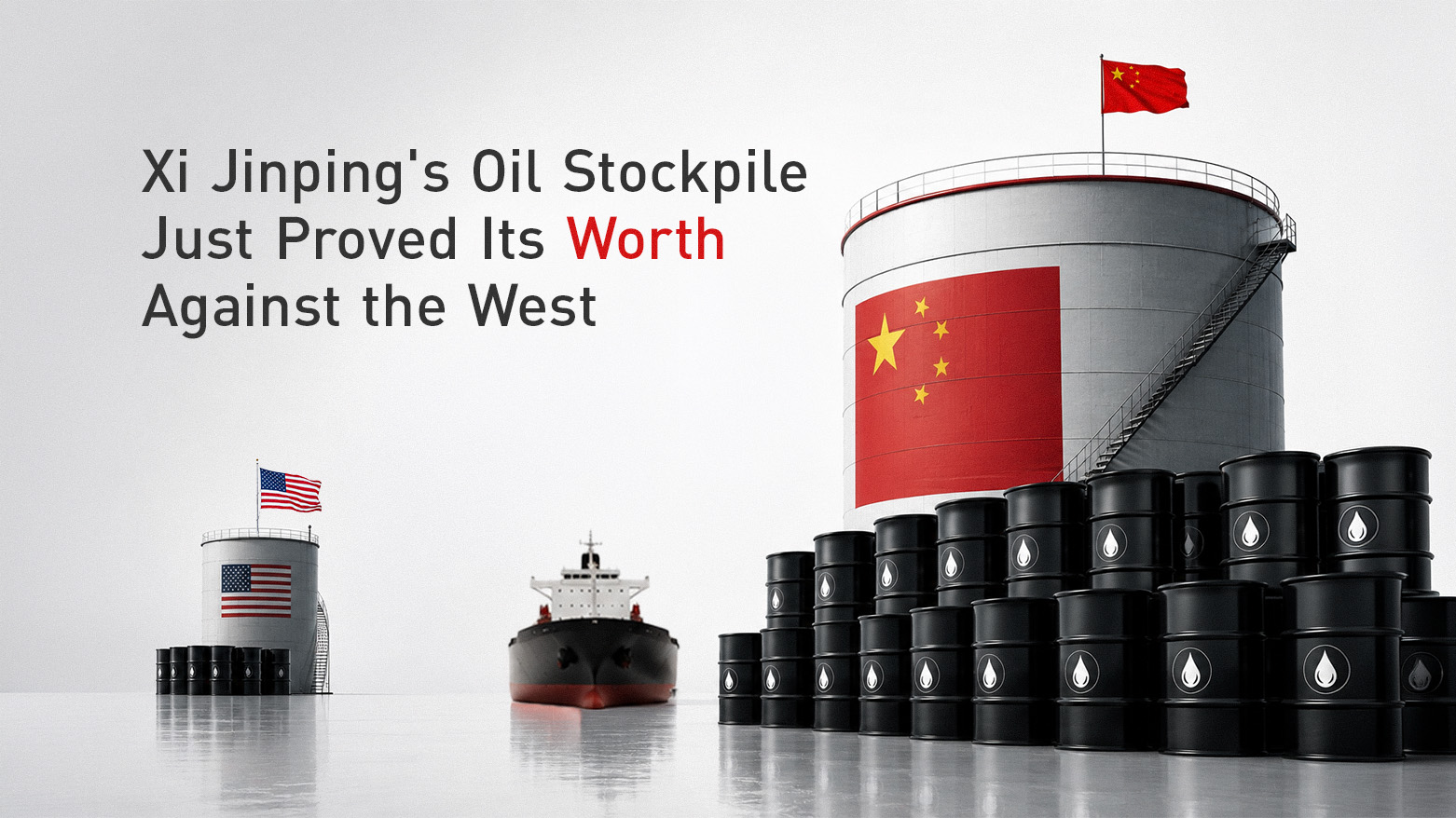
ERBIL (Kurdistan 24) - When the United States and Israel struck Iran in late February, China was ready. Years of deliberate strategic investment had given Beijing the world's largest oil stockpile, a reserve so vast that it allowed China to dramatically slash its crude imports as the conflict unfolded, keep a lid on global oil prices, and safeguard its own economy, all while demonstrating to Washington exactly what kind of leverage its energy policy had quietly assembled.
The Wall Street Journal reported on Sunday that by some estimates China's oil reserves last year were nearly 600 million barrels larger than those held by the United States, a gap that has given Beijing a swing-buyer position in global energy markets of a scale and consequence that Western policymakers had not fully appreciated before the Iran war began.
Chinese crude oil imports fell 23 percent from March to July compared with a year earlier, a deliberate and managed reduction that reflected not scarcity but strategic choice. Rather than scrambling to replace disrupted Gulf supplies, China drew down its reserves, kept its refineries running, and watched as the global oil market absorbed the shock of the Strait of Hormuz's effective closure without the price spike that many analysts had predicted. "Almost from day one there was this sense that, 'We are able to manage this. We don't need to panic,' " said Erica Downs, a scholar at Columbia University's Center on Global Energy Policy, as the Wall Street Journal confirmed on Sunday.
For Xi Jinping, the Iran crisis has been what the Wall Street Journal describes as a major vindication. For decades, Chinese leaders have worried about the country's heavy reliance on imported crude, most of which transits through straits that the United States or allied militaries could seek to block in a conflict. Xi spent years and tens of billions of dollars building the strategic petroleum reserve that the crisis has now validated as one of China's most consequential geopolitical assets.
Researchers at a think tank under state-owned China National Petroleum captured the lesson Beijing has drawn from the conflict, writing in spring 2026 that the Iran war shows that "against the backdrop of the world entering a new period of turbulence and transformation, localized regional conflicts are no longer confined to a specific locale," and that "China's energy sector must maintain bottom-line and extreme-scenario thinking." The language is a direct acknowledgment that Beijing views the Iran crisis not as a Middle East story but as a rehearsal for the scenarios it could face in a conflict over Taiwan.
The Taiwan dimension is the most strategically significant implication of what China's oil stockpile has demonstrated. The United States and its allies have long regarded energy supply disruption as one of their most powerful tools of pressure in any potential Taiwan conflict, relying on the assumption that China's dependence on imported oil transiting vulnerable chokepoints would constrain Beijing's willingness to sustain a prolonged military operation. The Iran war has now provided a real-world test of that assumption, and the result suggests that China's reserves are large enough and its shift away from fossil fuels fast enough to substantially blunt that pressure.
China's quicker-than-expected shift away from fossil fuels has combined with the stockpile to make Beijing the most powerful swing buyer in global energy markets, the Wall Street Journal confirmed. The combination of strategic reserves that can absorb supply shocks and a domestic energy transition that is reducing long-term import dependence gives China a degree of energy security that no previous Chinese leadership has possessed, and that Xi Jinping has pursued with a consistency and scale that has now been vindicated by the most significant energy market disruption of the 21st century.
The geopolitical implications extend well beyond Taiwan. China's ability to manage a 23 percent reduction in crude imports without economic distress, while simultaneously purchasing discounted Iranian oil that Washington's Operation Economic Outcast is trying to block, demonstrates that Beijing has built exactly the kind of energy resilience that Washington's maximum pressure strategy depends on its adversaries not having. As Treasury Secretary Scott Bessent pursues Operation Economic Outcast's objective of severing every Iranian economic lifeline, China's foreign ministry has warned that Beijing's cooperation with Tehran operates within international law and must not be disrupted, backed by the confidence of a country that has demonstrated it can absorb energy shocks that would cripple less strategically prepared economies.