Erbil's 'Dapper Policeman' Appointed Head of Citadel Police Station
Issam Mahmoud Qadir, known as Erbil's "dapper policeman," has been appointed head of the Citadel Police Station as part of continuing police reforms and reorganization.
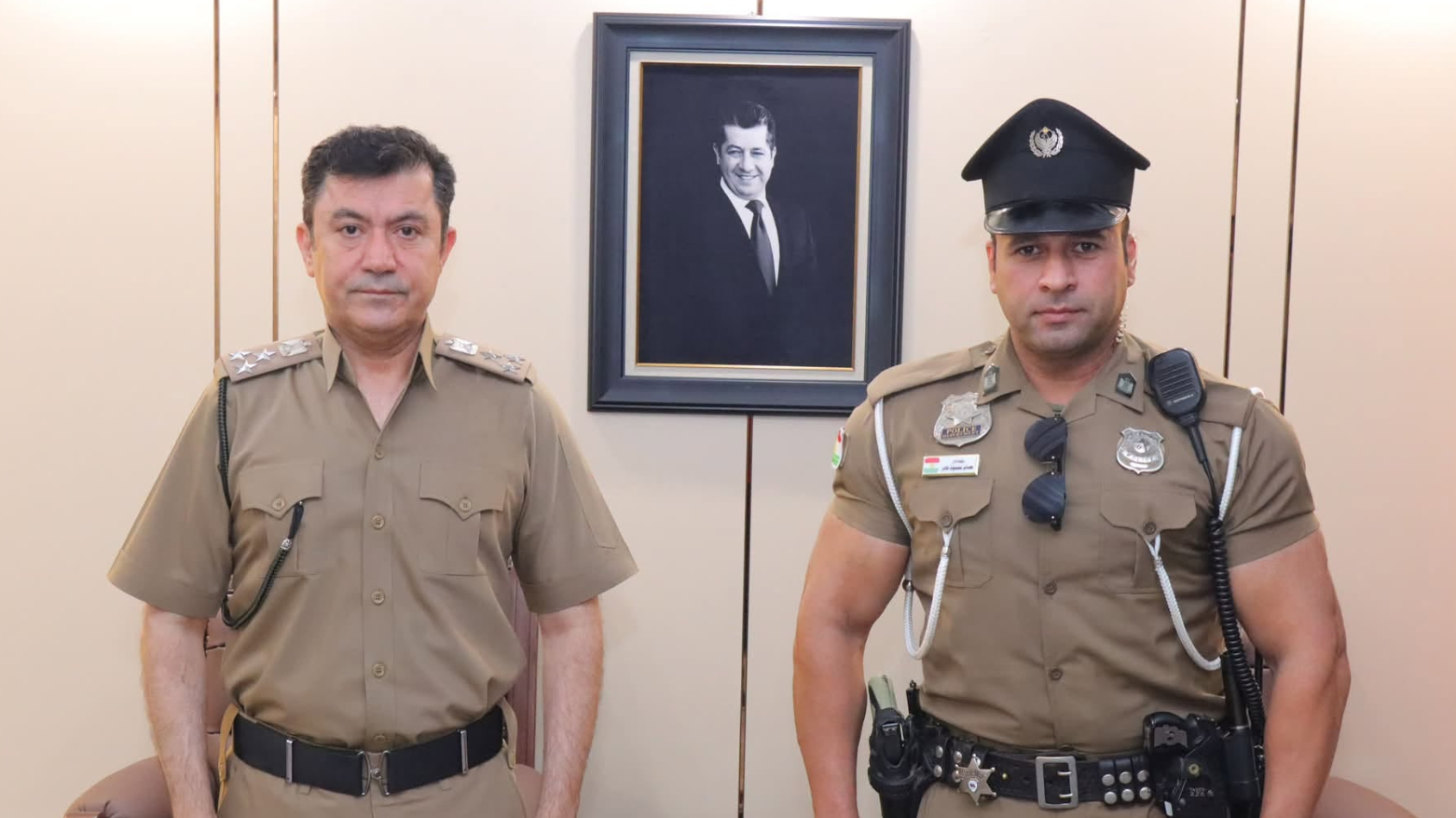
ERBIL (Kurdistan24) - Issam Mahmoud Qadir, widely known as Erbil's "dapper policeman," has been appointed head of the Citadel Police Station as part of continuing reforms and organizational changes within the Erbil Police Directorate.
The appointment was made on the recommendation of Brig. Gen. Kamil Barzinji, director of Erbil Police, according to the directorate.
Qadir told Kurdistan24 that his new responsibility formed part of an effort to reorganize police work and reduce distinctions between commissioned officers and rank-and-file personnel.
He said his priority at the Citadel Police Station would include improving the physical fitness and professional appearance of officers serving at one of Erbil's most visible tourist locations.
"The importance of my appointment is that I will make the other police officers like myself," Qadir told Kurdistan24.
"Because the Citadel is a tourist destination visited by many tourists, I will gradually help the police officers stationed here become physically fit like me."
Qadir has gained public recognition in Erbil for his distinctive appearance, personal fitness and polished presentation while serving in the police force.
He said physical exercise had already been part of his routine before he became well known, but that he began paying even greater attention to maintaining his physique after gaining public recognition.
He added that Kurds living abroad frequently discuss him, reflecting the attention his public profile has attracted beyond Erbil.
Appointment Comes Amid Wider Police Reform
The Erbil Police Directorate said in a statement that the personnel change was intended to create greater balance between officers and other police personnel while reorganizing operations.
The directorate wished Qadir success in his new role, emphasizing his responsibility to serve the city and uphold the rule of law.
His appointment comes as the Kurdistan Regional Government advances a broader police reform strategy intended to modernize policing, strengthen professionalism and improve public trust.
Kurdistan24 reported on Aug. 30 that KRG Interior Minister Reber Ahmed said the Kurdistan Region had entered an important new phase of police reform focused on public confidence, professional conduct, digitalization, leadership development and greater participation by women.
Ahmed said the reform should not be measured simply by administrative changes or revised internal procedures.
Instead, he argued, its success would ultimately depend on whether citizens receive better services and whether police personnel demonstrate greater professionalism in their daily interactions with the public.
Read More: KRG Interior Minister Says Key Phase of Kurdistan Police Reform Is Underway
The current reform program forms part of the Ninth Cabinet's wider institutional agenda under Prime Minister Masrour Barzani.
The government has presented policing as a service-oriented institution in which officers are expected not only to enforce the law but also to build public confidence through conduct, responsiveness and professionalism.
'Blue Concept' and Service-Oriented Policing
The KRG's 2026–2030 Police Reform Strategy is organized around what the government calls the "Blue Concept," a policing model emphasizing service, respect, integrity and confidence.
According to a KRG Department of Media and Information presentation previously reported by Kurdistan24, the reform strategy seeks to strengthen public trust, improve crime prevention and build policing practices grounded in the rule of law and respect for human rights.
The government has said that more than 10,000 police officers and other personnel have participated in professional development programs connected to the reform process.
Since July 2025, strategic support from the European Union Advisory Mission in Iraq has also helped train 35 local master trainers in service-oriented policing, human rights and reform principles.
Those trainers are expected to help embed the reform within the Kurdistan Region's own police institutions.
Four police stations have also been selected as pilot locations for testing the new approach: Kasnazan in Erbil, Saiwan in Sulaimani, Nizarke in Duhok and Central Police Station in Halabja.
The pilot program focuses on station organization, service delivery, public engagement and professional capacity.
Read More: KRG Details 2026-2030 Police Reform Strategy Built Around Public Trust
Although the Citadel Police Station is not among those four pilot sites listed in the KRG's reform program, Qadir's appointment comes within the same broader period of restructuring and professionalization inside the police service.
His role also carries particular public-facing significance because of the location.
The Erbil Citadel is one of the city's most prominent landmarks and a major destination for visitors, placing officers stationed there in frequent contact with residents, tourists and international visitors.
For Qadir, that visibility makes physical presentation and professionalism particularly important.
His emphasis on fitness reflects his own public image, but also speaks to the wider objective of creating a disciplined and professional police presence at a highly visible location.
The larger KRG reform agenda similarly emphasizes that police officers are often one of the most direct points of contact between citizens and the government.
Interior Minister Ahmed has argued that trust in police institutions will be one of the central indicators of whether the reform succeeds.
The KRG has therefore sought to move the debate over policing beyond traditional security functions toward questions of service, accountability, leadership and institutional culture.
Digitalization is another component of the reform strategy, with the Interior Ministry seeking to improve crime prevention, investigation transparency and the efficiency of services through modern systems.
Police colleges are also expected to adopt new curricula aimed at developing future leaders capable of strategic decision-making and institutional management.
The reform strategy further calls for greater participation by women in police ranks and leadership positions, reflecting the government's stated goal of creating institutions that better represent the society they serve.
Qadir's appointment at the Citadel Police Station represents a more localized element of that wider process.
For the Erbil Police Directorate, the immediate objective is to reorganize personnel and improve operations at the station.
For Qadir, the assignment carries a distinctly public dimension.
Having become recognizable in Erbil for his fitness and appearance, he now says he wants to transfer some of those standards to the officers under his responsibility.
At a police station serving one of Erbil's most visited landmarks, his new position will test how that highly personal public image translates into leadership, daily police work and service to the city.