Ammar al-Hakim: We Are Determined to End Attacks on the Kurdistan Region
Ammar al-Hakim says Iraq is determined to end attacks on the Kurdistan Region and that the Sept. 30 coalition withdrawal signals improving security and sovereignty.
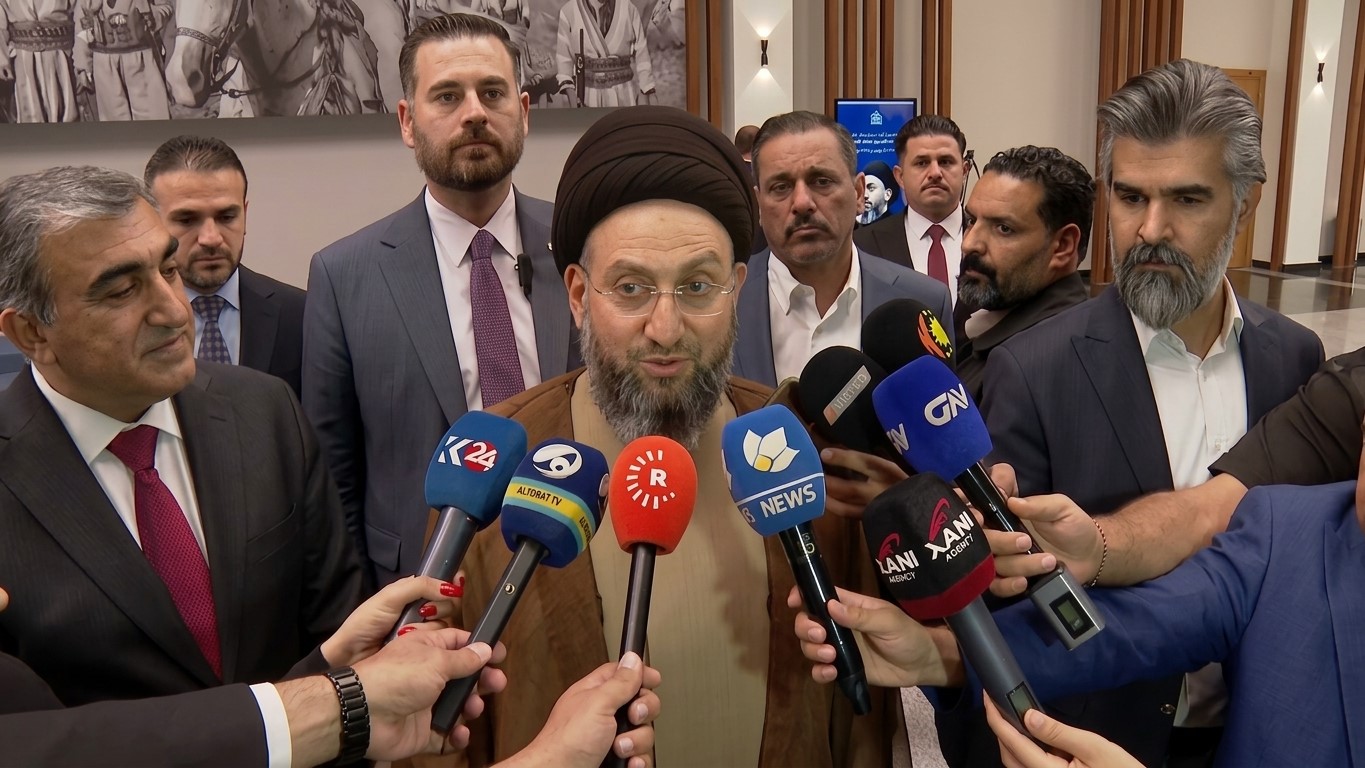
ERBIL (Kurdistan24) - Ammar al-Hakim, leader of Iraq's National Wisdom Movement, said Tuesday that efforts would continue to end attacks on the Kurdistan Region, stressing that its security and stability are inseparable from those of Iraq as the country approaches the scheduled end of the U.S.-led coalition's military mission.
Speaking during a visit to Duhok on Tuesday, Hakim told Kurdistan24 that the planned withdrawal of international coalition forces at the end of September sends a message that Iraq is recovering from years of conflict and instability.
Responding to a question from a Kurdistan24 correspondent, Hakim said Iraq had succeeded in defeating terrorism through the sacrifices of its people and through regional and international cooperation.
He described the conclusion of the coalition's mission as an indication that security conditions had improved and that Iraq had moved beyond some of the challenges that previously required a large international military presence.
Hakim also stressed that the Kurdistan Region cannot be treated separately from the wider security of the country.
"The security and stability of the Kurdistan Region are inseparable from the security and stability of Iraq," he said.
Hakim Pledges to End Attacks
Hakim said there was a determination to bring an end to attacks targeting both Iraq and the Kurdistan Region.
He added that efforts would continue to prevent violations of Iraqi sovereignty by any party in the future.
His comments come as the Kurdistan Region has faced repeated attacks during periods of wider regional confrontation, making the question of sovereign control over Iraqi territory and airspace increasingly prominent in political debate.
Hakim's remarks framed the issue as a national one rather than solely a Kurdistan Region concern, tying the protection of Erbil and other areas to the broader stability of the Iraqi state.
The Iraqi government and the United States previously agreed to conclude the military mission of the international coalition against ISIS in Iraq, with the withdrawal process scheduled around the end of September.
Iraqi political forces, particularly parties within the Coordination Framework, have strongly supported the move and presented it as an assertion of national sovereignty.
Hakim likewise characterized the transition as a sign that Iraq is capable of assuming greater responsibility for its own security.
Coalition Withdrawal and State Control of Weapons
The approaching Sept. 30 deadline also comes as Baghdad intensifies discussions over weapons held by armed factions outside effective federal control.
Kurdistan24 reported on Sept. 4 that Lt. Gen. Saad Maan, head of Iraq's Security Media Cell, said the federal government had moved beyond debating whether armed factions should be disarmed and was now concentrating on how to implement that policy.
Maan said Baghdad had "all options" available, although he did not specify what those options involved.
He presented the withdrawal of foreign forces and the regulation of weapons as connected elements of a wider sovereignty agenda: international forces leave Iraq while armed authority inside the country is brought under constitutional state control.
Maan also emphasized that decisions concerning national security, war and peace should be made through Iraq's constitutional institutions.
Read More: Saad Maan: Iraq Has 'All Options' to Disarm Militias
That issue remains politically sensitive because the Popular Mobilization Forces are legally part of Iraq's state security establishment, while individual factions within or alongside that structure may retain their own leadership, command arrangements and weapons.
The distinction is central to the government's stated objective.
Bringing weapons under state control does not necessarily mean dismantling legally recognized security institutions; rather, Baghdad's challenge is ensuring that no armed organization retains the ability to make independent military decisions outside federal authority.
According to reporting cited by Kurdistan24, some armed factions have shown varying degrees of willingness to discuss disarmament or integration, while others have resisted surrendering their arsenals.
Separate reports have suggested that some factions proposed suspending armed activity while retaining weapons for a limited period, but those details were attributed to anonymous political sources and have not been publicly confirmed by all parties involved.
Maan's comments indicated that the government continues to favor negotiated mechanisms and what he called "security diplomacy," even while maintaining that other options remain available.
Hakim's statements in Duhok fit within that broader discussion.
By describing the coalition withdrawal as evidence of Iraq's recovery while simultaneously insisting that attacks on the Kurdistan Region must end, he placed foreign troop departure and internal sovereignty within the same political framework.
For Hakim, the end of the coalition mission should signal not only a reduction in the need for international military assistance, but also a stronger Iraqi state capable of protecting all of its territory.
That includes the Kurdistan Region.
His insistence that its security is inseparable from Iraq's wider stability underscores the growing political expectation that the post-coalition period must be accompanied by stronger federal-regional security coordination and greater control over any armed activity that could expose Iraqi territory to renewed confrontation.
With the Sept. 30 transition approaching, the immediate test will be whether Iraq can translate that sovereignty agenda into practical security arrangements capable of preventing further attacks while preserving stability across both federal Iraq and the Kurdistan Region.