Through Needle and Thread, a Young Designer Reclaims Kurdish Heritage
"I wanted to bring back elements of Kurdish clothing that aren’t worn anymore," Kurdish designer Lana Zana Piran said.
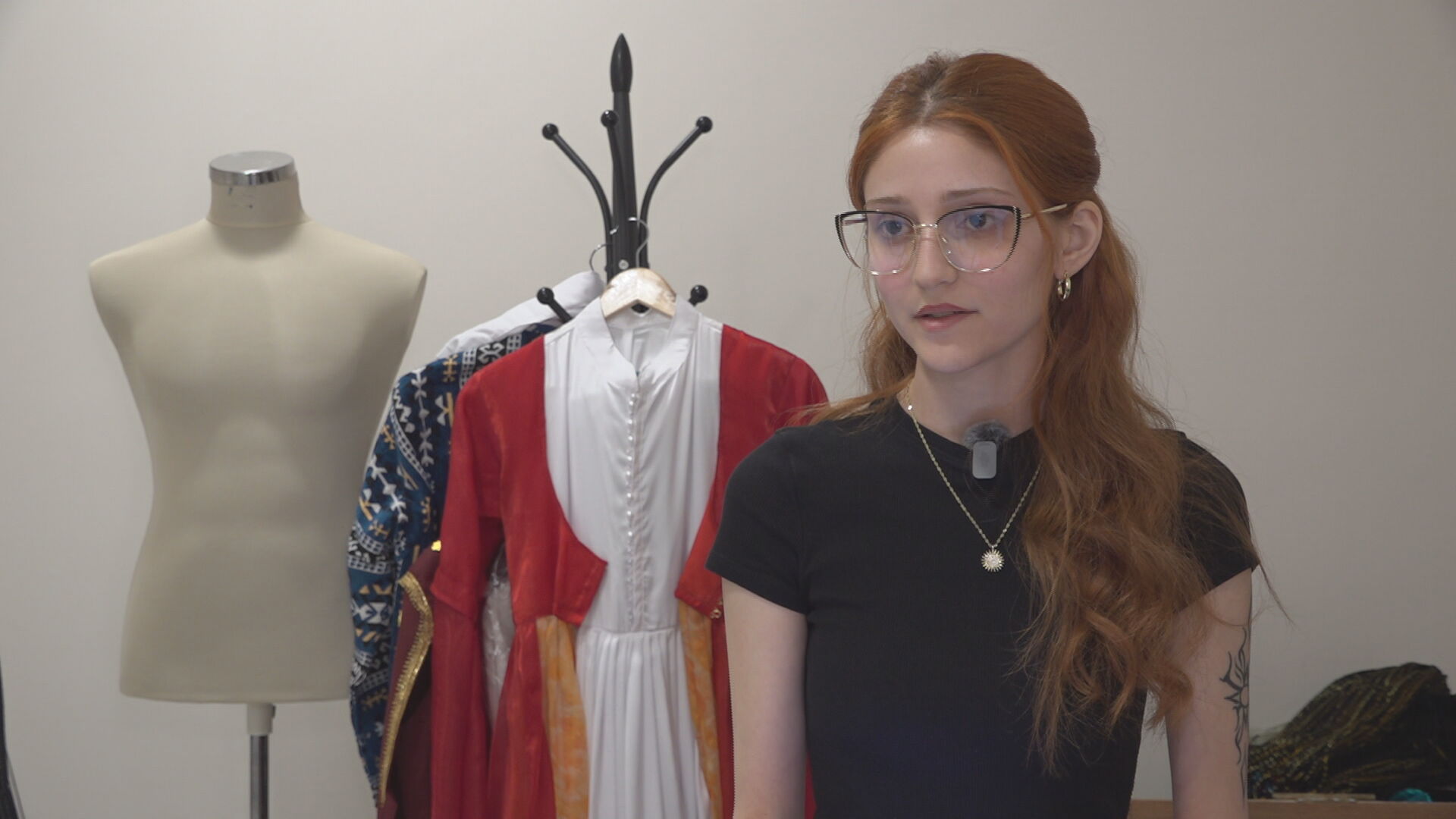
ERBIL (Kurdistan24) - At 20, Lana Zana Piran has already spent three years working on her first fashion collection. Yet the direction of that work is less about imagining what Kurdish clothing might become than asking what has already been left behind.
Piran, a fashion designer interviewed by Kurdistan24, calls the collection "Dunadun." She said the name comes from the Yarsani religious tradition and means "rebirth", an idea that became the organizing principle of the project.
"I wanted to bring back elements of Kurdish clothing that aren't worn anymore," she said.

For Piran, Kurdish dress is not simply material for contemporary reinterpretation. It carries history, and she worries that history can be diminished when traditional clothing is altered too freely in pursuit of modernity.
"I try to focus more on the traditional parts rather than the modern parts," she said. "I feel like making something traditional modern is kind of sad because history can get lost like that."
Her approach begins with looking backward.
Piran studies old photographs, identifying garments and details that have largely disappeared from everyday use, then works to return some of them to clothing that can be worn again. Among the examples she showed Kurdistan24 was a traditional dress associated with Kurdish communities in the Urmia region.
That attention to locality matters because Kurdish clothing has never been one uniform costume.

Historical and scholarly accounts instead describe a broad family of dress traditions shaped by geography, community, economic circumstances and local custom across areas now divided among Iraq, Iran, Türkiye and Syria.
The scholarly volume Kurdish Culture and Identity, edited by Philip Kreyenbroek and Christine Allison, describes broad regional traditions that include northern Kurdish, Badinani-Hakkari, Sorani and Mahabad-Saqqez forms.
Even those classifications cannot capture every variation: neighboring districts could develop distinct fabrics, cuts, headwear and methods of decoration.
Women's clothing traditionally relied heavily on layering.
Long dresses could be combined with trousers, jackets, waistcoats, sashes, aprons, jewelry and different forms of head covering. Metallic embroidery, beads, coins and elaborate belts were often associated with formal or celebratory clothing, while everyday garments tended toward more practical designs.
Men's dress likewise varied by locality.

Loose trousers, shirts, fitted jackets and broad sashes became widely recognizable features, including the ensemble commonly known in the Kurdistan Region as shal u shapik. Headwear, fabrics and tailoring could once convey where someone came from or which community they belonged to.
Behind the finished garment stood another layer of history: the craftspeople who made it possible. Weavers, tailors, embroiderers, dyers and metalworkers contributed to clothing that could function almost as a visual language, communicating place, social position, age or marital status.
Modern life has blurred many of those distinctions.
Urbanization, factory-produced fabrics and changing tastes have reduced the everyday presence of some older forms. Traditional Kurdish dress nevertheless remains highly visible at weddings, Newroz celebrations and Kurdish Clothing Day on March 10.
For Piran, preserving that inheritance does not mean freezing every garment exactly as it once existed. Her designs allow some change, but deliberately keep it limited.
She is similarly cautious about the idea of turning Kurdish clothing into a global fashion product.
"I don't think Kurdish clothing should become a global fashion brand because I feel like it might change too much if you want to make it for everybody," she said, adding that preserving its traditional character matters more to her than making it universally marketable.

That tension, between preservation and reinvention, sits at the center of Dunadun.
Fashion usually works by looking ahead, asking what people might want to wear next. Piran's first collection reverses the direction of that question. She searches photographs, regional traditions and disappearing forms for things that might deserve another life.
The result is not an attempt to reproduce every historical garment unchanged. It is a young designer's effort to keep older visual memories from becoming merely archival.
For Piran, "rebirth" means allowing those forgotten details to be seen again, not as museum objects, but as clothing capable of carrying part of the past into the present.
