President Barzani Discusses Iraq's Political Future in Al-Sharqiya Interview
President Masoud Barzani discusses Iraq's political and security situation, Erbil-Baghdad relations, and Middle East changes in an interview with Al-Sharqiya.
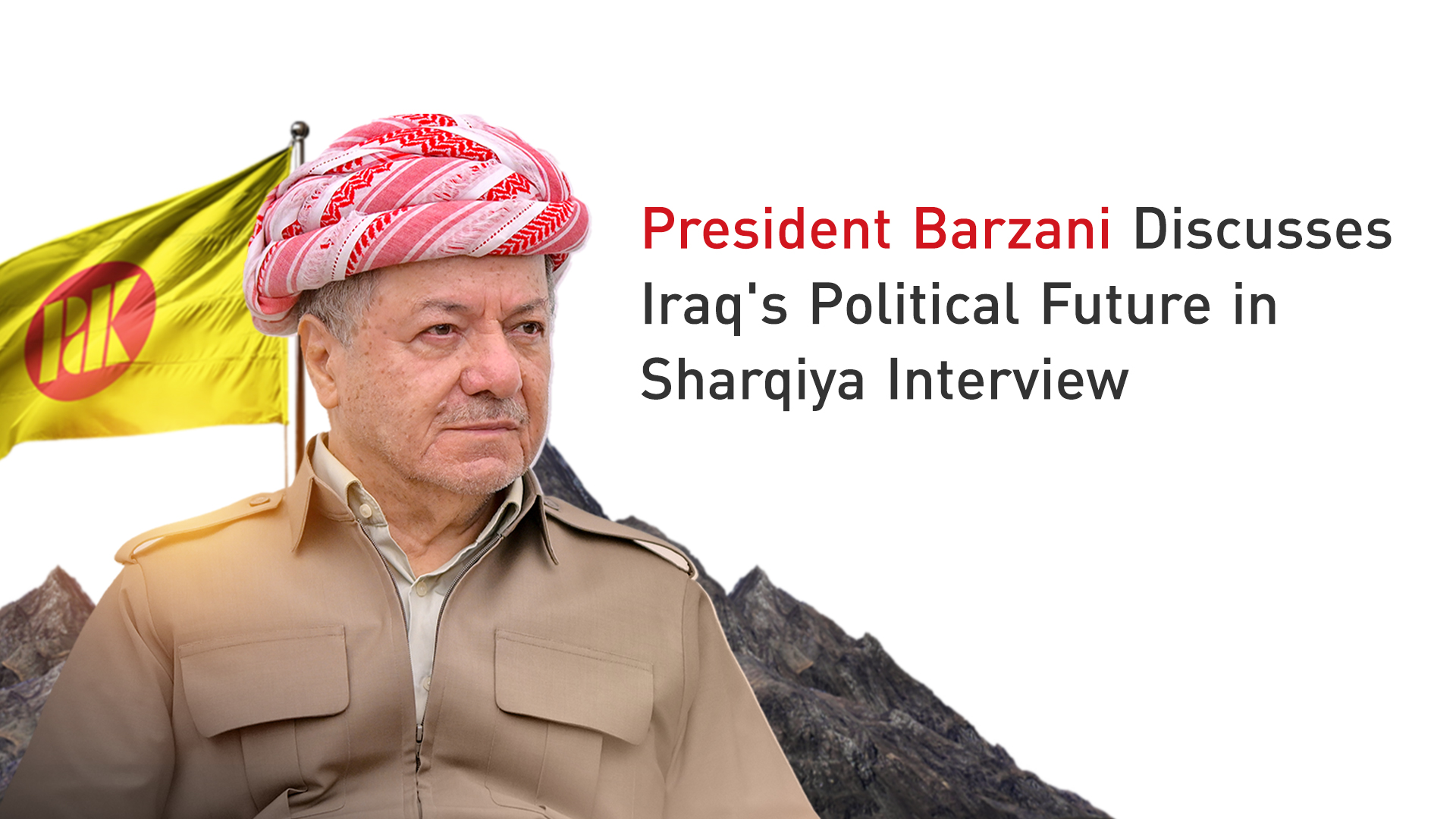
ERBIL (Kurdistan24) - President Masoud Barzani offered an extensive assessment of Iraq’s political and security situation, the constitutional rights of the Kurdish people, the US-Iran war, and the future of the region in an interview with Al Sharqiya, warning that Iraq’s political system could face collapse if the country fails to return to the principles of coexistence and respect for the constitution.
President Barzani said Iraq’s constitutional institutions do not govern the country as they should, arguing that “parallel mini-states” hold power instead. He warned that Iraq must return to the foundations of coexistence and constitutional implementation to preserve the country’s political system.
President Barzani said the fall of the former Iraqi regime in 2003 opened a new phase in the Kurdish people’s struggle, during which the Kurdistan Parliament endorsed federalism as a means of building a new Iraq.
He said a large part of the aspirations and struggle of the Kurdish people had been achieved, but not all of them.
President Barzani described federalism as the fair distribution of power and wealth, but said many officials in Baghdad do not believe in this principle and that a culture of centralized rule remains dominant.
He warned that Iraq had already tested centralized rule through what he described as “iron, fire, chemical weapons, and Anfal,” which ultimately failed and led to the regime’s collapse.
“Centralized rule was previously tested through iron, fire, chemical weapons, and Anfal, and it failed and collapsed. Therefore, any other authority that resorts to the same methods will inevitably meet the same fate,” President Barzani said.
President Barzani said that following 2003, an agreement was reached to build the new Iraq on three main principles: partnership, balance, and consensus.
He said the constitution was written in that spirit but that these principles had not been implemented in practice.
“We face a strange situation. We agree on and sign the government program, but once the government is formed, the constitution and agreements are forgotten, and personal whims become the decision-maker,” President Barzani said.
He also described the constitution as a roadmap for resolving all outstanding issues between Erbil and Baghdad, saying that if it were accepted as an arbiter and mediator, many disputes could be resolved relatively easily.
President Barzani identified the spread of drugs as another major threat to Iraq’s future, alongside corruption and unlicensed weapons.
He said the expansion of drug-related activity could pose a greater danger to the country’s future than either corruption or unlicensed weapons.
Regarding Prime Minister Ali al-Zaidi’s ability to bring weapons under state control, President Barzani said the prime minister could not accomplish the task alone and needed genuine support from the Coordination Framework.
“The prime minister cannot accomplish this task alone. He needs genuine support from the Coordination Framework. They appear to support him, but implementing this issue is very difficult,” President Barzani said.
He expressed hope that the issue would not escalate into internal fighting or confrontation, saying such a conflict would serve neither Iraq nor the Kurdistan Region, nor benefit any side.
President Barzani said he did not believe the issue of unlicensed weapons could easily be resolved even after the Sept. 30 deadline or if it were extended until June 30, 2027.
He attributed the difficulty to individuals who benefit from the existing situation and are unwilling to relinquish their weapons.
President Barzani said the important issue was ensuring that weapons are controlled and used only on the orders of the commander-in-chief, rather than allowing individuals to act according to their own wishes.
“If this is resolved, it will be a success for all of Iraq and for the armed groups themselves,” he said.
He also warned of the consequences of pressure from Washington, saying that failure to resolve the issue could result in US sanctions against Iraq, creating major difficulties and international isolation.
He said resolving the issue peacefully, whether in relation to Iran or any other party, would serve Iraq’s higher interests.
Asked whether an agreement between Washington and Tehran could end the dispute over weapons in Iraq, President Barzani said Iraq’s situation was fundamentally and directly linked to how the war between the United States and Iran ends.
President Barzani expressed deep concern over the withdrawal of US and coalition forces, comparing the situation with the withdrawal in 2011.
He recalled asking Abdul Qader al-Obeidi, who was then defense minister, and Jawad al-Bolani, who was then interior minister, whether Iraq had the ability to defend itself. According to President Barzani, they responded that they did not even have the capacity to protect a single police station.
“The Americans withdrew, and as a result, the catastrophe of ISIS’s arrival occurred in 2014. I am still afraid of a repetition of the same scenario,” President Barzani said.
He recalled that in 2014 the Iraqi government asked the United States, European countries, and NATO for assistance, arguing that the coalition’s air support had been essential to defeating ISIS.
President Barzani said ISIS had suffered a major defeat but remained a real threat.
“The international forces came at the formal request of the Iraqi government and for a specific purpose, which is to assist the Iraqi army and Peshmerga forces against ISIS. But now some believe that ISIS has completely ended and that these forces no longer need to remain. I hope their assessment is correct and that Iraq does not face another catastrophe,” he said.
President Barzani issued a warning to those opposing the United States, saying that if Washington simply stopped sending dollars to Iraq, the country would be unable to pay salaries within two or three months.
He challenged those advocating confrontation with Washington to explain what they would do under such circumstances, particularly given Iraq’s dependence on oil revenues.
President Barzani also reiterated his support for Prime Minister Ali al-Zaidi, describing him as a young man with good and genuine intentions.
He said the Kurdistan Region had fully cooperated with Zaidi in combating corruption and had handed over to Baghdad individuals accused of stealing money who had come to the region.
Responding to questions about continued attacks, President Barzani strongly condemned the strikes and said the Kurdistan Region had no part in the US-Iran war.
He said more than 1,000 missiles and drones had nevertheless been directed toward the region, describing the attacks as a source of astonishment and something he strongly condemned.
Regarding Iran’s internal situation, President Barzani said any change in Iran should come through the Iranian people themselves rather than through foreign intervention.
President Barzani reaffirmed the Kurdistan Region’s constitutional rights, particularly Article 140.
“Article 140 is a living constitutional article. It does not expire, and we will not relinquish it,” President Barzani said.
Regarding the oil and gas law, he said a model draft had been prepared in 2007 with the assistance of international experts, but that Iraq’s then-oil minister rejected it because of what President Barzani described as racist rhetoric directed against the Kurdish people.
President Barzani said Articles 111 and 112 of the Iraqi Constitution establish that oil belongs to all the peoples of Iraq, adding that the Kurdistan Region supports joint management in accordance with the constitution.
He also addressed the Kurdistan Region’s share of the federal budget, saying it should be determined according to the census.
Excluding the disputed territories, President Barzani said the Kurdistan Region’s actual share should be between 14 and 14.5 percent and should be fixed accordingly.
President Barzani described the process of unifying the Peshmerga forces under the Ministry of Peshmerga as a historic and national step.
Addressing Kurds in Syria, he said:
“The Kurds in Syria are a dear part of our body. They must be protected, and we must support them through mutual understanding with the Damascus government so that they can consolidate their situation.”
President Barzani also offered what he described as a historical lesson, stressing the importance of self-reliance rather than dependence solely on external powers.
“If you do not trust yourself and rely only on external power, even if it is America, a day will come when it leaves you. What matters is relying on your own strength,” he said.
President Barzani stressed the importance of protecting Iraq’s dignity and sovereignty, saying Iraqis themselves should make decisions regarding their country’s sovereignty and be prepared to say no when necessary.
Despite the complexity and challenges facing Iraq and the wider region, President Barzani concluded the interview on an optimistic note.
“Despite all the complexities and challenges, I have always been and remain optimistic about the future,” he said.
President Barzani’s Interview with Al-Sharqiya TV: Full Transcript