KRG Interior Minister Says Coalition Withdrawal From Iraq Is ‘More Political Than Security-Driven’
Rebar Ahmed warns that Islamic State remains a serious threat, says Iraq’s security forces still need international support, and cautions that narcotics pose a danger to Iraqi families and society
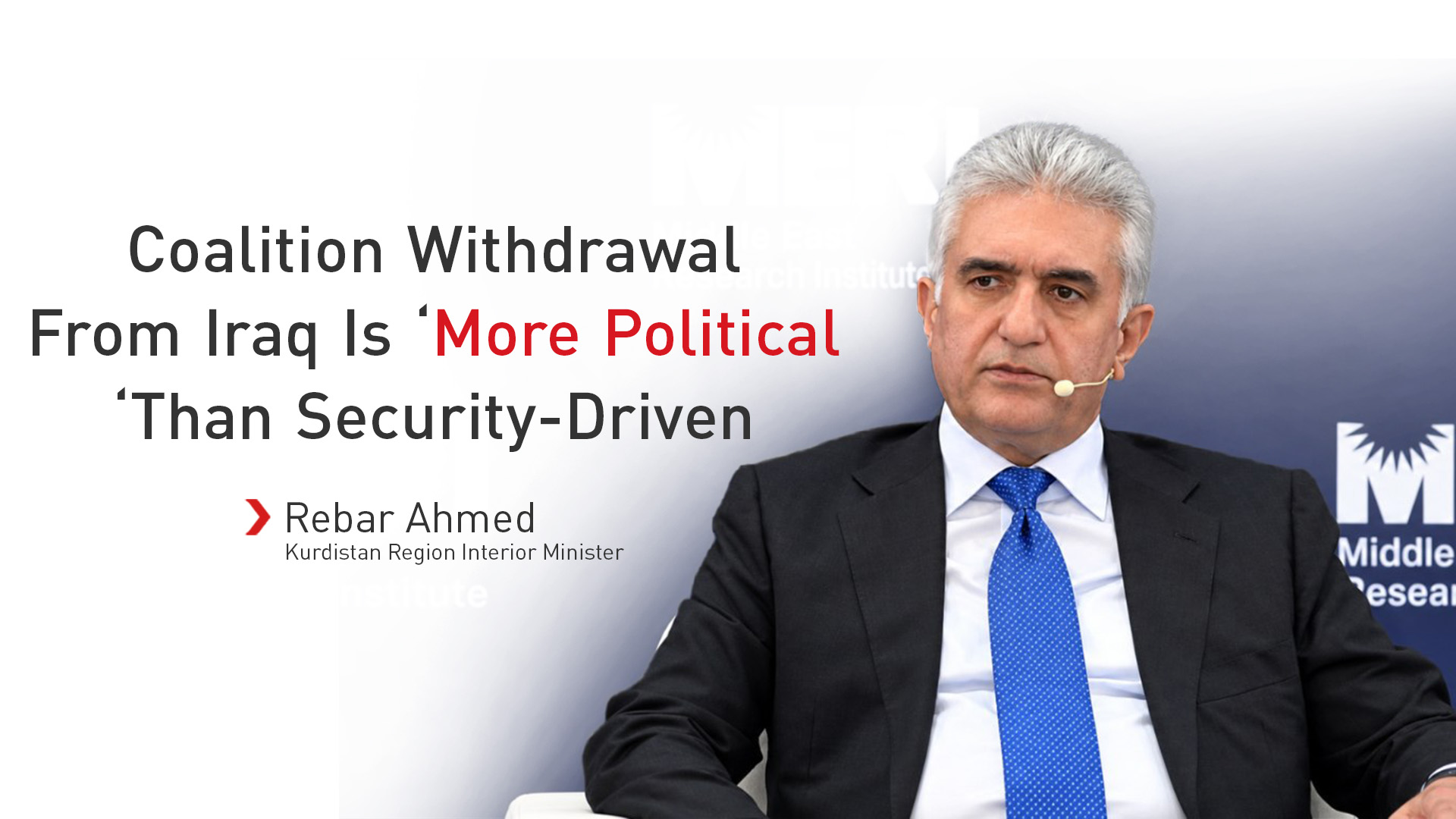
ERBIL (Kurdistan24) — Kurdistan Region Interior Minister Rebar Ahmed said on Tuesday that the withdrawal of US-led international coalition forces from Iraq was driven more by political considerations than security requirements, warning that the Islamic State (ISIS) group remained a serious threat and that Iraqi security forces still needed international assistance.
Speaking at a Middle East Research Institute (MERI) panel in Erbil, Ahmed said Iraq continued to face multiple security challenges, including the risk of an Islamic State resurgence, organized crime, cross-border criminal networks, corruption and narcotics trafficking.
Ahmed said the international coalition had been formed in 2014 following a formal request from the Iraqi federal government for international assistance against the Islamic State, which had seized large areas of Iraq and Syria.
He recalled that after US forces withdrew from Iraq in 2011, the country struggled to confront the growing threat posed by the extremist group, prompting the formation of an international coalition led by Washington and involving several European countries.
The coalition provided Iraqi security institutions with military expertise, intelligence assistance and air support, helping Iraqi forces and the Kurdistan Region’s Peshmerga defeat the group’s territorial expansion.
Ahmed praised the coalition’s contributions to Iraqi society, government institutions and security and military forces, emphasizing the importance of its air support in reversing the Islamic State’s advances.
With assistance from coalition forces, particularly their air capabilities, the Peshmerga and Iraqi army managed to break the group’s momentum, he said, adding that the situation would have been significantly different without that support.
‘Islamic State Is More Powerful Than Before 2014’
Ahmed rejected the idea that the Islamic State threat had ended, warning that the group remained dangerous and that extremist ideology continued to find a foothold in Iraq.
He argued that the group in its current form was more powerful than it had been before 2014, underscoring the continuing risk of a resurgence if underlying conditions were not addressed.
The minister said poor public services and a failure by governments to respect Iraq’s diverse communities could create conditions conducive to the return of extremist groups.
He also warned that the coalition’s withdrawal would place a significant additional responsibility on Iraq, raising questions about whether the country’s military and security institutions were adequately prepared to confront emerging threats without the same level of international assistance.
Although Iraq’s security environment differs from that of 2014, Ahmed said security institutions still require external support. He suggested that the assessments of military and security officials might differ from those of politicians advocating the coalition’s departure.
Ahmed Questions Iraq’s Readiness for Coalition Withdrawal
Addressing the political push for the coalition’s departure, Ahmed said the decision to withdraw the forces at Baghdad’s request was based more on political considerations than on an assessment of security needs.
He raised questions about the readiness of Iraq’s military and security institutions to manage the challenges that could emerge after the withdrawal, particularly if critical intelligence, training and operational capabilities were disrupted.
Ahmed warned against losing the capabilities that Iraqi security institutions had developed through cooperation with the international coalition.
He said proposals had been put forward for the federal government to establish bilateral security agreements with the United States and European countries, but that option had not been pursued.
The minister stressed the importance of such arrangements, arguing that Iraq’s security challenges could not be addressed in isolation from regional and international cooperation.
He said Iraq continued to need military training, intelligence support and equipment, adding that securing those capabilities through bilateral agreements would be more straightforward than forcing coalition partners to leave the country.
Narcotics Pose a Growing Threat to Iraqi Society
Beyond the Islamic State, Ahmed identified narcotics trafficking, organized crime, cross-border criminal activity and corruption as major threats to Iraq’s internal security.
He placed particular emphasis on the social consequences of drug abuse, arguing that narcotics could inflict damage on families and communities on a scale that he considered greater than terrorism.
His remarks highlighted the widening scope of Iraq’s security challenges, which extend beyond counterterrorism to include criminal networks and threats that undermine social stability.
The warning comes as Iraq faces the challenge of maintaining the security gains achieved against the Islamic State while addressing other sources of instability.
Ahmed’s assessment was that the country needed to preserve its international security partnerships and strengthen domestic institutions rather than assume that the defeat of the group’s territorial control had eliminated the threat.
The minister’s comments also underscored a broader concern for the Kurdistan Region: any reduction in international assistance must be accompanied by sufficient Iraqi capabilities to prevent extremist groups from exploiting security gaps.
For Ahmed, the central issue was not simply whether foreign forces should remain in Iraq, but whether the country could maintain its security and respond to evolving threats without losing access to the training, intelligence and military support that international partners had provided.
Iraq’s Post-Coalition Security Transition and the Risk of an Islamic State Resurgence
The coalition’s withdrawal from Iraq on Sept. 30, 2026, marked a significant turning point in the country’s security arrangements, placing greater responsibility on Iraqi security institutions to prevent an Islamic State resurgence and address evolving threats.
The transition has also raised questions about whether Baghdad can maintain the intelligence, training and operational capabilities previously provided by international partners.
As Rebar Ahmed emphasized, preserving security cooperation through bilateral agreements with the United States and European countries could help Iraq sustain its counterterrorism capabilities while confronting wider challenges, including organized crime and narcotics trafficking.
The withdrawal followed the September 2024 agreement between Baghdad and Washington to end the US-led Global Coalition’s military mission in Iraq in phases. On Sept. 30, 2026, the coalition formally concluded its Operation Inherent Resolve mission in Iraq, with coalition forces, including US and British personnel, departing as security responsibilities shifted to Iraqi institutions.
However, the end of the coalition’s military mission did not mean an end to all international security cooperation, as Washington said it would continue targeted training and intelligence support to Iraqi partners.
The transition has nevertheless intensified debate over Iraq’s readiness to confront remaining Islamic State cells and other security threats, particularly as the Kurdistan Region has raised concerns about gaps in air defense and the loss of critical military capabilities.