What Is America's 'Mother of All Bombs' and Can It Hit Iran?
The GBU-43/B Massive Ordnance Air Blast, known as the "Mother of All Bombs," is America's largest non-nuclear bomb. As Washington considers its use against Iran, questions remain about its destructive power, combat history, and ability to penetrate deeply buried nuclear facilities.
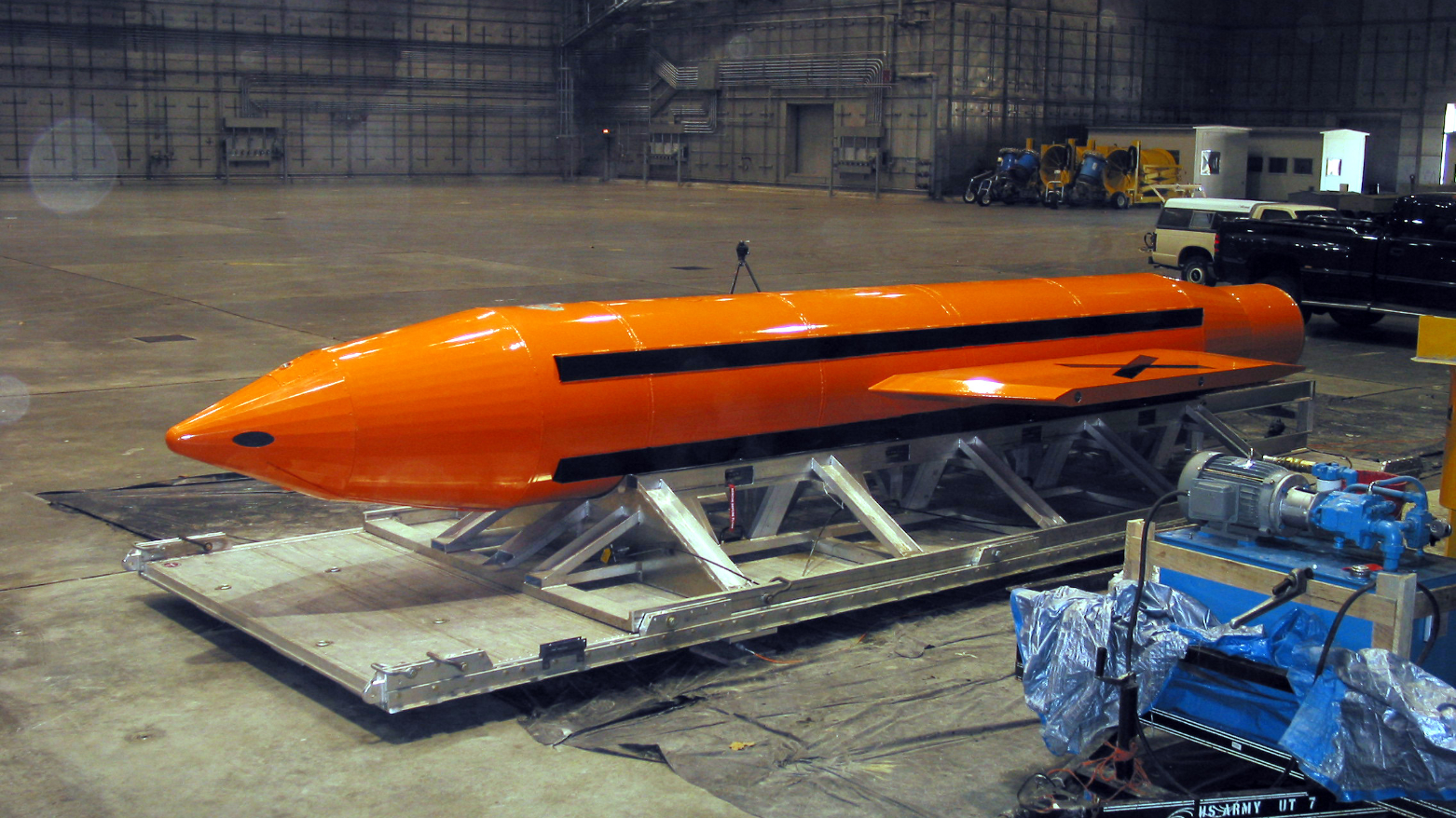
ERBIL (Kurdistan24) - The GBU-43/B Massive Ordnance Air Blast bomb, widely known as the "Mother of All Bombs," is one of the United States' most destructive conventional weapons. Designed to deliver an enormous blast across a broad area, it has returned to international attention following reports that Washington is considering its use against Iran.
CNN reported on Oct. 15 that American military planners had prepared options involving the bomb against Iranian energy infrastructure and nuclear sites, including the suspected underground facility known as Pickaxe Mountain.
President Donald Trump subsequently stressed that the weapon is non-nuclear, without confirming an order to deploy it.
What exactly is the MOAB?
MOAB is the acronym for Massive Ordnance Air Blast, although its unofficial nickname, "Mother of All Bombs," became more familiar than its technical designation.
According to the US Air Force, the GPS-guided GBU-43/B weighs approximately 21,600 pounds (9,800 kilograms).
Unlike a nuclear weapon, it relies entirely on conventional explosives. Its explosion is commonly estimated at the equivalent of approximately 11 tons of TNT.
The bomb is built to generate exceptionally powerful blast pressure across a large area, rather than bore deeply through rock or reinforced concrete. That makes its effects potentially devastating against exposed positions, personnel, equipment and some defensive obstacles, but does not make it suitable for every fortified target.
Its size also dictates how it is delivered.
Rather than being carried beneath a fighter jet, the MOAB is deployed from a C-130-family transport aircraft. The weapon rests on an airdrop platform, is extracted from the aircraft, and then uses satellite guidance and control fins to steer toward its designated target.
How and why was it developed?
The Air Force Research Laboratory began developing the bomb in late 2002 at Eglin Air Force Base in Florida, ahead of the US-led liberation of Iraq.
It was conceived as a GPS-guided successor to the BLU-82 "Daisy Cutter," an earlier large conventional bomb. The first full-scale MOAB test took place on March 11, 2003, producing a mushroom-shaped cloud reportedly visible from 20 miles away.
The weapon also served a psychological purpose. Pentagon leaders publicly discussed its intimidating effect, hoping the display of overwhelming conventional firepower might deter Iraqi forces from resistance.
Although the bomb was deployed to the region in April 2003, it was not used in the Iraq War.
When was it used in combat?
The MOAB's first confirmed combat use came on April 13, 2017, when US forces dropped one on an Islamic State (ISIS-K) tunnel complex in Achin district, Afghanistan's Nangarhar province.
According to a contemporaneous Pentagon statement, the strike was intended to destroy militant positions and reduce the danger to US and Afghan troops conducting nearby operations.
American commanders said ISIS-K had used tunnels, bunkers and improvised explosive devices to strengthen its defenses. Afghan officials subsequently reported dozens of militants killed, although independent verification of the death toll was limited.
The operation established the MOAB's capacity for massive attacks on a tunnel-associated battlefield, but it did not demonstrate an ability to penetrate the deepest hardened underground installations.
Could it destroy Iran's underground nuclear facilities?
That is the central uncertainty surrounding the latest reports.
The GBU-43/B is principally a blast weapon, not a dedicated earth penetrator. Its ability to damage entrances, surface infrastructure or relatively shallow positions does not mean it can reach nuclear facilities protected by thick rock.
The US military has a different weapon for deeply buried targets: the GBU-57 Massive Ordnance Penetrator, or MOP. Weighing approximately 30,000 pounds, it is heavier than the MOAB but engineered specifically to penetrate hardened underground structures before exploding.
In June 2025, US B-2 bombers employed GBU-57 weapons against Iranian nuclear facilities during Operation Midnight Hammer, according to Pentagon briefings.
CNN reported that some US officials doubt a MOAB strike could reach suspected infrastructure beneath Pickaxe Mountain, which is believed to be protected by layers of granite.
What would its use mean?
Using a MOAB against Iran would represent a major escalation in conventional firepower and could create serious civilian risks, particularly around energy installations or populated areas.
But spectacle is not the same as strategic success. Its impact would depend on the target's construction, location and vulnerability, as well as the potential for Iranian retaliation.
For now, the reported plans remain options rather than an announced military order. The essential distinction is that the MOAB can produce extraordinary surface destruction without necessarily destroying what lies deep beneath it.