Trump Says U.S. May Target Iran's Pickaxe Mountain
President Donald Trump says the "Mother of All Bombs" is non-nuclear and leaves open further strikes on Iran, while ruling out ground troops and criticizing Ukraine's refinery attacks.
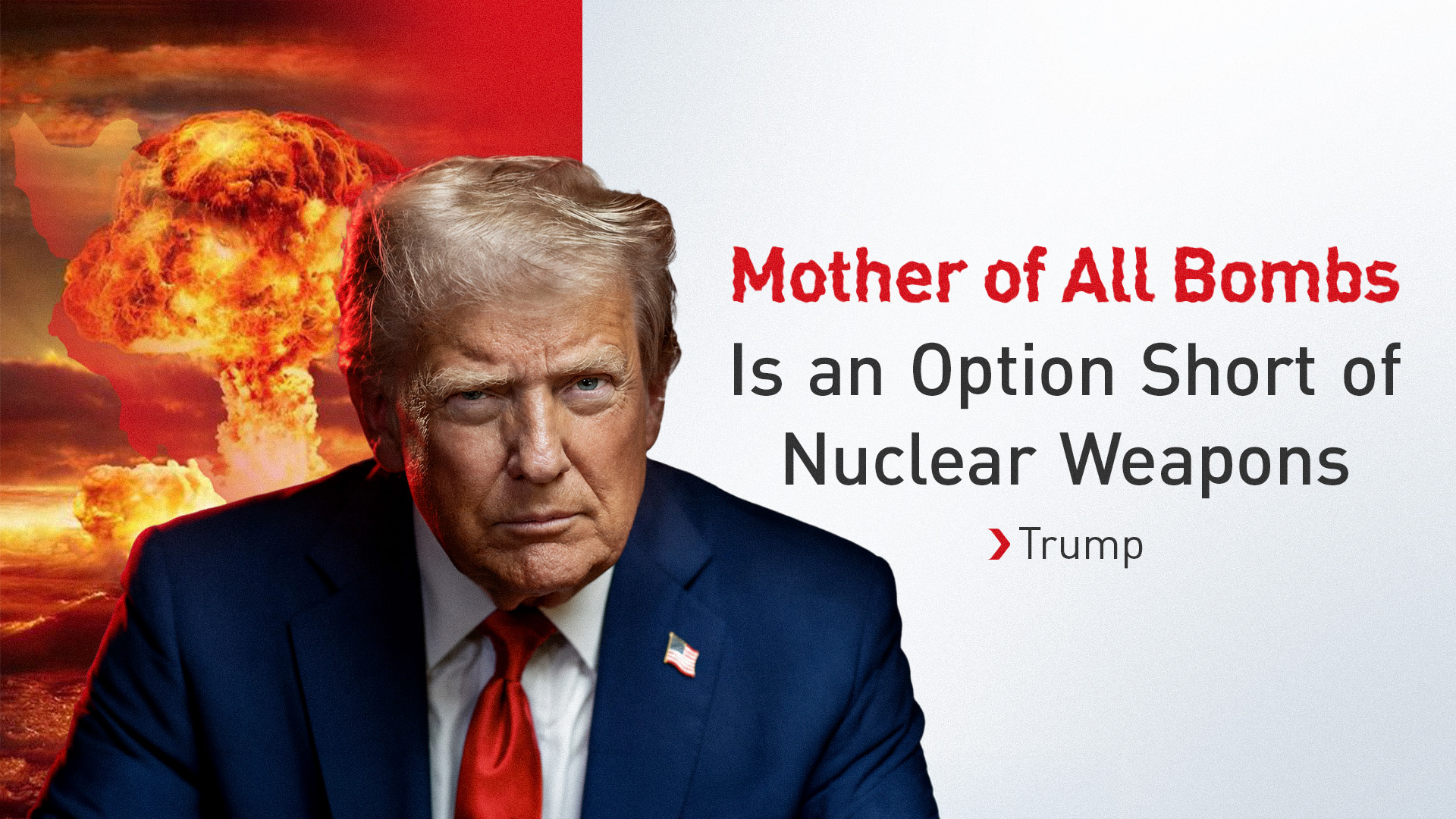
ERBIL (Kurdistan24) - U.S. President Donald Trump said the "Mother of All Bombs" is a non-nuclear weapon as Washington considers its options toward Iran, while also raising the possibility of another strike on Iran's Pickaxe Mountain nuclear site and ruling out the use of American ground troops.
Speaking to Rob Finnerty on Newsmax on Oct. 15, Trump was asked about reports that his administration was considering using the powerful conventional bomb in a future operation against Iran.
"The mother of all bombs is not nuclear," Trump said, describing it as an extremely large conventional weapon.
Asked whether Washington might instead use a tactical nuclear weapon, Trump rejected the idea, saying the United States did not need to employ nuclear arms.
He also said Washington was considering further action against Iran's nuclear infrastructure.
Trump claimed earlier U.S. operations had severely damaged Iran's nuclear facilities but suggested additional action could be required against Pickaxe Mountain.
"Now we're looking at Pickaxe Mountain," he said, adding that the United States "may have to go there."
When Finnerty asked whether such an operation could involve American troops on the ground, Trump replied: "No, I don't see that."
The president also said the United States was engaged in discussions with Russia and China about nuclear disarmament.
He described denuclearization as difficult, particularly because of differences in the size of the three countries' nuclear arsenals, but said talks were taking place with both Moscow and Beijing.
Iran remained the central foreign-policy issue during that portion of the interview.
Trump said his objective was to ensure that Tehran never obtains a nuclear weapon and argued that ending military pressure prematurely could allow Iran to rebuild its capabilities.
Later in the interview, he said Iran was negotiating with Washington and predicted that the conflict would end soon "one way or the other."
Trump also portrayed Iran as severely weakened by previous U.S. and Israeli military operations, although those assessments were his own characterization of the current state of Iran's military and leadership.
Israel and Netanyahu
Asked about Israeli Prime Minister Benjamin Netanyahu, Trump pointed to what he described as a successful military partnership between Washington and Israel, particularly in operations against Iran.
He said Israeli political figures wanted him involved ahead of Netanyahu's reelection campaign, but stopped short of detailing what role he might take.
Asked directly whether he trusted Netanyahu, Trump replied: "I don't trust anybody," adding that this applied generally to politics.
He nevertheless described his relationship with the Israeli prime minister positively and again linked their cooperation to military operations against Iran.
Trump criticizes Ukraine over refinery strikes
The interview also turned to Ukraine and Russia, with Trump strongly criticizing Kyiv's decision to resume attacks on Russian oil refineries.
Finnerty noted that Ukrainian forces had renewed strikes on Russian refining facilities despite previous U.S. pressure to halt such attacks.
Trump said targeting refineries was contributing to higher global energy prices.
"If you tell me that Zelensky is again shooting at refineries, all he's doing is making the world oil price higher," Trump said.
When Finnerty confirmed that Ukraine had resumed the attacks, Trump responded: "Well, I think that's a disgrace."
He argued that Ukraine had other military targets available and should avoid striking facilities that produce diesel needed by international markets.
Trump also repeated his criticism of Ukrainian President Volodymyr Zelenskyy, saying he was "not a big fan" of the Ukrainian leader.
He argued that reaching a settlement with Russia could be difficult under Zelenskyy and said he found the Ukrainian president more difficult to deal with than Russian President Vladimir Putin.
At the same time, Trump said he wanted both sides to stop fighting and suggested both Moscow and Kyiv ultimately wanted the war to end.
His comments came as Ukraine resumed attacks on Russian energy infrastructure after briefly suspending them under U.S. pressure.
U.S. weapons stocks
Trump also addressed U.S. military supplies, including Patriot air-defense systems and Tomahawk missiles.
He said Washington was rebuilding its own ammunition stocks rapidly and that the United States needed to prioritize maintaining sufficient supplies for its own defense.
Once American stockpiles were adequately replenished, he said, U.S. allies would again be able to purchase larger quantities.
Trump contrasted that approach with the previous administration's military assistance to Ukraine, criticizing the scale and terms of the support provided under former President Joe Biden.
Across the interview, Trump presented Iran as the most immediate military challenge while linking U.S. decisions on Ukraine, Russia and Israel to wider concerns over warfare, weapons supplies and global energy prices.
His remarks left open the possibility of further U.S. military action against Iranian targets, but he drew two explicit limits: no use of nuclear weapons and, according to his current position, no deployment of American ground forces.