Erbil Archaeological Site Reveals Secrets From 6,000 Years Ago
An archaeological site in Erbil reveals secrets from 6,000 years ago, says antiquities director Nader Babakr, as Bryn Mawr’s dig is renewed through 2029.
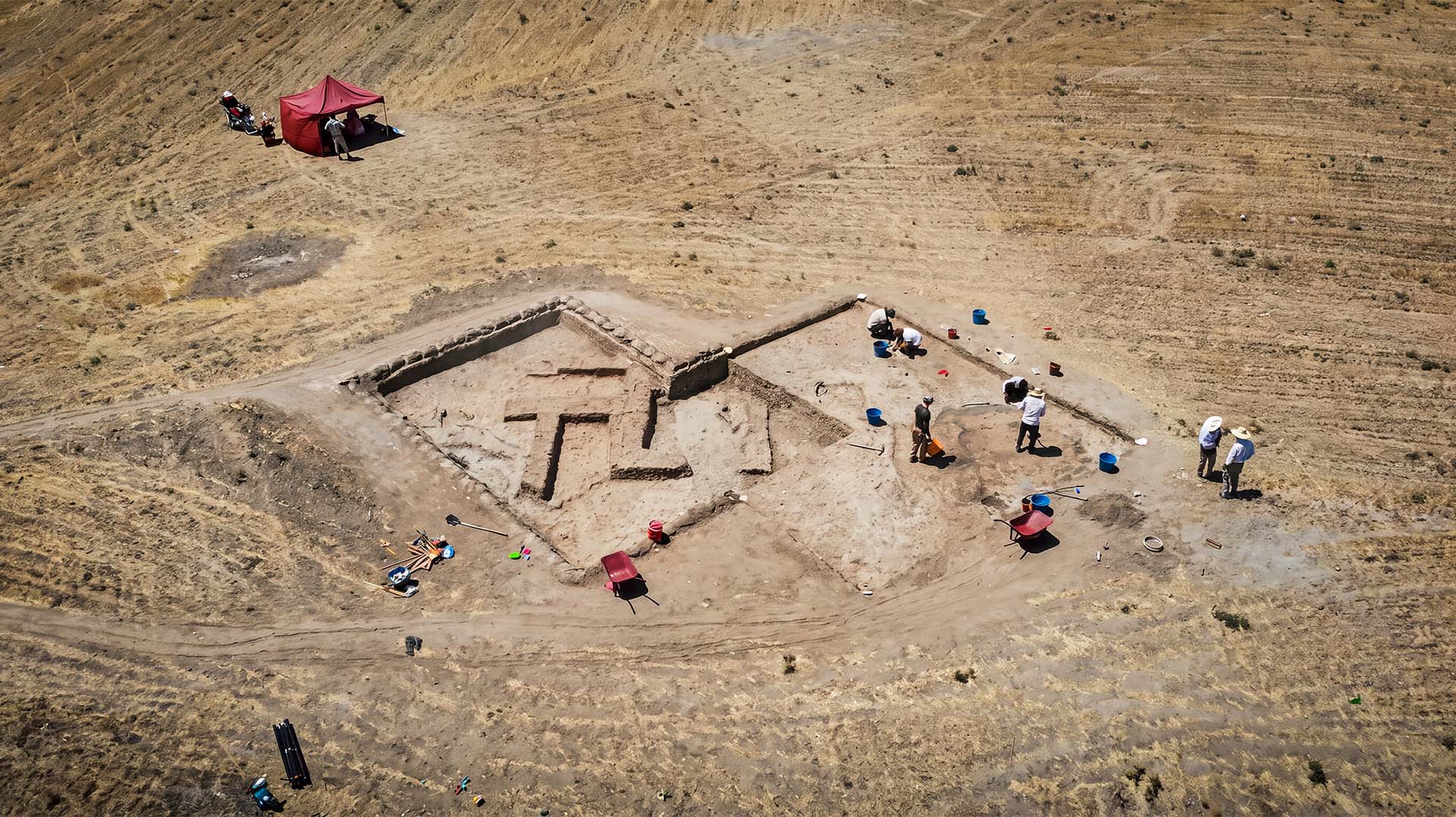
ERBIL (Kurdistan24) - An archaeological site in the Erbil plain is revealing secrets from 6,000 years ago. Erbil’s director of antiquities and heritage, Nader Babakr, said on Wednesday, that Girdi (hill) Matrab holds a record of settlement from 4000 BC to the Seleucid and Parthian periods.
On the fate of the finds, Babakr said: “No intact piece or tool is taken out of the country. All of them are cataloged in cooperation with the Erbil antiquities team and kept in the Erbil Museum.
An advanced storage facility was set up inside the museum for this purpose, and only some samples, such as bones and charcoal, are sent to international laboratories for scientific analysis.”
He said the site covers about 20 hectares and holds evidence of rich human life from the Ubaid period and the Late Chalcolithic to the Seleucid and Parthian eras.
In his view, the discovery of the site has changed the understanding of how society and civilization were organized in northern Mesopotamia and Kurdistan.
Babakr said the importance of the work lies in documenting daily life, the organization of settlement, and economic activity over thousands of years.
Rather than focusing only on kings and empires, he said, the team studies the communities that actually made the history of ancient Kurdistan.
He added that Matrab hill shows Kurdistan was not merely a margin in the history of ancient Mesopotamia but a living center of creativity and civilization that linked the Tigris Valley and the Zagros Mountains.
Babakr said the research began in 2020-2021 with an archaeological survey before moving to systematic excavation.
In Section B, the team found a Late Chalcolithic town dating to around 4000 BC. It includes residential buildings, storerooms, a large oven, administrative seals and several artifacts, which he said point to food production and handicraft work.
In Section A, the team uncovered a large Hellenistic-era residential area of about 250 square meters, dating to the third and fourth centuries BC. It has rooms, courtyards, an oven and evidence of cloth production.
In Section C, the team found a large building and architectural complex from the Seleucid period, with foundations made of brick. Babakr said it may have been an important public or institutional building.
On obstacles, he said intense summer heat and the fragile nature of mud construction are the main challenges.
The team preserves the structures for future generations through precise digital documentation, protective covering and modern techniques, he said.
Babakr said the research will continue for the next three years. Instead of random digging, the team will use advanced techniques, including ground-penetrating radar (GPR), magnetic survey, drone mapping and environmental analysis, to identify streets and buildings underground without damaging them.
He pointed to continued support from the Kurdistan Regional Government in facilitating the teams’ work.
He said the project is also an important opportunity to train a new generation of young Kurdish archaeologists alongside international experts in excavation, digital mapping, clay analysis and geophysical survey.
Separately, the General Directorate of Antiquities and Heritage in the Kurdistan Region officially renewed the excavation term at the site for Bryn Mawr, the American university.
The decision was signed by Engineer Awara Kwekha Ali, the directorate’s director general.
The renewal rests on Law No. 5 of 2021, the Kurdistan Region’s antiquities and heritage law, Article 17, paragraph three, and on partnership contract No. 211 between the two sides.
Under the decision, the university will continue its survey and excavation work in the Erbil plain from 2027 to 2029, under the same legal terms and procedures.