US State Department Corrects Its Libya-Turkey Statement
The correction was achieved through significant efforts by US Chargé d'Affaires in Athens Josh Huck in coordination with regional partners and State Department colleagues, after the original statement failed to condemn the Libyan Parliament's ratification of the agreement
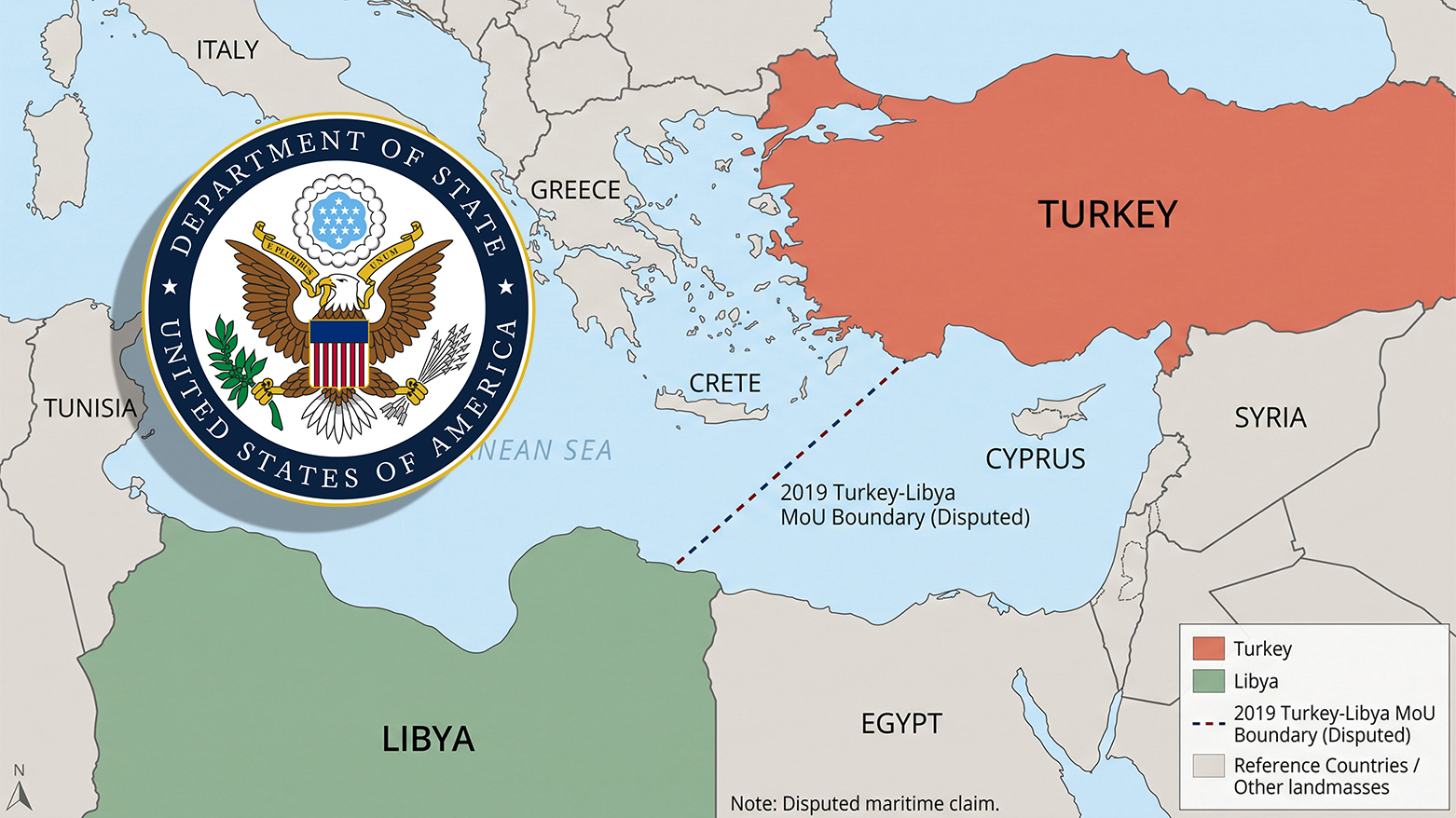
ERBIL (Kurdistan 24) - The US State Department issued a corrected statement on the Libyan Parliament's ratification of the Turkey-Libya maritime delimitation memorandum of understanding, calling the ratification unhelpful and provocative and saying it has raised tensions in the region, following coordinated efforts by the US Embassy in Athens and the Greek Embassy in Washington to reverse an initial State Department statement that had failed to take a critical position on the agreement.
"The announcement of the ratification of the Turkish-Libyan delimitation memorandum of understanding has raised tensions in the region and is unhelpful and provocative and our position on this matter has not changed," the corrected statement reads. "We encourage all countries, including partners in the Eastern Mediterranean, to resolve maritime disputes through good-faith negotiations and avoid any provocative behavior. Greece and Türkiye are both NATO allies. We encourage them to engage bilaterally to address any areas of disagreement."
What Changed And Why
The correction followed coordinated diplomatic pressure after the State Department's initial statement on the Libyan Parliament's October 21 ratification of the 2019 Turkey-Libya maritime boundary memorandum failed to characterize the ratification as provocative or problematic. The initial statement was seen by Athens as an implicit acceptance of the agreement's legitimacy, which Greece has consistently rejected as illegal, null, and void under international maritime law. US Chargé d'Affaires in Athens Josh Huck and his team worked in coordination with regional partners and State Department colleagues to achieve the correction, which represents a reaffirmation of Washington's longstanding opposition to the Turkey-Libya memorandum.
The Background
The 2019 Turkey-Libya memorandum of understanding on maritime boundaries drew an imaginary line across the Mediterranean between the Turkish coast and the Libyan coast that critics argue ignores the presence of Greek islands, including Crete, that lie between the two countries and that under the UN Convention on the Law of the Sea generate their own exclusive economic zones. Greece argued the agreement attempted to eliminate Greek islands' maritime entitlements, while Cyprus said it directly encroached on Cypriot waters. Egypt signed a competing maritime boundary agreement with Greece in 2020 directly contradicting the Turkey-Libya line.
The European Union declared the agreement illegal and without legal effect on October 21, 2026, the same day the Libyan Parliament ratified it. Türkiye welcomed the ratification. The State Department's corrected statement now aligns Washington with the EU's position that the agreement is provocative and raises regional tensions, and reaffirms that the US position on the matter has not changed despite the initial statement's ambiguity.
The corrected statement's call for peaceful resolution of maritime disputes and its note that such resolution opens the way for commercial investment and exploration reflects Washington's broader interest in Eastern Mediterranean energy development, given Rubio's discussion with Greek PM Mitsotakis during his Athens visit this month on Greece's role as an energy transit corridor connecting Europe and the Middle East.