Barrack Cites Iraqi Militia Disarmament Target, Says Iran Talks Near De-escalation
U.S. Presidential Special Envoy characterized Iraq's relationship with Tehran in unusually direct terms. "Iraq is hand-in-glove part of the Iranian overall plans [...] several proxies within its operation which have ministerial command."
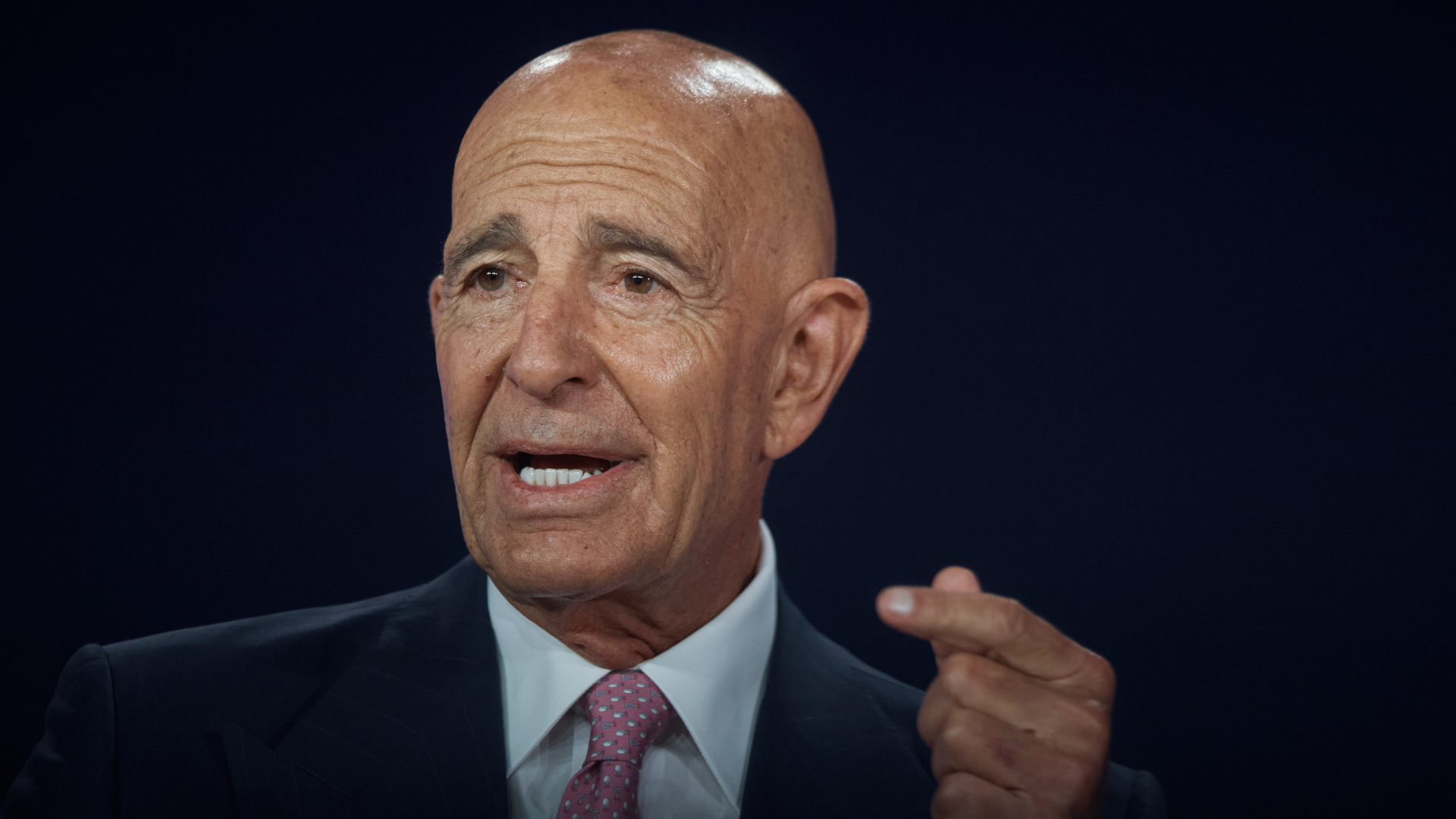
ERBIL (Kurdistan24) - U.S. Presidential Special Envoy for Iraq and Syria Tom Barrack has outlined a proposed end-of-June target for disarming militias in Iraq, warning that removing armed groups from the country's security landscape would require negotiated arrangements to replace them, as Washington pursued a separate diplomatic opening with Iran.
Speaking with Becky Anderson at the Global Perspectives event in Doha on Thursday, Oct. 29, Barrack addressed Iran's influence in Iraq, negotiations involving Tehran, the future of regional security alliances and reconstruction in Syria.
His comments offered an account of the Trump administration's approach, although he did not announce a completed agreement on militia disarmament or Iranian de-escalation.
Discussing the challenges confronting Iraq's new prime minister, Barrack referred to a prospective deadline: "By the end of June you're going to disarm these what we call militias and that disarming is a cooperative effort of what do you replace it with, what do you give them, what's the system, what's the framework."
He did not specify the year, identify an agreed enforcement mechanism or explain which groups would be covered.
Barrack characterized Iraq's relationship with Tehran in unusually direct terms. "Iraq is hand-in-glove part of the Iranian overall plans [...] several proxies within its operation which have ministerial command."
He cited Iraq's approximately 1,400-kilometer border with Iran and the presence of armed groups with links to state institutions as obstacles to changing that relationship.
The envoy nevertheless praised the Iraqi prime minister, whom he did not name during this exchange. "This young prime minister is courageous, he is smart, he's plenty rich enough so there's not an issue of corruption and he's got a monumental task."
Barrack said Washington supported the government's efforts, while acknowledging the difficulty of disarming groups whose functions and connections are embedded in Iraq's political and security structures.
He also questioned the record of American intervention. "After 2003 and 23 years of really daunting interaction by the US in Iraq, most of what we've done there has been problematic."
Rather than create another security vacuum, he said, the United States wanted to reduce tensions and help Iraq develop a workable framework for coexistence.
He contrasted oil-producing Iraq, with an established revenue base, against Syria's much weaker investment environment.
On Iran, Barrack said the administration remained interested in an agreement despite difficult negotiations led by U.S. envoy Steve Witkoff. "He's always open to a deal. [...] He has a stick and a carrot. He is always inclined to go to the carrot."
Barrack rejected the suggestion that Trump was simply seeking a public-relations victory ahead of the U.S. midterm elections or that diplomacy depended on Israel's election calendar.
He identified a specific proposal being considered by Tehran: "We're very close. Qatar presented a seven-day option, I think it's open source and acknowledged, and Iran is digesting it."
Barrack credited Qatari leaders with acting as intermediaries but gave no terms for the proposed arrangement and did not say Iran had accepted it.
Restoring trust, he argued, remained the central obstacle to even preliminary talks. "The trust on both sides was evaporated. [...] As we eliminate our counterparties within Iran communication becomes much more difficult."
He said Qatar, Pakistan and other partners were trying to bring the parties into a process that could first suspend hostilities and reopen channels of communication rather than settle all outstanding disputes.
Barrack offered a qualified prediction about the immediate prospects: "I think in the next two weeks you could have dramatic steps forward of everybody saying let's bring the temperature down, let's start again, let's get rid of the hostile kinetic activity and find a new alignment."
He presented that as a possibility, not a negotiated timetable or confirmation of a breakthrough.
Anderson asked about reports of a letter from Vice President JD Vance to an Iranian official named Rezaei and possible talks the following week in Qatar or Türkiye.
Barrack did not confirm either report. He emphasized the risk that fresh incidents could overturn delicate contacts, citing the Houthis, piracy and instability involving Somalia and Djibouti. "The greatest risk of miscalculation is the unintended consequences of a mistake."
Asked whether Washington was considering further military action, Barrack said: "The use of kinetic action is taken so seriously by everybody in this administration including the president so giving every option for that not to happen is what you see taking place in front of you."
His comments did not exclude military options, but emphasized efforts to avoid them.
That diplomacy formed part of a broader change Barrack described in U.S. commitments to the Middle East. "We're here, we're not leaving, we're just saying we're not going to own it anymore, we need participation from the region."
He maintained that Washington was not abandoning its partners or seeking a security vacuum; instead, it expected governments in the region to take a larger share of responsibility.
"You can rely on America to be there as a supporter, as a friend, but not as a guarantor." Barrack pointed to diplomatic contacts involving Saudi Arabia, Pakistan and Türkiye with Iran as examples of regional governments managing relationships even when the United States was not directly participating.
Anderson challenged him on how that approach would reassure Gulf states that had faced Iranian attacks following U.S.-Israeli strikes.
He argued that regional arrangements should eventually involve Israel as well. "We need everybody at the table including Israel [...] the problem with the Islamabad MOU was they were missing from the table."
Barrack discussed the Mecca agreement, an Islamabad memorandum and the Abraham Accords as potential components of a wider security structure, while acknowledging that the process would take time and require cooperation among governments with different interests.
Barrack also asserted, without presenting supporting evidence in the interview, that "There is no imminent threat of nuclear."
In defining the administration's approach to Tehran, he added: "The adversary has been the IRGC, not the Iranian people." Both remarks were his assessments, rather than findings independently demonstrated during the discussion.
Asked whether an Israeli political change would be needed for regional diplomacy, Barrack said the outcome should not depend on Prime Minister Benjamin Netanyahu's political future. He rejected territorial expansion as a viable path: "The path is not a greater Israel and I think that that's an illusion."
Anderson noted that Netanyahu and figures in his administration had helped promote the idea; Barrack acknowledged the role of Israeli political rhetoric while arguing that neighboring countries ultimately needed to cooperate.
"Everybody is realizing the answer to this is diplomacy not war." Barrack said any long-term Israeli settlement with neighboring states would depend on dialogue rather than recurring conflict.
He also defended Israel's concern for its borders following the October 7 attacks, while referring to continued Israeli incursions into Syria.
On Syria, Barrack claimed its leadership was prepared for a different relationship with Israel: "Syria has made it clear [...] that it is not predatory to Israel and it wants a peace and normalization agreement."
He pointed to the possibility of broader regional engagement, but presented normalization as an objective rather than an agreement already reached.
Anderson questioned Barrack about proposals to revive the Kirkuk-Baniyas oil pipeline as an alternative trade route to the Strait of Hormuz.
She also raised Reuters reporting that he had advocated participation by a business partner's company, asking whether reconstruction efforts would benefit Syrians or politically connected investors. Barrack did not directly detail the reported relationship or the pipeline's proposed commercial structure.
Instead, he emphasized the difficulty of attracting financing. "Trying to find somebody to come and invest inside of Syria, by the way, is an almost an impossibility."
He cited banking limitations, currency instability, debt, remaining sanctions-related restrictions and unsettled security arrangements, including issues involving Alawites, Kurds, Druze and foreign fighters.
Barrack said he had approached contacts from his business career, including major energy companies such as Exxon, Chevron, HKN, ConocoPhillips and Total, because substantial investments might not generate returns for 10 to 15 years. "The Trump administration is not enriching themselves or anything. It's trying to entice and figure out ways and programs including relieving export controls on a place like Syria."
He praised assistance from Qatar, Saudi Arabia and the United Arab Emirates, while stressing that diplomatic understandings and investment proposals would not by themselves resolve Syria's economic constraints.
The envoy also credited Syrian authorities with avoiding armed retaliation to Israeli incursions, a characterization he offered without independent evidence in the interview.
Barrack returned repeatedly to the same immediate objective: an initial reduction in violence that could permit negotiations to continue. His remarks left open the terms of Qatar's proposal, the practical arrangements for Iraq's militia disarmament and the timetable for any wider regional security agreement.