Kurdish Poet’s ‘Mending’ Set To Music In London Opera
Sarwa Azeez tells Kurdistan 24 her poem ‘Mending’ draws on her grandmother’s flight from a burned village, and that hearing it sung in London ‘gives blood back to the heart of humanity’
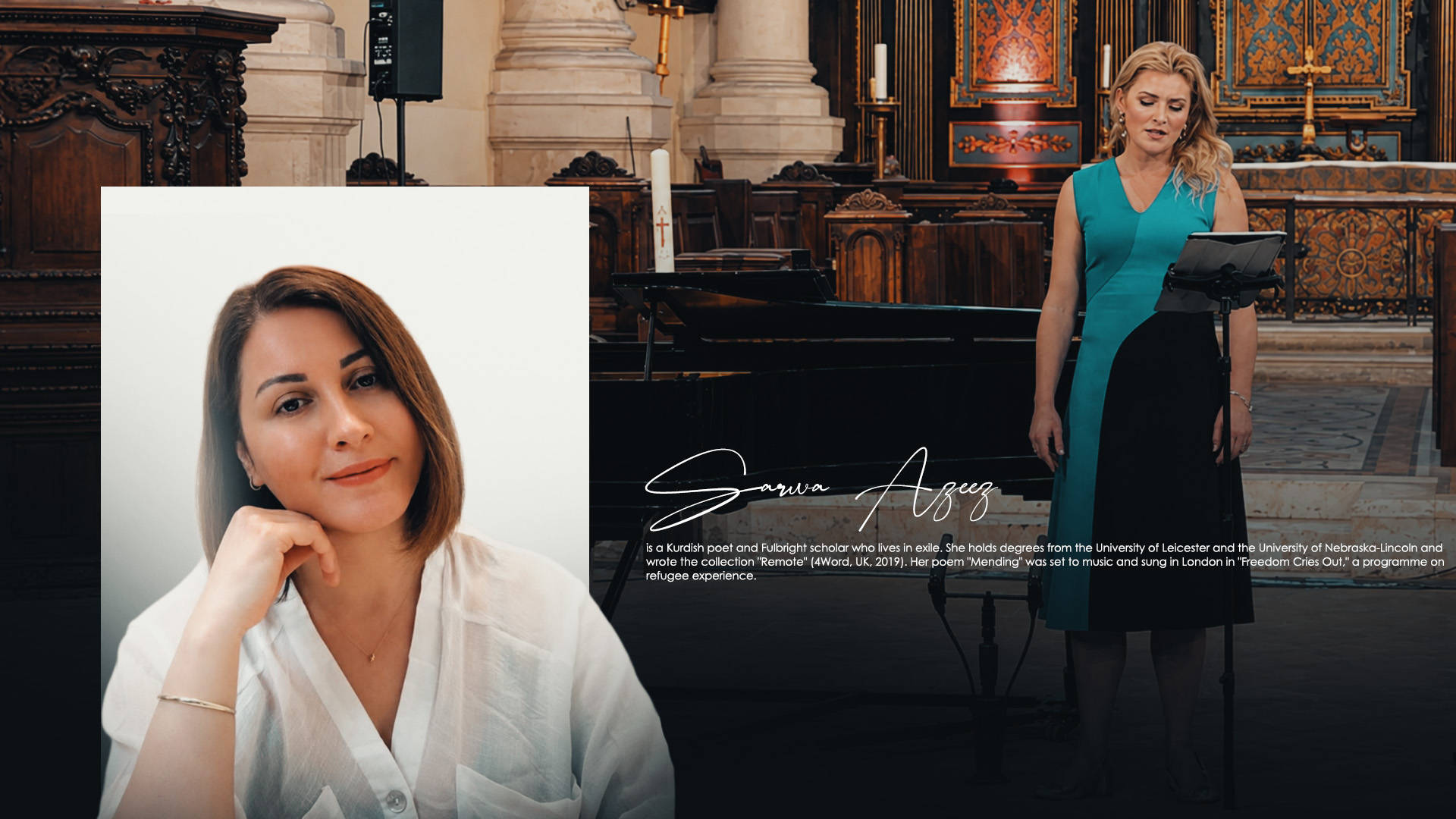
ERBIL (Kurdistan 24) - Kurdish poet Sarwa Azeez said her poem “Mending,” sung in London as part of a refugee-themed song cycle, grew out of her family’s own story of displacement, in an exclusive interview with Kurdistan 24.
She said her maternal grandmother was a child when her village in Eastern Kurdistan (Rojhelat) was burned down, and that the family was forced to leave, moving first to Türkiye and later to Southern Kurdistan (The Kurdistan Region).
“Growing up, I heard her stories of hunger, cold, and the profound experience of being uprooted,” Azeez said. Those stories, she said, stayed with her and felt deeply relevant to refugees today, whose lives are often shaped by the same uncertainties, losses and struggles for survival. As someone who also lives in exile, she said she felt the need to write the poem, and many others, to share those stories and voices. “Displacement is not simply a political condition but a deeply human experience,” she said, describing poetry as a way of carrying these experiences beyond the boundaries of geography, nationality and time.

Azeez said “Mending” was first published in the journal the other side of hope. The organizers of the program “Freedom Cries Out” later contacted the journal’s editors, who connected them with the poets whose work they wished to include, bringing together the voices of poets of different nationalities through music and opera. In a video of the performance, soprano Samantha Crawford sings the poem, accompanied by pianist Berrak Dyer, at the Holy Sepulchre church on Holborn Viaduct. The video’s description dates the recording June 18, 2025, while organizers listed the concert for June 19, 2025.
Asked what her poems about refugees aim to do, Azeez said poems do not always have aims. “I write what I feel, especially those feelings that are difficult to articulate or suppress,” she said. Writing poetry, she said, is an emotional conversation with herself as well as with whoever reads it, and she does not always begin with a particular message. Sometimes she simply feels compelled to give language to an experience, a memory or an emotion that refuses to remain silent. In the case of refugees, she said, poetry can create a space where people are met “not merely through statistics, political debates, or the labels imposed on them, but through their humanity,” allowing readers to listen to the inner lives of those whose stories are too often unheard.
Of hearing her words sung, she said it is a wonderful feeling. In a world that seems increasingly desensitized and politically polarized, where technology and artificial intelligence are changing how people communicate, she said, hearing a poem brought to life through the human voice feels particularly meaningful. “To me, this collaboration gives blood back to the heart of humanity,” she said. There is something profoundly moving about words once written in solitude becoming music, carried by a soprano and shared with an audience, she said, and it reminds her that poetry is something people feel in their bodies as well as understand. When political divisions reduce people to categories, nationalities or opposing sides, she said, “music and poetry create a space where we can encounter one another through our shared vulnerabilities, grief, and longing.” She said she is deeply grateful that “Mending” has become part of the project, and that its words can travel across borders to people who may never have encountered her story or the stories of her people.
“Mending” is one of five poems in “The Names of the Earth,” a song cycle by composer Raymond Yiu that sets stories from real refugee accounts first published in the other side of hope. The others are “Stranger” and “I See You” by Priscilla Okoye, “when you talk your language” by Tatiana Dolgushina and “The names of the Earth” by Alberto Quero. The cycle was commissioned for “Freedom Cries Out,” a program created by Crawford in 2024 in partnership with Refugee Education UK, exploring homeland, exile, war, family, hope and new beginnings. According to the video description, the poem sets the small daily labor of a mother repairing socks against the devastation of a crushed home and the loss caused by war.
Azeez is a Kurdish poet, essayist and Fulbright scholar with a master’s degree in English literature from the University of Leicester and a master of fine arts in creative writing from the University of Nebraska-Lincoln. A Pushcart Prize nominee, she is the author of the poetry collection “Remote,” published in the UK by 4Word in 2019. Her work has appeared in World Literature Today, Collateral Journal, the other side of hope, ONE ART, Genocide Studies and Prevention, Women Writing for a Change and elsewhere.