Four Major Road Projects Underway in Central Sulaimani
Sulaimani is advancing four road projects worth over 45 billion dinars as the KRG expands infrastructure, with Prime Minister Masrour Barzani pledging services for all.
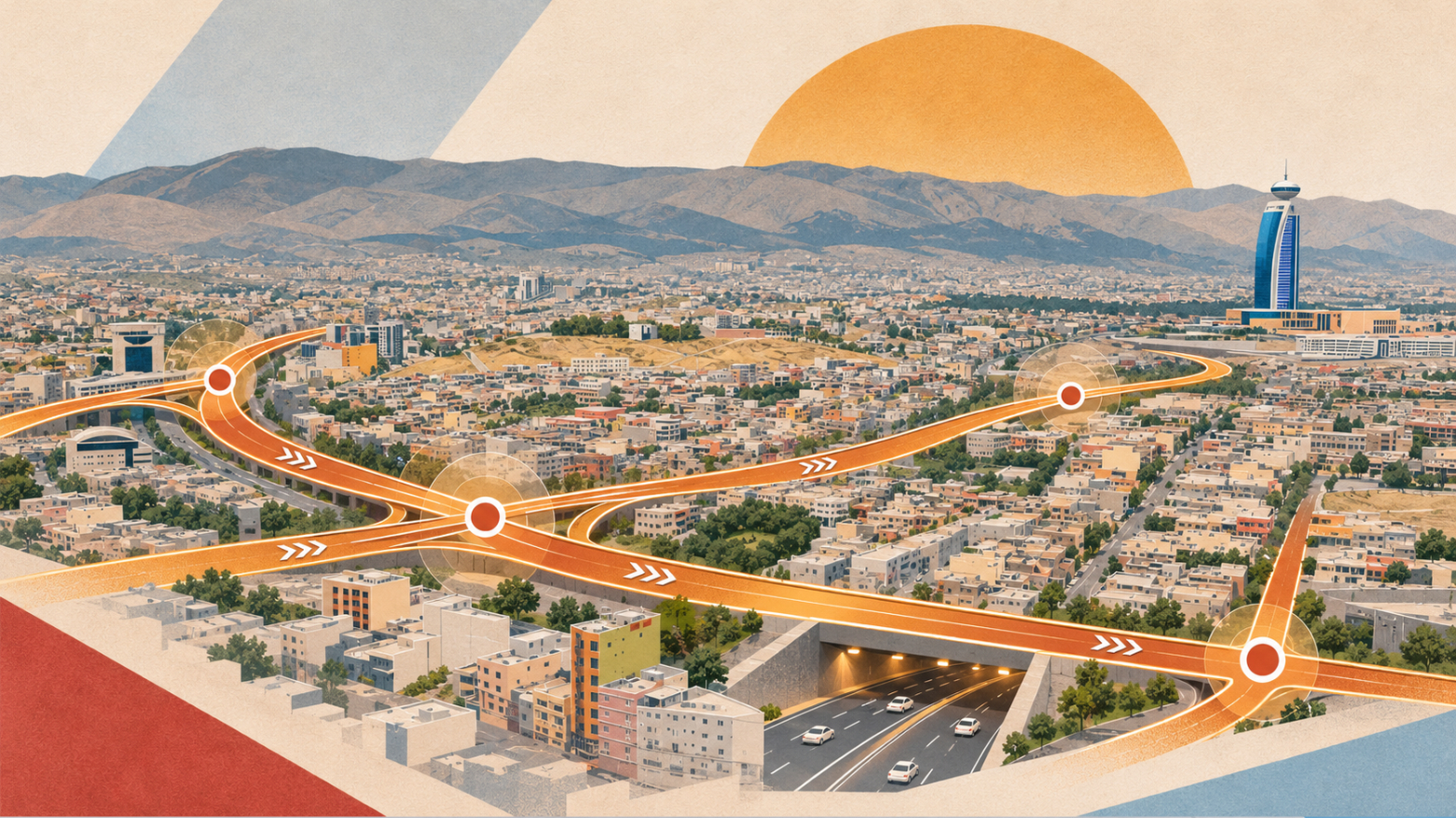
ERBIL (Kurdistan24) - Sulaimani Municipality is implementing four strategic road projects worth more than 45 billion Iraqi dinars, including new intersections and an underpass intended to ease traffic congestion and improve connections between the city center and its surrounding road network.
Anjam Hussein, spokesperson for the Sulaimani Municipality Presidency, told Kurdistan24 that the projects had entered the implementation phase.
The municipality is prioritizing work on the Martyr Shawkat Haji Mushir intersection, which carries a budget exceeding five billion dinars and which officials hope to open to motorists as soon as possible.
A second project involves an underpass on Salim Street at a cost of 7.8 billion dinars.
According to Hussein, the underpass is designed to improve traffic movement between Malik Mahmoud Ring Road and Saholaka, where the new connection is expected to reduce congestion.
The municipality has also laid foundation stones for the Goizha intersection, budgeted at 17 billion dinars, and the Qaratoghan intersection, at 15 billion dinars.
Both are planned to improve access between central Sulaimani and the 100-Meter Road. The administration has not supplied individual completion dates for those two junctions.
The Goizha and Qaratoghan intersections together account for 32 billion dinars of the planned expenditure.
Their relatively large allocations reflect the financial scale of the two developments, although officials have not provided detailed construction specifications or expenditure figures for either project.
Together, the four developments are intended to address traffic bottlenecks at several points in the city, rather than concentrate improvements on a single road. Hussein said they are proceeding alongside additional road works and three strategic projects on routes outside Sulaimani.
Some projects are expected to finish before the end of 2026, although he did not specify which.
The work comes as the Kurdistan Regional Government (KRG) pursues infrastructure development across transportation, electricity, water, healthcare and education.
Under Prime Minister Masrour Barzani's Ninth Cabinet, the government has presented public investment as a means of improving services and supporting economic activity across the Kurdistan Region.
Prime Minister Barzani has repeatedly emphasized that those services should reach citizens regardless of where they live.
During the inauguration of the Shekhan-Bahadre dual carriageway on Oct. 26, 2026, the Prime Minister declared: "It is the government's responsibility to serve all citizens without discrimination."
He added that the Kurdistan Region was continuing to develop as additional projects entered service, despite the challenges facing the government.
The KRG's July 2026 figures illustrate the wider scale of road development.
According to official statistics, 1,271 intercity road projects, covering a combined 5,940 kilometers and valued at approximately 5.32 trillion dinars, had been initiated. Of these, 810 were completed and another 461 remained under implementation.
Sulaimani accounted for 426 of the intercity projects, with a combined reported value of 832 billion dinars.
The government also recorded 872 inner-city projects in Sulaimani, totaling approximately 1.6 trillion dinars across municipal and related urban-service categories.
These figures reflect the broader development program and are separate from the budgets announced for the four road projects currently advancing in central Sulaimani.
Road construction represents only one component of the government's infrastructure agenda. Water infrastructure has received attention as drought pressures and growing urban demand place additional strain on existing supplies.
The KRG reports nine dams with a combined storage capacity of approximately 253 million cubic meters, alongside investments in reservoirs, drinking-water distribution networks and wastewater systems.
For Sulaimani, the Dukan-Sulaimani 3 water project represents another major undertaking.
Valued at $423.89 million, the development is intended to provide a longer-term response to the city's water shortages. Kurdistan24 reported in October that construction had reached approximately five percent completion.
Other water projects are advancing in Chamchamal, Darbandikhan and surrounding districts.
Read More: KRG to Implement $423 Million Dukan-Sulaimani 3 Water Project
In electricity, the government has pursued its Runaki initiative to replace reliance on neighborhood diesel generators with continuous grid supply.
The Ministry of Electricity announced on Oct. 19 that approximately 90 percent of the Kurdistan Region had access to 24-hour electricity, with full coverage targeted by the end of 2026.
Read More: More Than 90% of Kurdistan Region Now Has 24-Hour Electricity Under Runaki Program
The government's investments also extend to education and healthcare. Kurdistan24 reported that 236 schools and kindergartens had been completed since 2019, including 47 in Sulaimani, while 1,211 school buildings in the province had undergone renovation.
In healthcare, construction of Erbil's 150-bed specialized cancer hospital had exceeded 80 percent completion by late October, alongside other efforts to expand medical facilities and specialized treatment services.
Read More: Erbil's 150-Bed Cancer Hospital Nears Completion
Agricultural storage, industrial development, housing, tourism and waste management form additional parts of the KRG's development strategy. Its July report listed 856 investment projects representing more than $25 billion in capital across several sectors, distinct from direct government infrastructure spending.
For Sulaimani residents, however, the immediate benefits of the latest road projects will depend on construction schedules and the effectiveness of the new traffic connections once they become operational.
The municipality has outlined the proposed routes and financial allocations, but has not provided detailed traffic projections, expected journey-time reductions or confirmed completion dates for all four projects.
The Martyr Shawkat Haji Mushir intersection, Salim Street underpass and the Goizha and Qaratoghan intersections therefore remain at various stages of development, with officials expecting at least some of the ongoing road projects to enter service before the end of the year.