Duhok Stages 'Derwêş or Godot,' Exploring Kurdish Identity Through Theater
Duhok stages 'Derwêş or Godot,' a play by Halkawt Idris directed by Hamrin Jamil, examining Kurdish identity, history and oppression through theater.
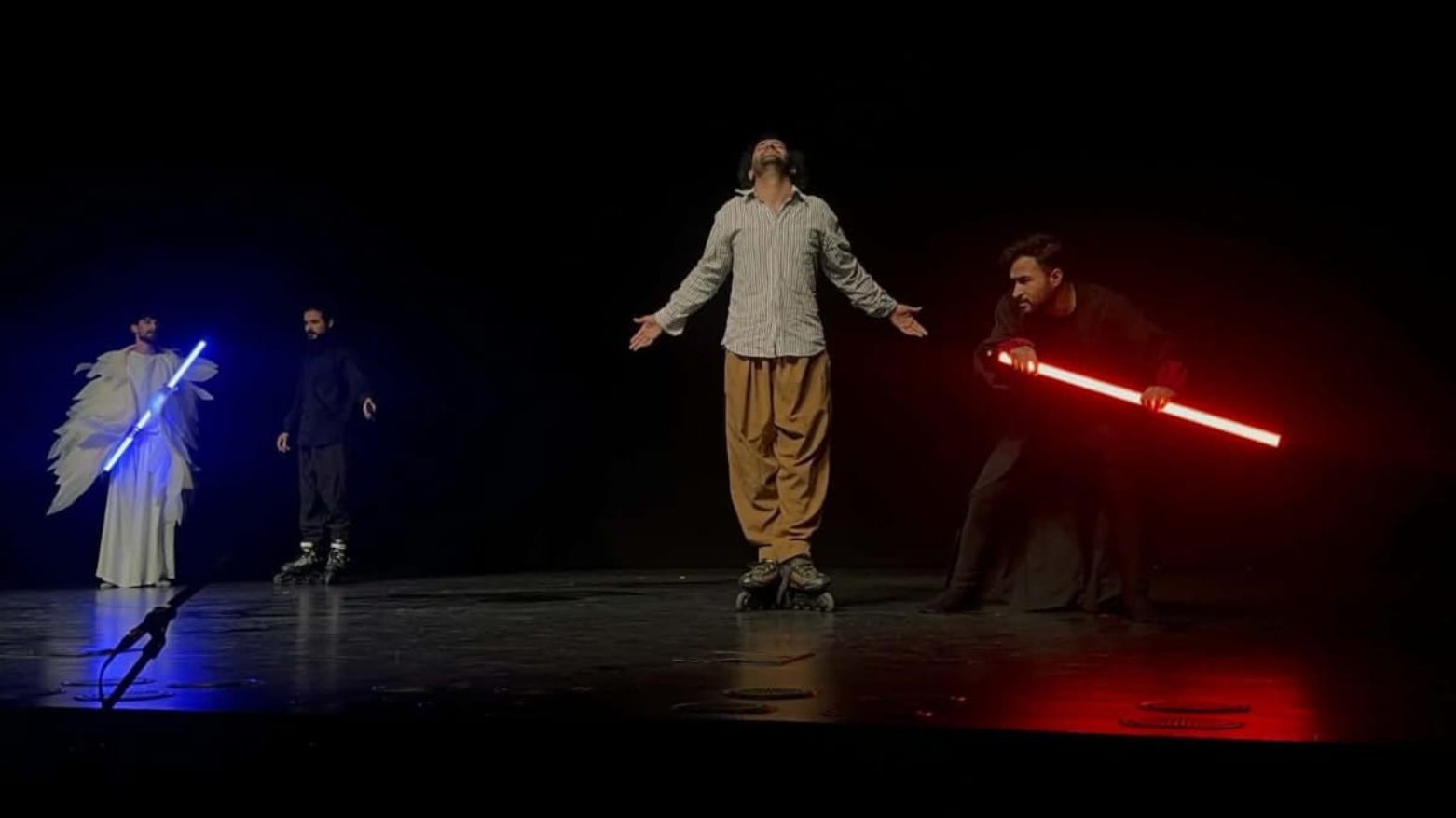
ERBIL (Kurdistan24) - A theatrical production exploring loneliness, Kurdish identity and the relationship between past and present was performed at the University of Duhok's College of Fine Arts on Monday, Nov. 2, 2026, bringing together two contrasting approaches to storytelling on stage.
Titled "Derwêş or Godot," the play was written by Halkawt Idris and directed by Hamrin Jamil. Its story follows a group of actors who reflect on their personal lives before disagreeing over which work they should perform: Samuel Beckett's masterpiece 'Waiting for Godot' or Kurdish epic folktale 'Derwishe Ebdi (or in Kurdish Derwêşê Evdî)'.
Speaking to Kurdistan24 on Tuesday, Jamil explained that the disagreement divides the performers into two groups. One favors 'Waiting for Godot', while the other prefers Derwishe Ebdi. The production ultimately brings the competing ideas together by presenting Waiting for Godot in a Kurdish form.
"The story follows a group of actors who talk about their lives and their loneliness," Jamil said, describing the personal concerns at the heart of the theatrical narrative.
That starting point gives the production two overlapping subjects. The actors are characters with their own experiences of isolation, but they are also performers deciding how to tell a story. Their choice of material becomes part of the drama, rather than simply a decision made before the performance begins.
According to Jamil, the final approach does not separate an international theatrical work from the concerns of Kurdish society. Instead, the performers use a Kurdish interpretation to address questions about the experiences and fate of the Kurdish people.
Jamil said the story concerns a group of artists preparing a theatrical production over the course of a week. Although the work they eventually choose may originate from a Kurdish or foreign theatrical tradition, he emphasized that its subject matter remains connected to Kurdish life.

"The play may tell a Kurdish or foreign story, but its content is entirely connected to the reality of Kurdish life," he said.
The director identified politics across the four parts of Kurdistan, as well as the attitudes of the authorities toward Kurds, among the central issues addressed in the performance.
In his account, those themes are not presented as separate from the actors' personal reflections. The production connects their lives and loneliness with wider questions about the circumstances in which Kurdish communities have lived.
Jamil also described a historical dimension to the work. The play places an older period alongside a modern one, allowing the production to compare Kurdish experiences across different eras.
"The play explores how the Kurds have faced oppression and injustice over many years and how they have sought to free themselves from those conditions," he said.
The comparison between historical periods is intended to draw attention to both continuities and differences between the Kurdish past and present. Jamil did not specify which events or historical figures feature in the production, so the themes are best understood through the director's description rather than as a detailed account of particular episodes.
The director's remarks suggest that the choice between Waiting for Godot and Dervish Abdi provides the play with a way to examine how different theatrical narratives can be used to express Kurdish experiences.
The performance at the University of Duhok placed those questions in an artistic setting, combining the story of a divided acting group with a broader examination of politics, memory and identity.
For this staging, Jamil's stated aim was to connect the actors' theatrical choices with the realities and historical struggles of the Kurdish people.
Kurdistan24's Arts and Culture reporter Garmian Geli contributed to this report.