Prime Minister Barzani to Oversee Next Stage of Erbil's Green Belt Initiative
Prime Minister Masrour Barzani to launch Erbil Green Belt's second phase, covering 11,000 dunams with plans for 1.8 million trees and three irrigation ponds.
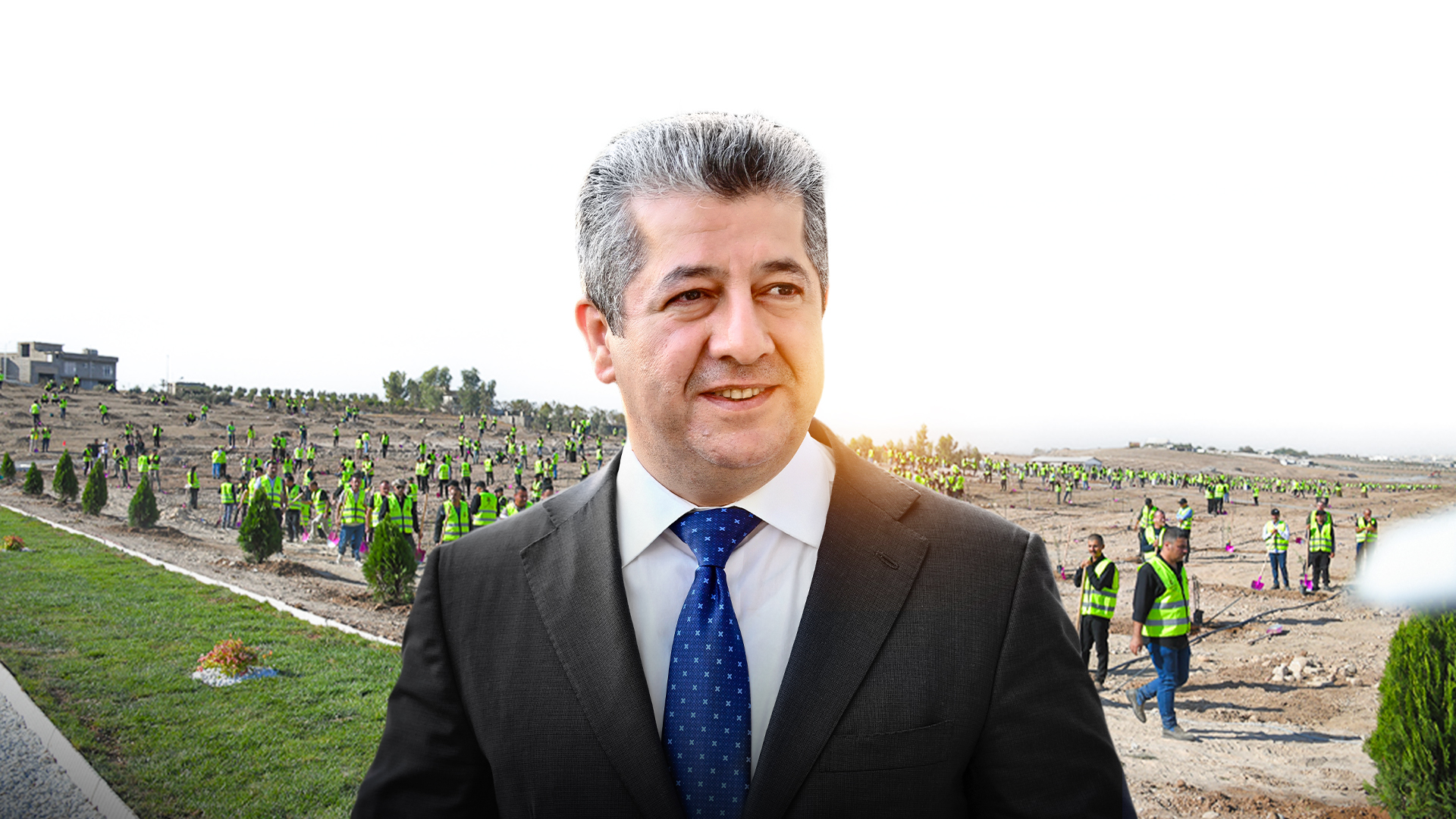
ERBIL (Kurdistan24) - Kurdistan Regional Government (KRG) Prime Minister Masrour Barzani is scheduled to formally launch the second phase of Erbil's Green Belt project on Sunday, Nov. 15, 2026, marking another step in the government's efforts to expand green spaces, protect the environment and address the effects of climate change around the regional capital.
The new phase will cover approximately 11,000 dunams of land, with plans to plant 1.8 million trees, primarily olive and pistachio varieties, and construct three irrigation ponds to support the plantations.
Prime Minister Masrour Barzani will attend the launch in the presence of the Greek consul, reflecting the project's cooperation with Greece, from which the saplings for the new phase are expected to be imported.
The initiative forms part of a long-term environmental plan to establish a continuous green corridor around Erbil, combining afforestation, agricultural development and measures intended to strengthen the city's resilience to changing climatic conditions.
The Second Phase
The latest stage of the project will focus on two locations: Gazna village along the main Erbil-Duhok road and Sibiran along the Erbil-Khabat road.
These areas form part of the planned circular green belt extending beyond Erbil's 150-Meter Ring Road, where the government intends to develop a forested corridor approximately two kilometers wide.
Under the announced plans, 1.8 million saplings will be planted during the second phase, with olive and pistachio trees making up the principal varieties. Three irrigation ponds will also be established to support the plantations and help maintain them through periods of limited rainfall.
The project is being implemented by Doski Holding, a local company responsible for carrying out the works.
Preparatory work on the second phase had already begun earlier this year. In July, project executive director Karwan Meski told Kurdistan24 that crews had started clearing land and installing perimeter fencing before proceeding with irrigation infrastructure and planting.
At the time, Meski said more than 500,000 olive trees were planned for the new area. Sunday's announced target of approximately 1.8 million trees reflects the broader planting program outlined for the phase.
The formal launch attended by Prime Minister Masrour Barzani follows those earlier preparations and marks a further stage in the project's implementation.
The Green Belt initiative was inaugurated on Oct. 30, 2025, when Prime Minister Masrour Barzani launched the first phase of the project.
That initial stage established plantations around the outskirts of Erbil and was completed after approximately 10 months of work.
According to figures previously provided by project officials, the first phase covered around 15,200 dunams, with approximately 700,000 trees planted, predominantly olive trees alongside smaller numbers of orange trees.
Its completion provided the foundation for the project's subsequent expansion, allowing work to proceed on additional land and irrigation facilities.
The overall Green Belt is planned as a circular environmental corridor surrounding Erbil, with a long-term target of approximately seven million trees.
The project aims to create a natural barrier against dust and desertification, increase vegetation around the capital and improve environmental conditions as urban development continues.
Farmers' Rights and Compensation
The expansion will also involve agricultural land and properties within the designated project areas.
The Erbil General Directorate of Agriculture has assured farmers and landowners that their rights will be protected throughout implementation, following the approach adopted during the first phase.
According to the directorate, affected landowners and farmers will receive compensation as part of the arrangements for carrying out the project.
The commitment is particularly relevant as the Green Belt expands into additional locations around the city, requiring coordination between agricultural authorities, contractors and existing landholders.
Environmental Protection and Climate Resilience
The Green Belt is among the major environmental initiatives undertaken by the KRG's Ninth Cabinet, linking the expansion of green spaces with longer-term planning for climate adaptation and agricultural development.
The project's objectives include reducing dust storms, improving air quality, addressing desertification and creating conditions for increased agricultural production around Erbil.
Government environmental assessments have previously projected that the completed Green Belt could absorb between 140,000 and 210,000 tons of carbon dioxide annually, although these remain estimated future benefits rather than measured reductions from the project at its current stage.
Officials have also identified potential economic advantages, including employment opportunities associated with planting, irrigation, maintenance and agricultural production.
The incorporation of olive and pistachio trees is intended to make the plantations productive agricultural assets while contributing to the city's green coverage.
For Erbil, which has faced environmental pressures associated with rising temperatures, drought and expanding urban development, the project represents an effort to integrate environmental protection into the capital's longer-term development.
With the second phase moving forward under Prime Minister Masrour Barzani's supervision, the immediate priorities will be expanding the plantations, establishing the irrigation infrastructure and protecting the newly planted trees.
The project remains a multi-phase undertaking, with further planting and development required before the planned green corridor around Erbil is completed.