Historic Qubahan School in Amedi Undergoes French-Supported Restoration
Restoration of Amedi's historic Qubahan School, once a major center of Kurdish scholarship, will resume after winter with support from French partners.
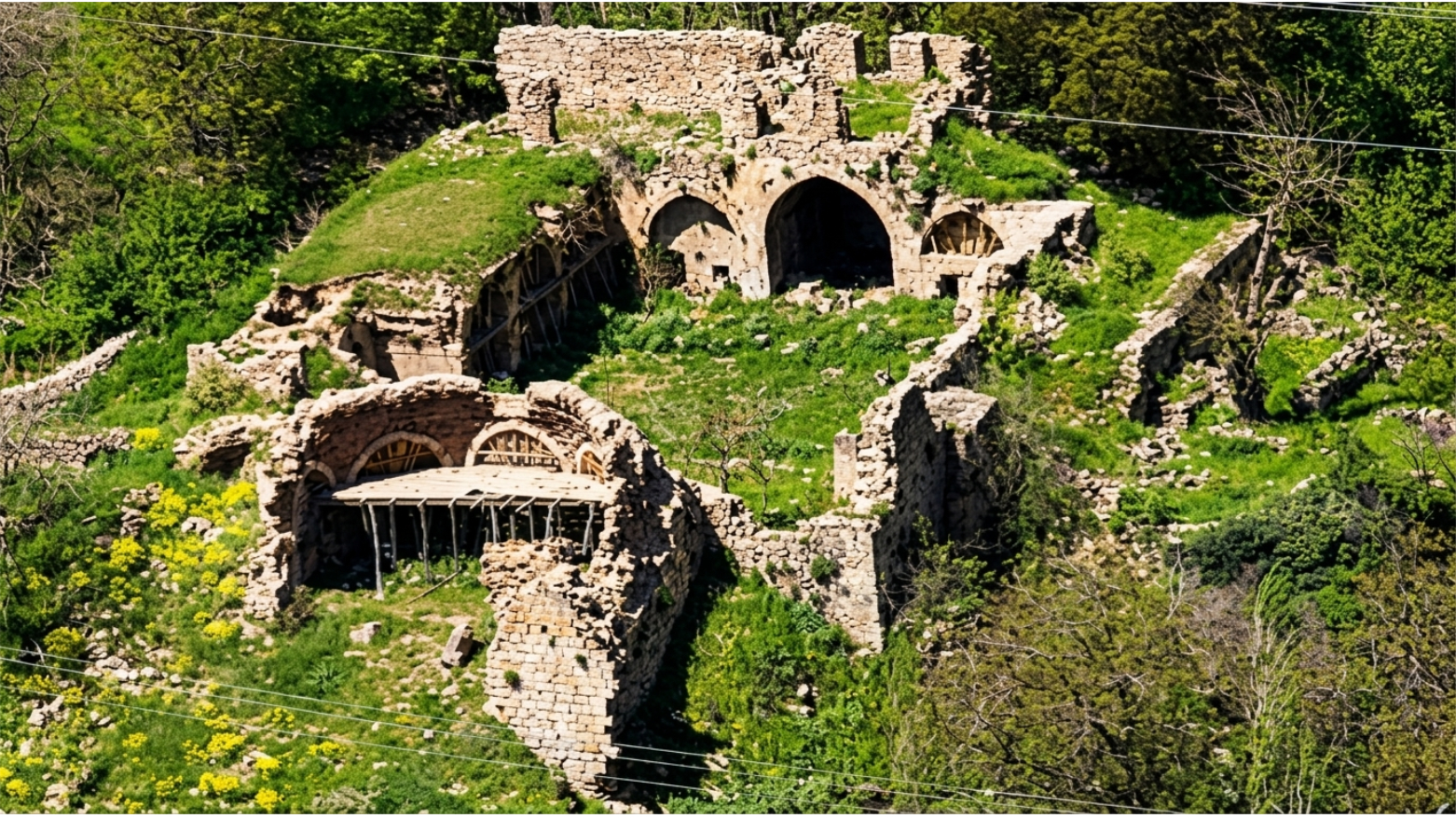
ERBIL (Kurdistan24) - Centuries after scholars from across Kurdistan traveled to Amedi to study philosophy, languages and the sciences, work is underway to preserve Qubahan School, a historic center of learning whose surviving buildings recall a period when the mountain district attracted students and teachers from far beyond its borders.
The restoration is part of a French-supported initiative covering six archaeological sites in Amedi district, Duhok province. Work began several months ago but has been temporarily suspended because of weather conditions, Bekas Brifkani, Director of Antiquities and Heritage in Duhok, told Kurdistan24.
Brifkani said the one-year project is being carried out in cooperation with Expertise France, with financial support from the ALIPH Foundation and the French Consulate. Teams are expected to resume work in March or April, when conditions permit, and complete the remaining conservation work.
The intention, he explained, is not to return the centuries-old school to the appearance of a newly constructed building. Instead, workers will protect surviving elements, reinforce vulnerable sections and restore portions where intervention is appropriate.
"The plan is not to completely reconstruct it as if it were a new building," Brifkani said, explaining that the international conservation standards being followed require much of the site to remain in its present form. Some parts will be preserved as they are, others stabilized against collapse, and selected areas restored.
That distinction matters at a site whose value lies not only in its architecture but also in manuscripts, scholarly careers and accounts that document its place in Kurdistan's intellectual history.
Qubahan continued to function as a school until 1961, long after its emergence as a major center of learning in the 16th century.
Its history survives in several kinds of evidence: manuscript notations identify where scholars wrote, official seals indicate patronage, and a traveler's account captures the scale and daily life of the institution. Read together, these records help explain why preserving what remains of Qubahan matters beyond the district itself.

A School Beneath Amedi's Citadel
Herish Kamal Rekani, a writer and researcher from Badinan, told Kurdistan24 on Nov. 20 that Qubahan stands northwest of Amedi Citadel, in the Shaqlafat valley beside the Amedi River and near the former village of Rubari.
Drawing on manuscripts and endowment records, Rekani dates the school's construction, renovation and expansion to the reign of Sultan Hussein Wali, who ruled from 1533 to 1573. He places its development within a period when the ruler supported religious and scholarly institutions.
Two manuscripts preserved in the library of the muftis of Akre, dated 1469 and 1471, make no mention of Qubahan, Rekani said.
He regards their silence as evidence supporting a later foundation, rather than one dating to the reign of Sultan Hussein Wali's father, Sultan Hassan, who ruled from 1465 to 1533. The absence of a reference, however, does not by itself establish when construction began.
More direct evidence comes from a manuscript dated 1542, written by Mohammed, son of Mahmoud Barwari, also identified as Bokhti-Botani. Its closing note places the work at "the Sultaniya School in the village of Qubahan," giving the institution a documented location and name during Sultan Hussein Wali's reign.
Rekani said surviving manuscripts and endowment documents frequently bear the sultan's seal. He also pointed to the names "al-Husseiniya" and "al-Sultaniya" in historical records, both associated with the ruler, before Qubahan became the name by which the school was widely known.
Scholars and Manuscripts
For generations, Qubahan drew scholars from different parts of Kurdistan and supported teaching, writing and the exchange of ideas across languages. Its history includes figures who traveled to Amedi as well as scholars who produced manuscripts there.
Among them, Rekani identified Mullah Mahmoud Bahusi, also known as Mizuri Zhuri, who died in 1689, as an early prominent figure. Mullah Rasul Surchi, a teacher in Saqqez in Eastern Kurdistan in 1667, later came at the invitation of an Amedi prince and became the madrasa's director and mufti.
The school's connections extended northward. Mullah Khalil of Siirt (1750-1843), a scholar and poet from northern Kurdistan, wrote a manuscript at Qubahan in 1778. Mullah Abdullah Rekani Mamisi, the Mufti of Zakho, who died in 1795, produced manuscripts there in Kurdish, Arabic, Persian and Turkish.
Rekani also named Mullah Yahya Mizuri, who died in 1839, a leading Badinan scholar and mufti who received scholarly authorization from Mullah Mahmoud Badini, who died in 1787. These careers suggest a network of learning extending beyond any one town or principality.
The school's literary activity encompassed translation and scientific writing.
An astronomy work, "Ruznama al-Jadid," was written in Turkish in 1778 by Allama, son of Mahmoud Bahusi. Mullah Abdullah Rekani translated it into Persian and copied it, while also preparing a glossary covering Kurdish, Arabic, Turkish and Persian.

An Extraordinary Institution
The Ottoman traveler Evliya Celebi, who visited Amedi in 1656, left a particularly detailed description of the school in his Seyahatname. He depicted a complex set among gardens beneath the citadel, with 16 domes, 60 rooms, a courtyard pool, flowing water and planted surroundings.
Celebi wrote that 300 to 400 students attended throughout the year, studying subjects ranging from Aristotelian philosophy to the natural sciences. His account describes a substantial institution with resources for both education and accommodation, rather than a small neighborhood school.
According to the traveler, income from gardens, shops, a watermill and jizya levied on 50 villages supported the madrasa. The principality's Sheikh al-Islam headed its teachers, and the guesthouse provided two meals a day.
Celebi associated its construction with Sultan Hussein and recorded the local name "Quba Madrasa." While Rekani traced the later Qubahan name to the village, Celebi linked it to a nearby bridge, preserving another historical explanation of the name.
"I traveled through the land of Kurdistan for 11 years, but I never saw a school like this one," Celebi wrote.
Qubahan remained a place of instruction until 1961, with Mullah Mohammed Shukri Mufti identified as its final teacher. The current conservation effort does not seek to recreate the institution described by Celebi. It aims to keep what survives standing, so that Amedi's educational history remains visible in the landscape where it unfolded.
Shorsh Harki, Kurdistan24's news writer and journalist, contributed to this report.